
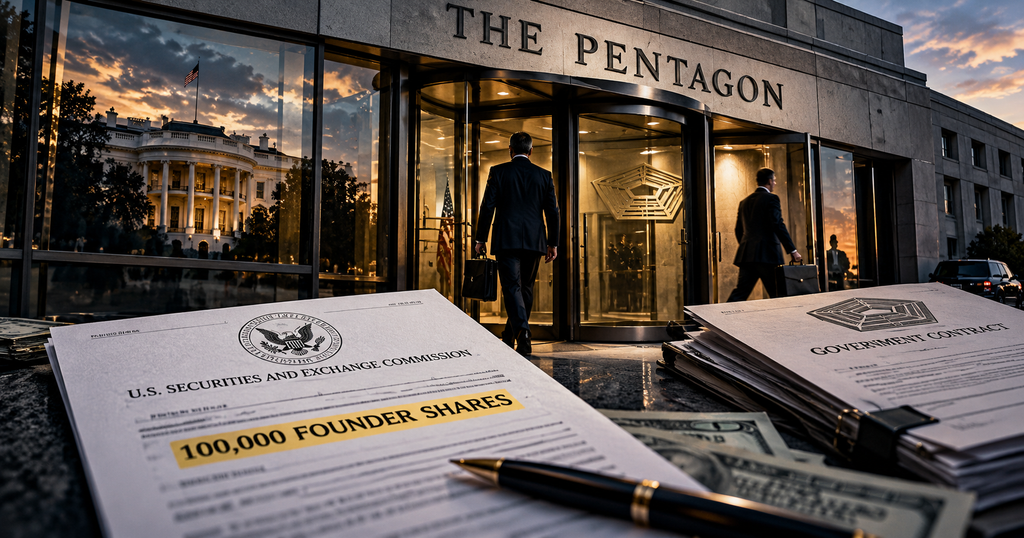
A senior Pentagon investment official received an indirect interest in 100,000 founder shares of an offshore acquisition company. Seven months later, he resigned from its board. The financial question left behind leads to nearly $350 million in federal consulting agreements—and two striking parallels with an earlier investigation.
The Trumportunity Report | October 13, 2026
Following the Money. Documenting the Power.
In February 2026, a senior Pentagon official appeared in a Securities and Exchange Commission prospectus as the recipient of an indirect financial interest in 100,000 founder shares of a British Virgin Islands-based acquisition company.
His name was George K. Kollitides II.
At the Pentagon, his responsibilities included advising Deputy Defense Secretary Stephen Feinberg, directing the Economic Defense Unit, and serving as vice chair of the Office of Strategic Capital’s investment committee.
The company was D. Boral Acquisition I Corp., a special purpose acquisition company, or SPAC, established to raise investment capital and pursue a future business combination.
On September 23, Kollitides resigned from its board of directors.
The resignation was documented in an SEC filing dated September 28. The disposition of his financial interest was not.
Did he retain it? Forfeit it? Transfer it? Did any economic rights survive his departure?
The public resignation notice provides no answer.
That unanswered question takes on additional significance alongside another development: nearly $350 million in Pentagon consulting agreements awarded to Alvarez & Marsal Federal, a business associated with the private-equity network in which Kollitides had spent much of his career.
The contracting awards have attracted national attention. But the SEC disclosures offer another point of entry into the story, one that raises questions about financial interests, public authority, and the consequences of decisions made by officials drawn from the business world.
The evidence does not establish that Kollitides violated ethics laws, improperly awarded a contract, or profited from a government decision.
It does establish a series of relationships and transactions that deserve examination.
And the pattern has precedents.
Two-tenths of one cent
D. Boral Acquisition I Corp.’s February prospectus disclosed that Kollitides received an indirect interest in 100,000 Class B founder shares through membership interests in D. Boral Sponsor I LLC.
The interest was compensation for board service.
The nominal acquisition price was $0.002 per share.
Two-tenths of one cent.
At that rate, 100,000 shares correspond to $200 in nominal acquisition consideration.
But that figure is not a valuation of the interest.
Founder shares in a SPAC are not ordinary shares acquired on the public market. They are part of a financial structure intended to reward sponsors and certain insiders if the acquisition company successfully completes a business combination.
The potential value depends on numerous factors, including the terms of the sponsor’s membership agreements, conversion rights, restrictions on transfer, the success or failure of a business combination, and the ultimate value of the resulting securities.
The economic upside could be substantial. It could also disappear.
The prospectus does not establish that Kollitides received a realized profit, much less a specific dollar amount.
What it does establish is that he received a financial interest through a private ownership structure while serving in a position of considerable governmental economic influence.
And the company’s own securities disclosures acknowledged that such interests can create potential conflicts.
The government official and the private company
The timing is unusually compact.
On February 10, 2026, Kollitides was appointed to D. Boral’s board and became chairman of its compensation committee.
The company’s public offering followed on February 12.
Its prospectus described his Pentagon responsibilities alongside his private-sector affiliations, including advisory relationships with A&M Capital and Star Mountain Capital.
That combination is important.
Kollitides was not simply a former businessman whose earlier career had become irrelevant upon entering government.
The SEC record presented his government and private-sector roles as contemporaneous professional relationships.
Federal ethics rules do not automatically prohibit every outside relationship or financial interest. Their application depends on the official’s classification, duties, financial holdings, recusals, authorizations, and other circumstances.
But when an official participates in federal economic and investment decisions, the public has a legitimate interest in knowing how those relationships were managed.
D. Boral’s September resignation filing introduced another uncertainty.
The company reported that Kollitides had resigned for personal reasons, effective immediately, and that his departure did not result from a disagreement about company operations, policies, or practices.
It did not disclose whether his indirect founder-share interest survived.
A private sponsor agreement might provide for forfeiture upon resignation. Another agreement might preserve some economic rights. A subsequent transaction might have changed or eliminated his interest.
The filing does not resolve those possibilities.
The absence of an explanation is not proof of concealment. Nor does it establish that Kollitides continued to own the interest.
It does, however, leave the public unable to trace a previously disclosed financial relationship to a documented conclusion.
That is a legitimate investigative gap.
Nearly $350 million in Pentagon consulting agreements
On October 9, ProPublica reporters Aaron C. Davis and Robert Faturechi published an investigation documenting two Pentagon consulting agreements awarded to Alvarez & Marsal Federal.
The first, approximately $67.6 million, was awarded in December 2025.
The second, valued at $281,089,206.65, was finalized in June 2026.
Together, the agreements amounted to approximately $348.7 million.
Both involved work associated with Pentagon offices where Kollitides held leadership or senior responsibilities.
The larger agreement was awarded without competitive bidding through an other transaction agreement, commonly called an OTA.
That detail deserves particular attention, not merely because of the amount involved, but because of the mechanism used to award it.
OTAs provide federal agencies with flexibility outside many of the ordinary requirements governing procurement contracts. They have been used extensively for defense research, prototypes, and specialized development work.
That flexibility can be useful when conventional procurement procedures are poorly suited to an urgent technological problem.
But consulting services are a familiar federal procurement category, with established competitive methods and comparatively straightforward ways to evaluate prices and qualifications.
ProPublica reported that procurement experts considered the use of an OTA for consulting work of this magnitude extraordinary.
The arrangement also limited public visibility into the services being purchased.
This is where the contracting story begins to resemble a financial mechanism documented in The Trump Extraction.
Before examining that comparison, however, the business relationships require clarification.
A&M Capital, Alvarez & Marsal, and Stephen Feinberg
Kollitides had a long career in private equity before entering the Pentagon.
He previously worked at Cerberus Capital Management, co-founded by Stephen Feinberg, who became deputy defense secretary in 2025.
He later became a partner at A&M Capital, the private-equity business associated with the broader Alvarez & Marsal enterprise.
A&M Capital and Alvarez & Marsal Federal are legally distinct businesses.
That distinction is essential.
But ProPublica documented relationships between the investment and consulting organizations, including shared support functions and collaboration involving investment opportunities and portfolio companies.
The consulting firm receiving the Pentagon awards was therefore connected through an established business network to an official exercising influence in the offices receiving its services.
That is not equivalent to proof that Kollitides awarded the agreements or received proceeds from them.
ProPublica reported that the Pentagon maintained he had complied with applicable ethics laws and regulations.
A&M Capital stated that Kollitides’ work for the investment firm did not involve defense matters, the Pentagon, or his government service.
The consulting business defended its work but did not provide ProPublica with detailed answers about how it obtained the larger agreement or the specific services being delivered.
The relevant questions remain concrete.
Who identified the need for these consulting services?
Who selected the contractor?
Who authorized the use of an OTA?
What alternatives were considered?
What work has been delivered, and how was its value determined?
And what role, if any, did Kollitides play in those decisions?
A contract’s maximum or reported value is not the same as money already disbursed. The distinction between awarded amounts, obligated funds, and actual payments must remain part of the accounting.
The questions concern both the expenditure of public resources and the procedures governing their use.
The first comparison: the Freedom 250 funding mechanism
Readers familiar with The Trump Extraction: An Investigative Triptych may recognize something about the Pentagon’s unusual contracting arrangement.
The earlier investigation examined how federal resources associated with America’s 250th anniversary were directed through a new administrative and organizational structure.
America250, the bipartisan initiative established by Congress, had spent years preparing for the national commemoration.
The Trump administration subsequently established its own celebration framework through the Salute to America 250 Task Force and Freedom 250.
Congress appropriated $150 million to the Department of the Interior for commemorative activities in 2025. Reporting subsequently identified a planned allocation of $100 million toward Freedom 250-related activities and $50 million toward America250.
Those amounts form part of a broader funding picture examined in The Trump Extraction, including other appropriations, federal expenditures, agreements, and commemorative projects. They should not be confused with a single $300 million transfer to Freedom 250.
The organizational structure is particularly revealing.
The National Park Service entered into a cooperative agreement with the National Park Foundation, which created Freedom 250 LLC as a wholly owned subsidiary to carry out commemorative work.
The National Park Foundation has stated that the subsidiary was created to provide the specialized capacity needed for the anniversary and that federal funds are distributed only for projects and budgets approved by the National Park Service.
That is the stated administrative rationale.
But the structure also placed a newly created private nonprofit affiliate between federal appropriations and the implementation of major public events.
Questions about financial accountability, project selection, donor influence, and the respective roles of America250 and Freedom 250 became subjects of congressional and journalistic scrutiny.
In March 2026, Senator Adam Schiff and other senators sought detailed information from Interior about the legal authority for directing funds to Freedom 250, the agreements governing the transfers, and the accounting of money obligated and disbursed.
Now consider the Pentagon’s $281.1 million OTA.
The two mechanisms are legally different.
The Freedom 250 arrangement involved appropriations, agency allocations, cooperative agreements, and a nonprofit implementing entity.
The Pentagon arrangement involved an alternative federal acquisition instrument awarded to a consulting business.
Yet both present a related accountability problem.
When public money moves through a less familiar administrative or contracting channel, the critical questions are who controls the decisions, what oversight applies, and how the public can follow the money.
In the anniversary investigation, the concern centered on the redirection of commemorative funding through a newly established implementation structure.
In the Pentagon investigation, it centers on the use of a noncompetitive OTA for an unusually large consulting engagement.
Neither mechanism is inherently unlawful.
Neither proves that funds were misused.
But each can alter the ordinary visibility of federal spending decisions, and each warrants examination of the justification, authorization, beneficiaries, and results.
The similarity is not a shared legal instrument.
It is the consequential choice of a funding mechanism.
And that choice is itself a government decision.
The second comparison: Tyler Hassen and the temporary business-world official
The other parallel is about personnel.
The Trump Extraction examined the placement of DOGE-associated personnel inside the Department of the Interior and the concentration of administrative functions involving information technology, finance, contracting, human resources, and grants.
One of the figures in that investigation was Tyler Hassen.
The report followed how changes in administrative authority affected the department’s capacity to manage projects, execute contracts, and pursue established priorities.
The larger question was not simply who occupied a particular office.
It was what that official could change while occupying it—and what remained afterward.
The Pentagon presents a related concern through Kollitides and the private-sector executives recruited into defense leadership under Feinberg.
Both investigations examine business-world personnel exercising significant authority within federal institutions, in circumstances where their decisions can establish arrangements that continue beyond their immediate involvement.
The recurring mechanism can be expressed in one sentence:
A temporary business-world official occupies a powerful government position, establishes consequential arrangements involving public resources and private interests, then returns to the private sector while those arrangements remain in place.
That is the sequence this investigation is testing against the documentary record.
At Interior, the earlier report examined the reorganization of administrative authority, the shifting of project priorities, and the consequences for contracting and agency operations.
At the Pentagon, substantial consulting arrangements were established during Kollitides’ government service, while his SEC-disclosed outside relationships raise additional questions about financial safeguards.
There is an important factual distinction.
Kollitides’ September resignation was from D. Boral’s corporate board, not an established departure from the Pentagon. His eventual return to private-sector employment cannot be treated as an accomplished event on the basis of that resignation.
Likewise, the precise decisions personally made by Hassen must be distinguished from broader actions undertaken by Interior officials during his tenure.
The comparison therefore rests on documented institutional consequences and overlapping roles, while the question of individual responsibility remains subject to the specific evidence.
The significance is that government arrangements can endure after the individuals who helped establish them change roles or leave.
A consulting agreement may continue.
An administrative reorganization may remain in force.
A new implementing entity may keep directing public programs.
An ownership interest may survive a resignation, depending on its governing agreements.
And the officials responsible for those decisions may no longer occupy the same positions when their consequences become apparent.
The official is temporary. The consequences are enduring.
That principle connects the two investigations more meaningfully than a shared political affiliation or professional background.
It concerns the lasting effects of authority.
The Gapportunity in the missing documentation
The documentary record often reveals important events without providing everything necessary to establish responsibility or financial benefit.
An appointment is announced.
A financial interest is disclosed.
An agreement is awarded.
A new organization receives responsibility for implementing a federal program.
An official resigns.
The dates and transactions may be visible. The agreements governing them, the reasons for particular decisions, and the ultimate financial consequences may be considerably harder to obtain.
That is where Gapportunity™ becomes useful as an investigative concept.
A gap in the public record may create an opportunity for private advantage or delay meaningful accountability. It may also reflect lawful confidentiality, routine reporting requirements, or documents that have not yet been obtained.
The existence of a gap does not establish which explanation is correct.
But the gap identifies the next evidentiary question.
In the Freedom 250 investigation, the unanswered questions concerned the allocation and expenditure of public funds, the relationships among the participating organizations, and the authority supporting the chosen arrangements.
In the Pentagon consulting investigation, they concern the selection of an unusual acquisition mechanism, the approval of substantial agreements, and the relationships between officials and contractors.
In the D. Boral securities record, the gap is more specific.
The prospectus identifies an indirect interest in 100,000 founder shares.
The resignation filing documents the official’s departure from the board.
The public resignation notice does not identify the disposition of the interest.
Three separate questions emerge from these records: what was authorized, who benefited, and what happened afterward?
Those are questions that documents can answer.
They should not require speculation.
What must be established next
The central financial question is whether Kollitides retained any economic rights associated with the 100,000 founder shares after September 23.
Answering it may require the sponsor’s operating agreement, individual membership arrangements, records of forfeiture or transfer, or additional securities disclosures.
A second inquiry concerns the ethics safeguards governing his Pentagon responsibilities.
What financial interests were disclosed? What recusals or restrictions applied? Were any waivers or divestitures required? Which decisions fell within his authority?
The Pentagon has stated that he complied with applicable requirements. The underlying records would permit a more independent assessment.
A third inquiry concerns the consulting agreements.
Who authorized the awards, why was the OTA mechanism chosen, what services were provided, and how were performance and value evaluated?
A fourth concerns the longer institutional consequences.
Which arrangements continue after an official changes roles or leaves? Who administers them? Who receives the economic benefits? And who remains accountable for the original decisions?
These questions must remain distinct.
No evidence presented here establishes that the D. Boral founder shares were connected financially to the Alvarez & Marsal Federal consulting awards.
Nor does the comparison with Freedom 250 establish that the same individuals coordinated the two arrangements.
The comparisons concern documented features of governmental authority, funding mechanisms, and transparency—not a proven common conspiracy.
That distinction strengthens the investigation.
It allows the evidence to establish what happened before conclusions are drawn about why.
Beyond the headline
The Pentagon’s nearly $350 million in consulting agreements is a substantial public expenditure story.
The SEC disclosure of Kollitides’ indirect interest in 100,000 founder shares is a separate financial-accountability story.
The comparisons with Tyler Hassen and Freedom 250 place both within a larger inquiry into the operation of federal institutions.
Taken together, they illuminate two recurring areas of concern.
One is the temporary concentration of consequential authority in officials recruited from the business world.
The other is the use of alternative administrative or contracting mechanisms to direct public resources.
Neither practice is automatically improper. Both can have legitimate purposes.
But when they intersect with private financial relationships and limited public disclosure, the burden on oversight becomes greater.
The questions do not end when a board member resigns, an executive returns to business, or a contract is signed.
They extend to the agreements left behind, the resources committed, the beneficiaries identified, and the records available to establish accountability.
The Pentagon’s 100,000-share question remains unresolved.
So do important questions about the $281.1 million OTA and the responsibilities of the officials involved.
The appropriate next step is not to declare a verdict unsupported by the documents.
It is to obtain the documents.
Because the consequences of government decisions do not necessarily depart with the officials who made them.
The official is temporary. The consequences are enduring.
And the money, the contracts, and the financial interests deserve to be followed long after the headlines have moved on.
Continuing investigation
This article establishes the opening record for an ongoing investigation by The Trumportunity Report.
Material developments will be documented in dated comments beneath this post, including newly obtained SEC filings, federal contracting records, ethics disclosures, congressional findings, and substantive responses from the individuals and organizations involved.
Updates will distinguish confirmed facts from unresolved questions and correct the record when new evidence requires it.
Readers seeking the historical foundation for the two comparisons can consult The Trump Extraction: An Investigative Triptych, published September 11, 2026, and freely available to the public.
Following the Money. Documenting the Power.
Sources and documentary record
Securities and corporate filings
- D. Boral Acquisition I Corp., SEC Form 424B4, February 2026. Prospectus, including management biographies, director compensation, sponsor interests, and founder-share disclosures.
- D. Boral Acquisition I Corp., SEC Form 8-K, February 2026. Director appointment and committee assignments.
- D. Boral Acquisition I Corp., SEC Form 10-K. Founder-share and beneficial-ownership disclosures.
- D. Boral Acquisition I Corp., SEC Form 8-K, September 28, 2026. September 23 resignation.
Pentagon consulting investigation
- Aaron C. Davis and Robert Faturechi, ProPublica, October 9, 2026. Reporting on the Pentagon consulting agreements, Kollitides’ professional relationships, acquisition methods, and official responses.
America250 and Freedom 250
- National Park Foundation, Freedom 250 Frequently Asked Questions. Explanation of the cooperative agreement and Freedom 250 LLC’s implementing role.
- National Park Foundation, FY2025 Audited Financial Statements. Description of the federal commemorative funding agreement and subsidiary structure.
- Senator Adam Schiff and colleagues, March 3, 2026, letter to the Department of the Interior. Congressional questions about funding authority, financial transfers, and oversight.
- ABC News, July 3, 2026, investigation of America250 and Freedom 250 financing.
Foundational investigation
- Robert Wright, The Trump Extraction: An Investigative Triptych, September 11, 2026. Interior Department administrative authority, Freedom 250 funding, and the extraction model.
Leave a Reply