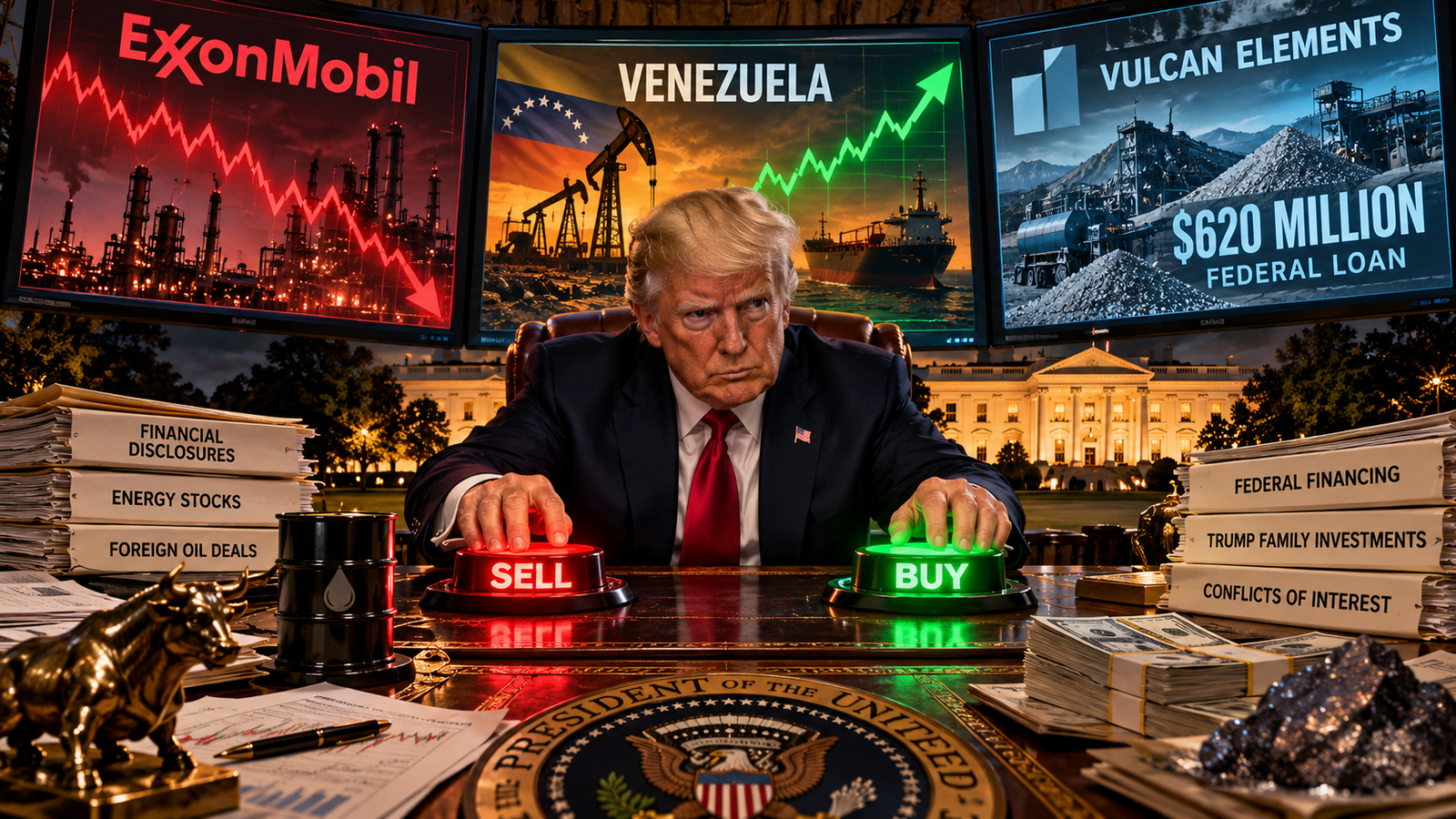
The central issue is not simply whether Wall Street firms can profit from faster access to presidential announcements. It is whether the President of the United States should have a financial interest in selling that advantage—and what consequences this arrangement presents for America’s economic and national security.
The two are inseparable.
Presidential Communications for Sale
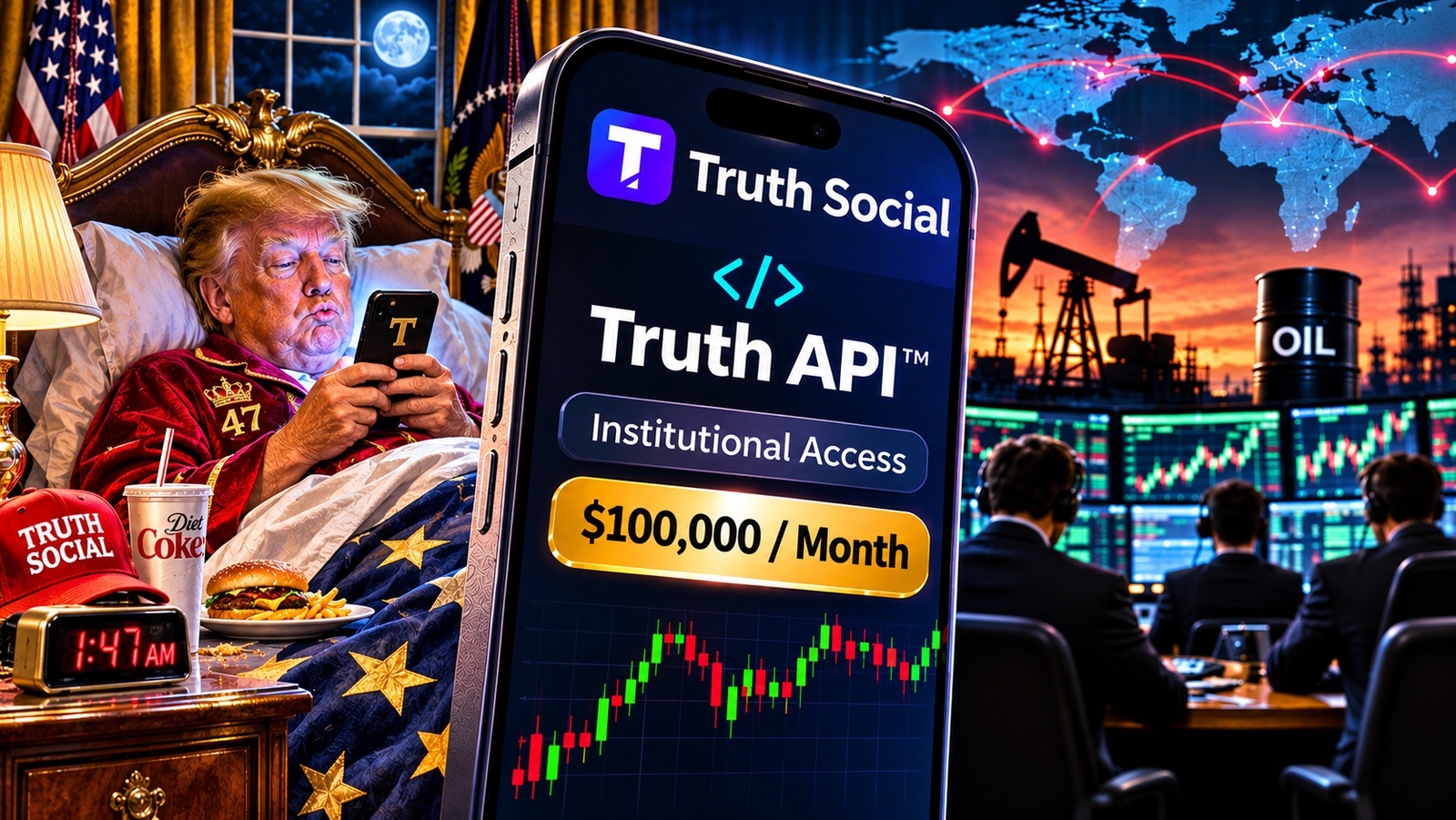
On July 16, 2026, Trump Media & Technology Group (TMTG) announced Truth API, a commercial subscription service providing institutional customers with accelerated, machine-readable access to posts from prominent Truth Social accounts, including that of the President of the United States.
TMTG interim CEO Kevin McGurn acknowledged the commercial significance of the product:
“Markets already move on Truth Social posts.”
The service commenced operations on August 1. By August 10, Trump Media reported more than ten customer agreements, predominantly with high-frequency trading firms, paying between $60,000 and $100,000 per month.
That represents between $720,000 and $1.2 million annually per subscription.
What these customers are purchasing is not exclusive information in the conventional sense. They are purchasing an informational advantage measured in fractions of a second. In automated financial markets, milliseconds matter.
Trump Media maintains that the information is publicly available and that Truth API is comparable to other commercial data subscription services.
However, McGurn also disclosed efforts to restrict unauthorized automated collection of Truth Social data while developing opportunities for wider third-party distribution.
Trump Media is simultaneously commercializing accelerated access and restricting competing methods of automated collection.
There is a fundamental difference between this and other commercial social media data services: the value of this particular product is derived substantially from the exercise of presidential authority.
According to Congressman Jamie Raskin’s July 30 letter to McGurn, President Trump retains approximately 41 percent ownership of TMTG through a trust he controls.
When Presidential Words Move Global Markets
From the Resolute Desk, President Trump can influence the price of oil through announcements concerning the war with Iran. The conflict itself has become a significant factor in the valuation of the commodity.
An August 21 Axios analysis examined 269 presidential posts concerning Iran or the Strait of Hormuz between February 28 and August 19, 2026.
Five-minute trading intervals
Average oil futures price movement
Normal intervals
0.20%
Following relevant Trump posts
0.73%
Although market responsiveness diminished over time, average price movements following these presidential announcements were 3.65 times greater than during normal intervals.
On March 23, 2026, approximately fifteen minutes before Trump announced on Truth Social that he was reversing his immediate threat to attack Iranian infrastructure, extraordinary trading activity occurred in international financial markets.
According to an October 13 Bloomberg investigation:
Oil futures equivalent to at least six million barrels were sold within two minutes.
Trading volume exceeded 8.5 times the comparable volume during the preceding week.
S&P 500 futures contracts representing more than $2 billion in market exposure changed hands during the surge.
Following Trump’s announcement, Brent crude prices fell by as much as 14 percent.
These transactions preceded the introduction of Truth API. They are not evidence of its misuse. They illustrate, however, the enormous financial advantage that advance knowledge of presidential decisions could provide.
Truth API subsequently established a commercial mechanism for selling a speed advantage in receiving such information.
Who Is Watching the Watchdogs?
The Commodity Futures Trading Commission (CFTC) began examining the suspicious March transactions.
Bloomberg subsequently reported that Arun Mel Gunewardena, Director of the Office of International Affairs and Senior Markets Advisor to CFTC Chairman Michael Selig, allegedly instructed a supervisor to retract a referral to the agency’s enforcement division and sought to oversee the collection of evidence himself.
On October 15, Selig disputed the allegations during a Fox Business interview, maintaining that the investigation had expanded rather than been curtailed.
The controversy arises against a backdrop of declining CFTC enforcement activity.
Fiscal year
Enforcement actions
2023
96
2024
58
2025
13
That represents an approximately 86 percent decline over two years.
On November 12, ten United States senators, including Michigan Senator Elissa Slotkin and Colorado Senator Michael Bennet, demanded further explanations concerning the alleged intervention.
The identities of the traders responsible for the suspicious March transactions have not been publicly established in the records examined for this investigation.
I could have predicted this. Missing, or hard-to-find, identities create operational Gapportunity™.
The International Dimension
Financial markets do not recognize national borders.
Foreign corporations, sovereign wealth funds, government-controlled enterprises and private investment intermediaries participate in international markets.
The introduction of Truth API therefore raises questions extending well beyond domestic securities regulation:
Are foreign entities eligible to subscribe?
Are the beneficial owners of subscribing institutions screened?
Can subscribers redistribute the accelerated data internationally?
Has any federal national security agency assessed the risks associated with this commercial arrangement?
What safeguards prevent entities associated with foreign adversaries from obtaining preferential access?
McGurn’s disclosure concerning wider third-party distribution makes these questions especially relevant.
A foreign entity need not obtain classified military intelligence to derive an economic advantage from presidential communications. Information concerning tariffs, sanctions, military operations and diplomatic negotiations can have substantial financial value.
The economic interests of foreign governments are not necessarily aligned with those of the United States.
Congressional and Judicial Scrutiny
Truth API has attracted multiple congressional and legal challenges.
July 21, 2026: Senator Mark Warner urged financial institutions to reject the service.
July 29: Senators Elizabeth Warren and Adam Schiff requested SEC scrutiny of its potential market-manipulation and insider-trading implications.
July 30: Congressman Jamie Raskin, Ranking Member of the House Judiciary Committee, demanded seven categories of records from Trump Media:
Communications between Trump Media personnel and government officials concerning the sale of accelerated or restricted access.
Identification of the Truth Social accounts available through the service.
Identification of subscribing customers and partners as of July 31.
Internal subscriber eligibility policies.
Marketing materials and related communications.
Subscription pricing information.
Internal revenue projections.
Raskin additionally demanded preservation of communications between Trump Media and the Trump administration, specifically including messages transmitted through Signal, WhatsApp, Telegram and X.
The deadline for producing the requested records was August 13, 2026, at 5:00 p.m.
August 3: Warner introduced the NO PROFIT Act, legislation intended to prohibit the commercialization of preferential access to market-sensitive government communications.
August 12: The Intercept and the Freedom of the Press Foundation filed a federal lawsuit challenging the arrangement.
August 14: Appearing on CNN, one day after his deadline expired, Raskin confirmed that he had received no response from Trump Media.
September 17: American Oversight and the Campaign for Accountability initiated additional litigation.
September 23: The Independent reported that San Francisco City Attorney David Chiu had brought suit against Trump Media under California’s Unfair Competition Law, seeking to terminate the service and impose financial penalties.
These proceedings challenge different aspects of the same commercial arrangement. Their allegations have not yet been established by final judicial rulings.
The Discovery Gap
On November 24, 2026, federal Judge J. Paul Oetken authorized limited discovery in the litigation brought by The Intercept and the Freedom of the Press Foundation, notwithstanding the defendants’ request to stay discovery.
The authorized discovery concerns the operation of Truth API, subscriber access, the participation of media organizations and communications between Trump Media and government officials.
The initial discovery deadline is January 29, 2027 (minus any delays, appeals, legal shenanigans, and Executive nose thumbs).
Meanwhile, the commercial service continues operating.
National Security for Sale?
The President of the United States possesses extraordinary authority over decisions affecting international commerce, military operations and financial markets.
Through Truth API, a corporation in which the president retains a substantial financial interest can derive revenue from selling preferential access to communications announcing those decisions.
The resulting conflict of interest warrants extreme scrutiny independently of whether any individual subscriber has committed insider trading.
The national security question is equally pressing. Who is purchasing this advantage, who ultimately benefits from it, and what protections exist against its exploitation by foreign interests? Can Trump’s “friends” overseas use the service?
The American public deserves answers.
Presidential authority is a public trust. Should preferential access to its exercise be a private commercial asset?
Mediaite, Michael Luciano, Anderson Cooper Shreds ‘Shameful’ Trump for Offering Early Access To Social Media Posts for $100,000 a Month, August 15, 2026.
Political Pressure, Corporate Accommodation and the End of Independent Fact-Checking
A Trumportunity Investigative Report
By Robert “Peace” Wright
What happens when the president of the United States threatens the head of one of the world’s most powerful communications enterprises with life imprisonment, and that enterprise subsequently dismantles its independent fact-checking program?
What happens when the corporation responsible for distributing information to billions of people discovers that questionable information can also be extraordinarily profitable?
And what happens when the anticipated financial penalties for permitting fraudulent activity are considerably less than the revenue generated by permitting it?
These questions arise from documented events, corporate policy decisions, financial disclosures, investigative journalism and mounting litigation involving Meta Platforms, Inc., the parent company of Facebook, Instagram, WhatsApp and Threads.
Our investigation begins with a threat.
I. The Threat
During the 2024 presidential campaign, Donald Trump directed an extraordinary warning toward Meta founder and chief executive officer Mark Zuckerberg.
In his book Save America, released in September 2024, Trump wrote:
“We are watching him closely, and if he does anything illegal this time he will spend the rest of his life in prison.”
Trump was referring to Zuckerberg’s previous involvement in funding election administration and his suspicions concerning Zuckerberg’s conduct during the 2020 presidential election.
Just days before Trump’s threat became public, Zuckerberg had sent a letter to House Judiciary Committee Chairman Jim Jordan on August 26, 2024, expressing regret over Meta’s response to pressure from the Biden administration concerning COVID-19 content moderation.
Zuckerberg maintained that Meta should not compromise its content standards in response to political pressure from any administration and expressed a willingness to resist such pressure in the future.
It was a commendable declaration of corporate independence.
Its durability would soon be tested.
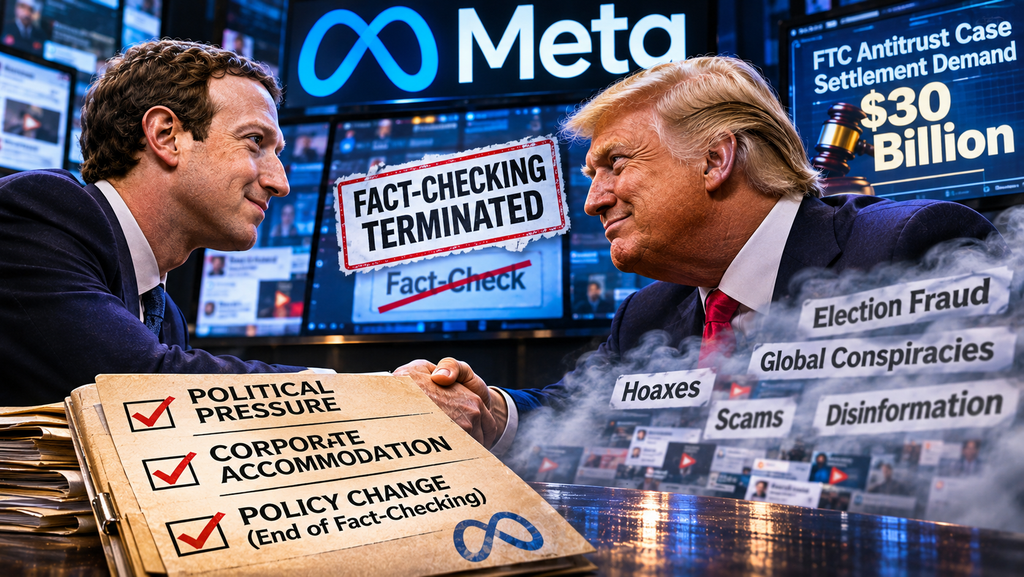
On January 7, 2025, Meta announced sweeping changes to its content moderation policies, including the forthcoming termination of its independent American fact-checking program.
During a press conference at Mar-a-Lago that same day, CNN correspondent Steve Contorno asked Trump whether Zuckerberg’s actions were directly responsive to the threats Trump had previously made against him.
Trump’s answer:
“Yeah, probably.”
While that answer does not establish Zuckerberg’s private motivations, we need not speculate about whether Trump believed his threats had influenced Zuckerberg’s decisions.
Following Trump’s November 2024 electoral victory, Zuckerberg’s relationship with the incoming president underwent a conspicuous transformation.
Date
Development
August 26, 2024
Zuckerberg declares Meta should resist political pressure from any administration.
August 28, 2024
Trump’s prison threat is reported publicly.
November 27, 2024
Zuckerberg dines with Trump at Mar-a-Lago.
December 30, 2024
Trump‘s inaugural committee receives a $1 million contribution from Meta.
January 2025
Republican political veteran Joel Kaplan succeeds Nick Clegg as Meta’s chief global affairs officer.
January 6, 2025
Trump ally Dana White joins Meta’s board of directors.
January 7, 2025
Meta announces the termination of its American third-party fact-checking program.
January 20, 2025
Trump returns to the presidency.
January 29, 2025
Meta agrees to a $25 million settlement of Trump’s lawsuit against the company.
January 30, 2025
Zuckerberg discusses the opportunities presented by a productive relationship with the United States government.
The $1 million inaugural contribution is documented in Federal Election Commission records.
The $25 million settlement resolved litigation originating from Facebook’s suspension of Trump’s account following the events of January 6, 2021. Approximately $22 million was designated for Trump’s future presidential library, with the remainder allocated to legal expenses and other plaintiffs.
Neither payment establishes an unlawful transaction, nor does the combined $26 million represent personal income received directly by Trump.
Nevertheless, the sequence warrants scrutiny.
A corporation whose chief executive had recently been threatened with life imprisonment was now financially supporting the incoming president’s inauguration, resolving his litigation against the company, restructuring its leadership and substantially revising its information-distribution policies.
During a January 30 internal company meeting reported by Business Insider, Zuckerberg described an opportunity to establish a productive partnership with the United States government.
He maintained that the company was not abandoning its principles.
The question, of course, is whether the principles had changed.
Meanwhile, Inside Meta
Meta’s newly emphasized commitment to freedom of expression was accompanied by reports in January and February 2025 that employees responsible for leaking confidential information could be terminated, that employee communications were being monitored and that certain forms of internal criticism could adversely affect performance evaluations.
Protecting confidential information is legitimate. Punishing substantive disagreement is another matter.
Pay attention when a corporation publicly presents greater freedom of expression as a central organizational principle while restricting some forms of expression within its own workforce.
III. A Thirty-Billion-Dollar Reason for Accommodation
As Trump returned to office, Meta faced federal antitrust litigation threatening its ownership of Instagram and WhatsApp, acquired in 2012 and 2014 for approximately $1 billion and $19 billion, respectively.
The Federal Trade Commission’s case originated in December 2020, during Trump’s first administration, alleging that Facebook had unlawfully maintained monopoly power through acquisitions and other anticompetitive practices.
Meta disputed the allegations, arguing that the government’s market definition failed to reflect contemporary competition.
With the trial approaching, Zuckerberg personally lobbied the incoming administration.
On April 2, 2025, The New York Times reported that Zuckerberg had made repeated visits to Trump and his advisers seeking a resolution to the antitrust case.
Subsequent reporting originating with The Wall Street Journal described remarkable settlement negotiations.
Negotiating position
Reported amount
Zuckerberg’s initial offer
$450 million
Meta’s subsequent offer
Approximately $1 billion
FTC chairman’s reported minimum
$18 billion
FTC’s reported demand
$30 billion
The original offer represented just 1.5 percent of the government’s reported demand. Meta also reportedly offered unspecified policy changes during settlement discussions.
Former FTC Chair Lina Khan responded pointedly:
“Mark bought his way out of competing, so I’m not surprised that he thinks he can buy his way out of law enforcement, too.”
Consider the chronology:
April 7, 2025: Meta officially ends independent third-party fact-checking in the United States.
April 8, 2025: Trump reportedly meets with FTC Chairman Andrew Ferguson and other administration officials concerning the antitrust litigation. Although reportedly receptive to a settlement, Trump is persuaded to allow the case to proceed.
April 14, 2025: The antitrust trial commences.
The litigation continued. Meta prevailed at trial in November 2025, and the FTC appealed in January 2026.
What the record does show us is that Meta was pursuing favorable treatment from the administration while undertaking substantial changes to its information policies.
Zuckerberg had considerable financial reasons to cultivate a favorable presidential relationship.
In January 2025, Trump removed numerous federal inspectors general responsible for investigating waste, fraud, abuse and misconduct within government agencies.
Meanwhile, Meta was preparing to eliminate its independent American fact-checking apparatus.
Although their functions and legal responsibilities differ, both developments reduced established mechanisms of independent scrutiny.
Meta’s January 7 announcement outlined several significant policy changes:
Termination of American third-party fact-checking.
Introduction of a crowdsourced Community Notes system modeled on X.
Removal of distribution penalties previously imposed on fact-checked content.
Relaxation of certain content restrictions.
Increased availability of political content in users’ feeds.
Changes to automated content enforcement.
Relocation of certain trust and safety operations outside California.
Meta argued that its previous moderation system had made excessive enforcement mistakes and that independent fact-checkers had introduced political bias.
However, professional fact-checkers evaluated claims; Meta itself determined how those findings affected content distribution.
On April 7, 2025, the company’s independent American fact-checking program officially ended.
Under the replacement system, even when a Community Note successfully identifies misinformation, the underlying content can continue circulating without the distribution penalty previously associated with independent fact-checking.
That distinction becomes especially important when engagement itself possesses commercial value.
V. Replacing Professional Verification with Public Consensus
Meta’s previous fact-checking program was imperfect. A January 2025 NewsGuard investigation examined 457 posts containing 30 false narratives originating from Russian, Chinese and Iranian disinformation sources.
Only 14 percent carried fact-checking labels.
Was its replacement an improvement?
Community Notes require consensus among contributors with differing perspectives before corrections become visible. Meanwhile, misinformation can continue circulating.
During the first six months of Meta’s American Community Notes program, approximately 15,000 notes were written, but only 900 were published.
During approximately the same period, International Fact-Checking Network director Angie Drobnic Holan reported that Meta’s European professional fact-checking program generated labels on approximately 35 million Facebook posts.
Although not directly comparable, the disparity is striking.
An October 2026 NewsGuard investigation found that 93.1 percent of the false American midterm election claims examined on X—the platform upon which Meta modeled its replacement system—remained without corrective notes. These included at least four false claims posted by Elon Musk himself.
A 2026 study published in Science Advances found that approximately 53 million American Facebook accounts received 80 percent of the content originating from identified repeat misinformation offenders.
An experiment involving approximately 16,000 volunteers demonstrated that removing content from those sources reduced exposure by approximately 70 percent, although no measurable changes in political beliefs or attitudes were detected.
Under Meta’s revised fact-checking policies, researchers could no longer conduct the same intervention.
Sources: Mashable, January 23, 2025; Nieman Journalism Lab, March 26, 2026; Marian-Andrei Rizoiu, The Conversation, July 2026; Agence France-Presse, October 21, 2026.
VI. Monetizing Misfortune: When Free Speech Comes With a Paid Exemption
One provision of Meta’s proposed Community Notes system received considerably less public attention than the termination of professional fact-checking.
Paid advertisements were to be excluded.
In January 2025, The Wall Street Journal, Reuters and Social Media Today reported that Meta intended Community Notes to apply to ordinary posts rather than paid advertisements.
Interestingly, X, whose system Meta was adopting, permitted Community Notes on advertisements.
Although separate advertising standards and fraud-prevention measures remained applicable, Meta’s proposed replacement for professional fact-checking would not initially extend to the very content for which Meta was being paid.
Subsequent investigative reporting revealed why this deserves particular attention.
Credit Where Credit Is Due
This portion of our investigation draws substantially upon the exceptional investigative journalism of Reuters reporters Jeff Horwitz and Engen Tham, whose reporting on Meta earned them the 2026 Pulitzer Prize for Beat Reporting.
We encourage readers to examine Horwitz’s November 6, 2025 investigation:
Is allowing fraudulent and misleading but paid to place advertising to freely circulate corrupt? In this case, corruption is paying Meta extremely well.
The Economics of Deception
According to internal corporate documents examined by Reuters, Meta projected that approximately 10 percent of its 2024 annual revenue would originate from advertisements promoting scams or prohibited products.
Approximately $16 billion.
The documents also identified approximately $7 billion in annualized revenue associated with advertising presenting particularly elevated fraud or legal risks.
Another internal estimate placed the daily number of higher-risk advertising impressions at approximately 15 billion.
Estimated higher-risk advertising impressions
Frequency
Per day
15 billion
Per hour
625 million
Per minute
10.4 million
Per second
173,611
These are estimated advertising impressions, not individual advertisements or unique victims. The revenue categories overlap and should not be added together.
Meta disputes the interpretation of its internal estimates, describing them as overly broad and the reporting as selective.
Importantly, these projections preceded the termination of independent American fact-checking. They reveal a preexisting financial incentive within the corporation at the time its moderation policies were being reconsidered.
Pay More, Stay Online
Perhaps one of the most disturbing findings concerns Meta’s reported treatment of suspected fraudulent advertisers.
According to Reuters, its automated systems generally required approximately 95 percent confidence before certain advertisers would be removed.
Suspected offenders falling below that threshold could face another consequence: higher advertising costs.
Meta maintained that the higher costs were intended to discourage questionable advertisers by making their advertisements less competitive.
When those advertisers continued purchasing advertisements, Meta received even more revenue per successful purchase.
The blurring of deterrence verses monetization becomes uncomfortable.
Reuters also found that users who interacted with suspicious advertisements could subsequently receive more of them through Meta’s advertising personalization system.
An individual who demonstrates susceptibility to a fraudulent financial offer may thereby become a more commercially valuable target for similar offers.
The very data that could help identify and protect vulnerable consumers can also help advertisers locate them.
VII. The Price of Compliance Versus the Profit of Noncompliance
Reporting published by TheNextWeb on April 22, 2026, drawing upon Reuters investigations and subsequent litigation, described Meta’s internal assessments of advertiser verification and regulatory exposure.
Implementing universal advertiser verification was reportedly estimated to cost approximately $2 billion, with potential revenue reductions of up to 4.8 percent.
A subsequent Santa Clara County lawsuit alleged that Meta had anticipated potential penalties of up to $1 billion while estimating approximately $7 billion in annual revenue from advertising categorized internally as “violating revenue.”
Although revenue is not net profit, the alleged corporate reasoning raises an obvious question.
When the anticipated financial consequences of permitting questionable advertising amount to a fraction of the revenue generated, what incentive does a corporation possess to eliminate it voluntarily?
Under such circumstances, regulatory settlements risk becoming predictable operating expenses rather than effective deterrents.
Making the Evidence More Difficult to Find
Reuters’ investigation into Meta’s dealings with international regulators revealed another disturbing practice.
In Japan, authorities had been examining Meta’s publicly accessible advertising library to determine whether fraudulent advertisements remained prevalent.
Meta reportedly identified the searches regulators were likely to conduct and repeatedly removed suspicious advertisements appearing in those results.
According to Reuters, the technique became part of a broader international strategy intended to manage regulatory perceptions and delay mandatory advertiser verification.
Meta disputed the suggestion that removing fraudulent advertisements from its library was misleading.
But removing fraudulent content because it is fraudulent and selectively removing it because regulators are likely to discover it serve different purposes.
One improves safety. The other can improve the appearance of safety.
China’s Advertising Pipeline
Despite restrictions preventing ordinary public access to Meta’s platforms within China, Chinese businesses can purchase advertising aimed at consumers elsewhere.
According to Reuters, Meta’s Chinese advertising revenue grew from approximately $7.4 billion in 2022 to $18.4 billion in 2024.
Internal assessments reportedly associated approximately 19 percent of its 2024 Chinese advertising revenue—more than $3 billion—with scams and other prohibited advertising.
An initiative to combat such advertising achieved substantial reductions during the latter half of 2024. Subsequent corporate decisions reportedly reversed aspects of that initiative, and problematic advertising increased again.
Internal documents indicated that revenue considerations influenced enforcement discussions concerning Chinese advertising partners, some of whom enjoyed special protections delaying the removal of suspicious advertisements.
In a separate journalistic experiment, Horwitz obtained advertising services through agencies associated with Meta’s partner network and successfully published advertisements promoting implausible investment returns.
Meta’s artificial intelligence systems even offered to generate alternative advertising content intended to improve the campaign’s effectiveness.
The issue was no longer simply whether Meta could identify fraudulent advertisements.
It was whether its commercial infrastructure could help questionable advertisers create, distribute and improve them.
From Where I sit and observe, things do not look good for Facebook.
Sources: Reuters investigations reproduced in the 2026 Pulitzer Prize archive; TheNextWeb, April 22, 2026; USA TODAY, May 12, 2026.
VIII. The Artificial Intelligence Dimension
AI-generated impersonations enable fraudulent advertisers to manufacture endorsements from trusted public figures who have never authorized them.
Fabricated endorsements involving Donald Trump, Elon Musk, Bernie Sanders and Alexandria Ocasio-Cortez have reportedly been used to promote fraudulent government benefit schemes.
In Brazil, manipulated images and voices of physicians have been used to sell questionable healthcare products. Financial professionals have similarly been impersonated to promote fabricated investment opportunities.
The Tech Transparency Project identified 63 alleged scam advertisers associated with more than 150,600 political advertisements and approximately $49 million in lifetime advertising expenditures on Meta.
Political misinformation, financial fraud and identity impersonation can therefore converge within the same advertisement.
And a successful deception can generate the same commercially desirable engagement metrics as a successful legitimate advertisement.
IX. Exporting the Experiment
In November 2025, Meta sought guidance from its own Oversight Board concerning the international expansion of Community Notes.
In March 2026, the Board warned that replacing professional fact-checking with Community Notes could create significant human rights risks, particularly in societies experiencing political repression, intense electoral conflict, discrimination or inadequate access to reliable information.
The Board recommended additional testing, transparency and careful evaluation of national circumstances.
Nevertheless, in September 2026, Meta announced testing in 16 Spanish-speaking Latin American countries:
Argentina, Bolivia, Chile, Colombia, Costa Rica, Ecuador, El Salvador, Guatemala, Honduras, Mexico, Nicaragua, Panama, Paraguay, Peru, Uruguay and Venezuela.
Professional fact-checking remained operational during the initial testing phase, with no definitive timetable announced for its termination.
By September 2026, Meta reportedly had more than 1.4 million registered Community Notes contributors.
Yet Community Notes themselves frequently rely upon professional journalists and fact-checkers to substantiate their corrections.
There is an inherent contradiction in undermining the institutions that produce reliable verification while introducing a system that depends upon their continued existence.
X. The Reckoning: From Corporate Policy to Civil Prosecution
By November 2026, Meta faced mounting litigation and regulatory actions involving allegations of fraudulent advertising, inadequate consumer protections and misleading corporate representations.
These proceedings extend across jurisdictions beyond the direct authority of the Trump administration.
California
A federal class action concerning an alleged stock manipulation operation involving Jayud Global Logistics alleged that fraudulent Facebook and Instagram advertisements helped inflate the stock’s price before its collapse, producing losses exceeding $500 million.
On March 25, 2026, a federal judge dismissed the case, reportedly without prejudice, finding that the plaintiffs had not sufficiently alleged Meta’s participation in creating the advertisements.
A separate civil prosecution brought by Santa Clara County in May 2026 alleged that Meta’s role extended beyond passive distribution.
The county alleged that Meta participated in the creation, optimization, targeting and dissemination of fraudulent advertisements while deriving substantial income from them.
The distinction could prove legally consequential: hosting fraudulent content is not necessarily the same as participating in its creation.
Rhode Island
On October 22, 2026, Rhode Island Attorney General Peter F. Neronha filed a lawsuit against Meta in Providence County Superior Court under the state’s Deceptive Trade Practices Act.
The complaint alleged that Meta knowingly profited from fraudulent advertisements despite representing to consumers that it employed sophisticated measures to prevent them.
The alleged fraudulent activities included:
Fabricated investment opportunities.
False Medicare and Social Security benefit offers.
Impersonation of trusted institutions and individuals.
Ineffective or dangerous medical products.
Other deceptive goods and services.
Particularly significant was the allegation that Meta knowingly used extensive information about its account holders to help advertisers identify and repeatedly target consumers most susceptible to fraudulent offers, especially senior citizens.
The state seeks restitution, civil penalties, injunctive relief, disgorgement of allegedly unlawful profits with interest and the appointment of an independent receiver, auditor or monitor.
A corporation that eliminated one form of independent oversight may ultimately find itself confronted with another imposed through judicial proceedings.
Australian consumer protection authorities have pursued Meta over cryptocurrency advertisements featuring unauthorized likenesses of prominent Australians. One victim identified in the litigation reportedly lost more than A$650,000.
In Britain, financial regulators identified 1,052 illegal financial advertisements on Meta’s platforms during a single week in November 2025.
Additional litigation includes actions involving the impersonation of financial professionals, a lawsuit brought by the attorney general of the United States Virgin Islands and litigation by the Consumer Federation of America alleging that Meta profited from fraudulent advertising while misrepresenting its prevention efforts.
These proceedings remain subject to judicial determination. But to their surprise is that Zuckerberg’s relationship with the American president cannot insulate Meta from every jurisdiction in which it conducts business. There still may be a threat of prison, not a tactical threat, but a founded one.
XI. Meta’s Defense
Meta disputes the interpretation of its internal financial assessments and maintains that fraudulent advertising harms its business by undermining consumer and advertiser confidence.
The corporation has reported substantial enforcement activities (according to Meta):
Reported enforcement measure
Magnitude
Scam advertisements removed during 2025
159 million
Accounts associated with scam operations removed
10.9 million
Detected scam advertisements removed before user reports
92%
Target percentage of revenue from verified advertisers by the end of 2026
90%
Meta has also reported developing facial recognition safeguards, pursuing litigation against fraudulent advertisers, cooperating with international law enforcement and introducing scam-detection features.
However, the 92 percent proactive removal figure concerns advertisements Meta successfully detected. It does not establish the percentage of all fraudulent advertising detected.
Nor can the number of advertisements removed be directly compared with the number of advertising impressions delivered (that is, how many times the ad was presented for view).
The outstanding question is whether commercial considerations improperly influenced the consistency and effectiveness of Meta’s safeguards.
XII. Cui Bono, Who Benefits?
The convergence of political and commercial interests revealed throughout this investigation deserves particular attention.
A presidential candidate threatened a powerful corporate executive with life imprisonment. That executive subsequently cultivated a relationship with the incoming administration while seeking relief from potentially devastating antitrust litigation.
His corporation dismantled its independent American fact-checking program while operating an advertising business whose internal documents reportedly revealed extraordinary financial incentives for permitting questionable advertising.
This evidence does not prove an unlawful arrangement between Zuckerberg and Trump. It does, however, reveal a convergence of interests from which both could potentially benefit. Direct profit for one, and a twisted sense of cover in a financial arena ruled by mayhem, at least, for the other.
More importantly, a political administration can benefit from diminished independent scrutiny.
A communications enterprise can benefit from favorable political relationships.
Questionable advertisers benefit from reduced obstacles to distributing misleading information.
And the corporation selling access to the public benefits financially from the resulting engagement.
The public, meanwhile, assumes the risks, and consumes the loss.
Freedom of expression is an essential democratic principle.
But freedom of expression should not be confused with a corporate entitlement to profit from deception.
Nor should a commitment to political independence be measured solely by a corporation’s willingness to resist the administration it opposes.
The more meaningful test is whether it possesses the same willingness to resist the administration whose favor it seeks.
This investigation is part of Trumportunity’s continuing examination of the intersections between presidential authority, corporate influence and private financial interests.
The author gratefully acknowledges the original reporting of the journalists and researchers whose work is referenced throughout this article.
Allegations contained in pending litigation remain allegations unless established through judicial findings or other competent evidence.
An investigation into broken marketing promises, corporate accountability, customer deposits, and the unanswered questions behind Trump’s gold-colored smartphone.
By Robert D. Wright : Trumportunity : November 2026
On June 16, 2025, the Trump family entered the American telecommunications market with an announcement seemingly designed to appeal to every patriotic consumer who had ever complained about foreign manufacturing.
A new wireless service. A gold-colored smartphone. An American brand.
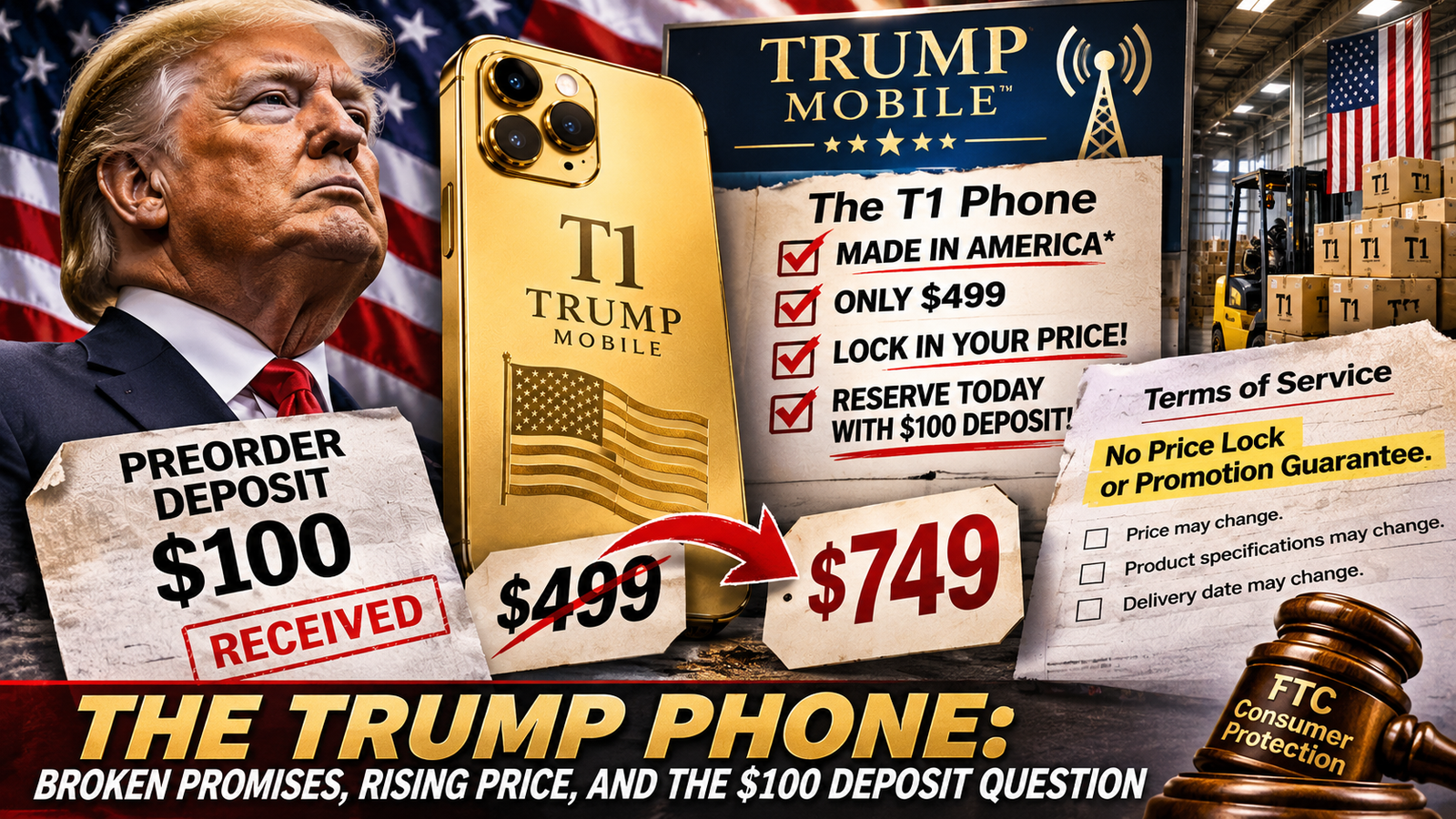
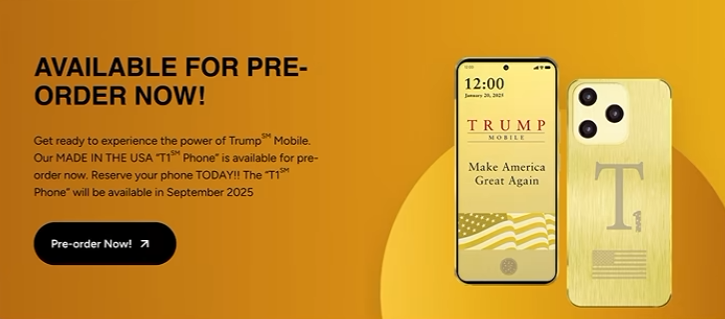
The T1 Phone would cost only $499, and customers could reserve their place in line with just a $100 deposit. The device was initially promoted as MADE IN AMERICA, with availability advertised for September 2025.
Trump Mobile’s original promotional advertisement promised a “Made in the USA” T1 smartphone available in September 2025. The company’s own marketing provides a historical record against which subsequent changes can be examined.
THE FIRST BROKEN DEADLINE: SEPTEMBER 2025
Trump Mobile’s original advertisement did more than promise an American-made smartphone. It explicitly announced that the T1 Phone would be available in September 2025. That deadline came and went without delivery. October passed, then November, then December. By January 2026, customers were still waiting.
It was not until May 13, 2026—more than seven months after the advertised September deadline—that Trump Mobile announced shipments were beginning. Even then, the company declined to disclose how many phones had been ordered or shipped.
For customers who paid $100 deposits in anticipation of a September 2025 release, the question is unavoidable: What happened to their money during those additional months, and what obligations did Trump Mobile incur by failing to meet its advertised delivery date?
Clearly, the proposition was straightforward: be a patriot, support an American enterprise, purchase an American-made smartphone, and secure promotional pricing before the opportunity disappeared.
It was a powerful combination of patriotism, brand loyalty, and purchasing urgency.
But behind the gold finish and American flags, the promises began changing.
Delivery dates slipped. Manufacturing claims evolved. Product specifications shifted. And the company’s contractual terms eventually made clear that placing a deposit did not guarantee the advertised price, the originally described product, or even the opportunity to purchase a completed phone. Remember the ‘ol switcheroo?
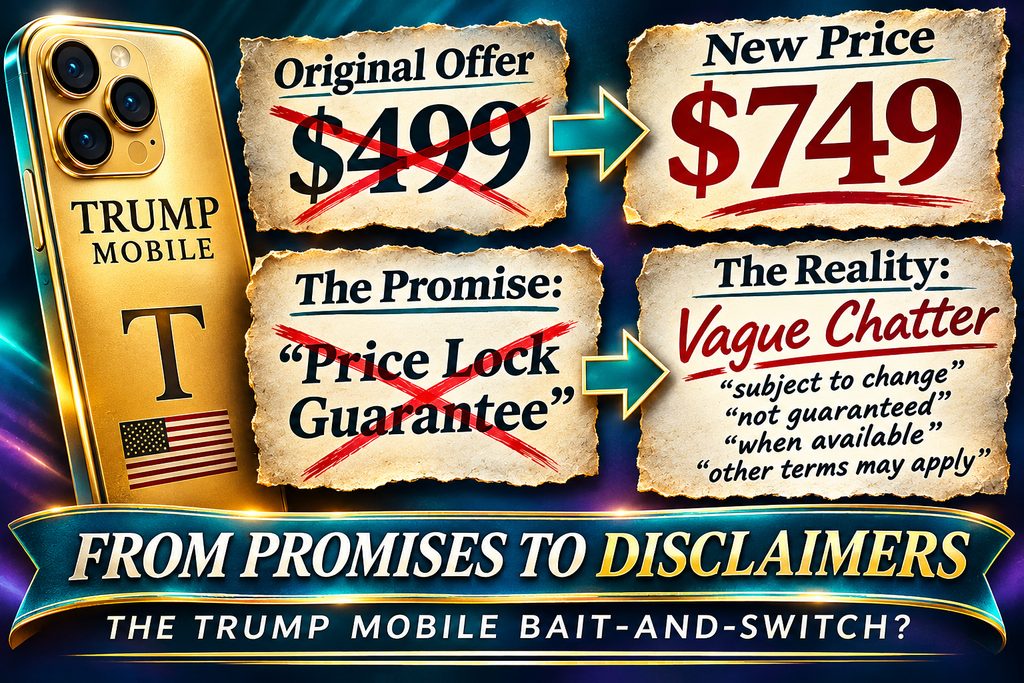
By September 2026, the advertised price had increased to $749, a 50% increase over the “locked in” price offer.
That alone would justify examining the company’s marketing practices. But the more consequential questions concern the money collected from customers, the businesses behind the Trump Mobile name, and the obligations those businesses may ultimately have to honor.
Because a smartphone can be manufactured, rebranded, delayed, or replaced.
A customer’s money is another matter.
Fraud by Design: A Marketing Professional’s Assessment
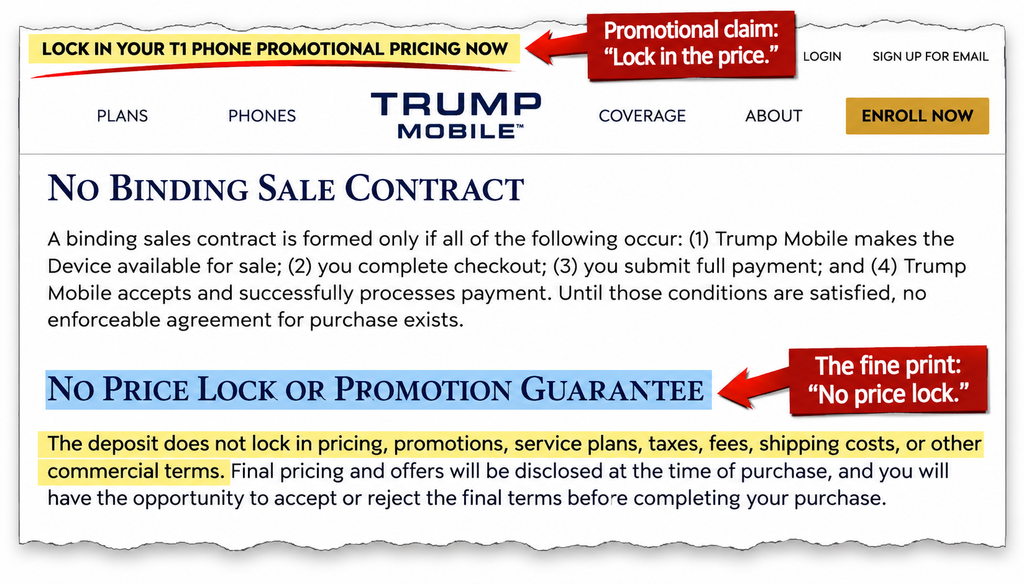
The first message prospective customers encountered was unmistakable:
The terms explicitly stated that a deposit did not secure the advertised price.
As a career marketing professional, I recognize the significance of that arrangement. Advertising placement, messaging hierarchy, and calls to action are fundamental elements of consumer decision-making. A prominent promise can induce a purchase decision long before a customer encounters the qualifying language farther down the page.
Based on my professional experience and my examination of the evidence, it is my opinion that a deliberately engineered deception in the customer’s purchasing journey occurred.
I do not regard this as an innocent inconsistency. In my assessment, the promotional message was designed to create an expectation that the contractual terms expressly refused to honor.
The company invited consumers to commit their money on the strength of a promise it simultaneously disclaimed.
The promise was made at the top of the page, as was the call to action/enroll now button. The escape clause was waiting below.
What Does Federal Advertising Law Say?
The Federal Trade Commission has long recognized the problem of attracting customers with an appealing offer that the seller does not genuinely intend to fulfill on the advertised terms.
The regulation addresses more than an outright refusal to sell. It also examines misleading representations concerning a product’s characteristics, origin, availability, and the conditions under which it is offered.
Importantly, is it a legitimate promotional offer? Or an offer designed to secure a consumer’s commitment under expectations the seller does not intend to honor? This is a scab that needs to be removed.
A price increase, by itself, does not establish bait advertising. Nor does the existence of contractual qualifications automatically make an advertisement unlawful. In a nutshell, the question is whether the overall purchasing experience materially misled consumers and whether the offer was genuine.
That question became particularly relevant when the company swapped the marketing narrative while subsequently changing the advertised price. A double-switcheroo, masterfully parlayed.
The Price-Lock Promise Meets Reality
What initially appeared to be a contradiction between Trump Mobile’s advertising and contractual terms became considerably more consequential in September 2026.
The company had promoted its T1 smartphone at $499 while soliciting $100 preorder deposits. Customers were promised a locked-in preorder price.
Trump Mobile’s original June 16, 2025 Terms of Service also warned that “Prices and fees may change.” Meanwhile, its separate Terms of Use contained mandatory arbitration and a class-action waiver. Customers were encouraged to secure promotional pricing while the company’s legal documents reserved flexibility over prices and also attempted to contractually restrict how disputes could be pursued.
Its revised terms, dated April 6, 2026, explicitly disclaimed any guarantee that customers would receive the advertised price.
Then the advertised price increased to $749.
That’s $250 more—a 50% increase over the original advertised price.
The significance is not simply that a company raised its price. It is that customers were encouraged to commit money through promotional messaging about locking in pricing while the contractual language denied them that protection.
The later price increase demonstrates why that distinction mattered.
Whether individual customers who deposited $100 were ultimately required to pay the higher price remains a separate question requiring verification. The April 2026 terms also cannot automatically be applied to deposits made under earlier agreements; the company’s own language states that the version in effect when a deposit was placed governs that deposit.
Nevertheless, the contradiction between the promotional promise and the revised contractual disclaimer was no longer merely theoretical.
The price changed. The promised protection was nowhere to be found in the revised terms.
But pricing was only one element of the original offer that changed.
Made in America—Until the Language Changed
When Trump Mobile introduced the T1, American manufacturing was central to its appeal.
The device was presented as an American-made alternative to smartphones assembled overseas. For consumers motivated by domestic manufacturing, that distinction was not incidental. It was part of the product’s identity.
As the months passed, the company’s descriptions became less definitive.
Language emphasizing American manufacture gave way to references to American innovation, American teams, and American involvement in design and quality.
Those are not equivalent claims.
A phone can be designed in the United States, inspected by an American company, sold under an American trademark, and still be manufactured primarily overseas.
The distinction matters because consumers were not merely purchasing technical specifications. They were being invited to make a patriotic purchasing decision.
Independent examinations of the T1 subsequently raised questions about the handset’s origins. Technology reviewers identified substantial similarities between the Trump-branded device and HTC’s U24 Pro, a smartphone introduced for 2024 before Trump Mobile announced its product.
The resemblance extends beyond a superficial similarity in appearance. Reviewers have pointed to shared hardware characteristics and design elements that suggest the T1 may be based on an existing device rather than an entirely new American-engineered platform.
That does not conclusively establish the handset’s manufacturing arrangements or prove that HTC supplied Trump Mobile directly.
But it creates an obvious question.
If the T1 is substantially derived from an existing overseas smartphone, what exactly did Trump Mobile contribute beyond its branding, distribution arrangements, and marketing?
The answer should be relatively simple to document: identify the manufacturer, the assembly facilities, the supply chain, and the extent of American production.
Instead, those details have remained a source of public controversy.
The phone did eventually begin reaching customers and reviewers in May 2026, nearly a year after its announcement. Its existence is no longer hypothetical.
Its commercial history, however, remains difficult to reconcile with the simplicity of the original sales pitch.
And that brings us to the business itself.
Behind the Trump Name: Who Actually Runs Trump Mobile?
To understand Trump Mobile, it is necessary to distinguish the brand customers recognize from the legal entities responsible for operating the business.
The name on the product is Trump.
But the company identified in customer agreements is T1 Mobile LLC, doing business as Trump Mobile.
Reporting has also identified Liberty Mobile as a significant operational participant, while questions have arisen concerning the involvement of Ensurety Ventures and other associated businesses.
The Trump Organization’s role includes licensing the Trump name and related intellectual property. It has disclaimed responsibility for designing, manufacturing, or selling the handset.
These distinctions are not merely administrative.
In a corporate arrangement involving multiple entities, the business that advertises a product, the business that processes a payment, the business that fulfills an order, and the business that receives licensing revenue may not be the same. These functions are segregated by design. Segregation creates Gapportunity™.
Nor does a familiar brand necessarily guarantee the obligations of a separately organized company using its name.
Consider the implications for a customer who paid a $100 deposit because the product carried the Trump name.
Which company received that payment?
Which company holds it?
Which company must refund it?
And which company, if any, has already received revenue generated by the transaction?
The available public record does not establish the complete movement of preorder funds among these entities.
That is precisely why the corporate relationships deserve examination.
A trademark license can generate revenue for the owner of a brand without making that owner responsible for every debt incurred by the licensee.
There is nothing inherently improper about that arrangement. It is a familiar feature of modern commerce.
The concern arises when customers reasonably associate the financial strength and reputation of a famous brand with a business whose actual obligations may rest elsewhere.
The brand sells the confidence. The contract determines who owes the money.
To determine whether those two things align, we need to follow the deposits.
How Much Money Did Trump Mobile Collect?
The advertised preorder deposit was $100. The claim was that your $100 deposit locks in your $499 price.
That figure sounds modest when considered as an individual transaction. Multiplied across a large customer base, however, it could represent substantial funds.
Although we have yet to obtain Trump Mobile’s financial records, reports circulating from Washington to New Delhi have placed the number of prepaid orders near 590,000—representing approximately $59 million in potential customer deposits. The figure remains unverified, and Trump Mobile has thus far not been willing to publicly confirmed the actual number of paid preorders.
Without a verified customer ledger, the estimate cannot establish the number of completed payments, cancellations, refunds, duplicate orders, or phones delivered.
Nevertheless, the possibility of substantial customer deposits raises a financial question independent of the eventual sale of the handset.
What happened to the money while customers waited?
The Hidden Value(s) of Customer Deposits
A customer deposit has value beyond the purchase it is intended to secure.
Money held by a business is money no longer available to the customer who paid it.
Depending on how those funds are managed, deposits may generate interest, provide working capital, or reduce borrowing costs. Even when a customer eventually receives a full refund, the financial benefit of holding that money in the meantime may remain with someone else.
Consider this hypothetical example.
If a business held $50 million for a full year at a 4 percent annual return, the gross earnings would be $2 million. At 5 percent, the figure would rise to $2.5 million.
At 4.5 percent, the result would be approximately $2.25 million.
Those figures are illustrations, not findings about Trump Mobile. We have not established that the company collected $50 million, retained that amount for a year, invested it, or earned any interest.
The deposits may have been collected gradually, refunded, applied to purchases, or used in ways that generated no investment return.
But the economic principle remains:
A business does not necessarily have to complete a sale to benefit from collecting a customer’s money.
The company’s April 2026 preorder terms expressly state that deposits do not accrue interest for customers.
What the terms do not disclose is whether the funds generate any financial benefit for the business holding them.
Were deposits maintained in segregated accounts? Were they commingled with operating funds? Were they used to purchase inventory or finance business expenses? Were any amounts transferred to affiliated entities?
Who controlled the accounts?
And who ultimately benefited?
Those questions cannot be resolved by examining a promotional website.
They require accounting records.
The Bankruptcy Contingency: Who Gets Left Holding the Bag?
Donald Trump’s businesses have filed for Chapter 11 bankruptcy six times. He knows how bankruptcy can allow a business to shed debts and reorganize.
Could bankruptcy be Trump Mobile’s contingency plan? If T1 Mobile LLC becomes responsible for refunds it cannot afford, bankruptcy could leave customers competing with other creditors for whatever assets remain, while separate companies benefiting from the Trump brand continue operating.
We have no evidence such a plan exists. But the corporate structure raises a consequential question:
If the business responsible for refunding customers is not the same business ultimately benefiting from their payments, what happens when the refunds come due?
The brand survives. But the debts?
Congressional Questions—and the Value of Silence
On October 8, 2026, Senator Maggie Hassan, ranking member of the Joint Economic Committee, publicly challenged Trump Mobile over consumer privacy, security, telecommunications compliance, and its business relationships.
Her inquiry followed reports of customer-data exposure and concerns about whether Trump Mobile and its operating partners had satisfied applicable Federal Communications Commission requirements.
The senator requested information concerning the company’s operations, ownership, customer protections, and financial arrangements, with a response deadline of October 29.
The questions were not limited to whether the T1 worked as advertised.
They concerned who was operating the service, whether customers were adequately protected, and whether the company’s regulatory obligations were being fulfilled.
As of this investigation, we have not located a publicly available response addressing the Senator’s questions.
That does not establish that Trump Mobile failed to answer the senator privately.
But it leaves the public without answers to matters central to understanding the business.
Silence as a Strategy of Delay
One recurring mechanism examined in The Trump Extraction is the strategic value of nonresponse.
When questions about public accountability go unanswered, the resulting delay can benefit those whose conduct is under scrutiny. Deadlines pass, investigators pursue follow-up inquiries, and the burden of obtaining information shifts to those demanding accountability.
Strategic delay can also have economic consequences.
Funds remain under someone else’s control. Customers must decide whether to wait, request refunds, or pursue other remedies. Investigators must work to obtain information that the business itself possesses.
This does not prove that Trump Mobile deliberately adopted silence as a financial strategy. I bring this up to help display why timely disclosure matters. “Houston, we have a serious transparency issue.”
In a business collecting customers’ money, time, information, and energy, delay itself has an economic value.
The concerns raised by Senator Hassan extend beyond financial accountability. They reach into the security of the communications network and the personal information entrusted to it.
When a Communications Device Becomes Someone Else’s Instrument
A smartphone is not simply a telephone.
It can contain a customer’s contacts, photographs, correspondence, location history, authentication credentials, banking applications, and access to personal and professional accounts.
Its security depends on far more than the name printed on the back.
The hardware supply chain, operating system, software updates, network operator, and customer-data infrastructure all matter.
That makes transparency about Trump Mobile’s technical partners particularly important.
The Customer-Data Problem
In May 2026, Trump Mobile confirmed that customer information had been exposed in a security incident attributed to a third party.
Subsequent reports described additional claims of compromised customer information, including an October incident in which a ransomware group asserted that it had obtained records associated with thousands of users.
Some exposed records were reportedly corroborated by journalists. But the full scope of the alleged intrusion, the attacker’s method, and the extent of any continuing access have not been independently established.
The available reporting raises questions about the security practices of the businesses handling Trump Mobile customers’ information.
Senator Hassan’s inquiry also identified apparent gaps in publicly available FCC filings involving Trump Mobile and Liberty Mobile, including records relevant to preventing illegal calls and verifying telecommunications authority.
Those concerns require regulatory clarification; and I concede that a seemingly missing filing is not, by itself, a final determination of wrongdoing.
But a telecommunications provider cannot ask consumers to trust its patriotic branding as a substitute for, or in in leu of independently verifiable security protocols and FCC compliance.
Lessons from Compromised Technology
The danger of compromised electronics is not speculative.
As early as 2006, Princeton University researchers demonstrated how malicious software could manipulate certain Diebold voting machines and spread between devices. CNN reported on the findings.
In 2011, researchers at Argonne National Laboratory demonstrated how an inexpensive hardware modification installed on-site, in minutes, could enable remote manipulation of another Diebold voting system.
Those were ethical business attacks involving specific vulnerabilities and access requirements. They did not demonstrate that every electronic device is equally susceptible, but the underlying lesson extends well beyond voting machines:
The person holding an electronic device is not necessarily the person controlling it.
The September 2024 Israeli attacks, involving explosive pagers and walkie-talkies in Lebanon, demonstrated another kind of supply-chain vulnerability: communications equipment physically altered before reaching its intended users. 39+ killed, 3000+ injured including innocent women and children and shoppers at market.
Those devices were not ordinary smartphones. Their destruction depended on concealed explosives and a controllable remote detonation system.
The relevance is the larger principle that a device’s appearance and branding do not establish the integrity of its components or supply chain.
Similar verification questions have arisen in other high-profile Trump arenas.
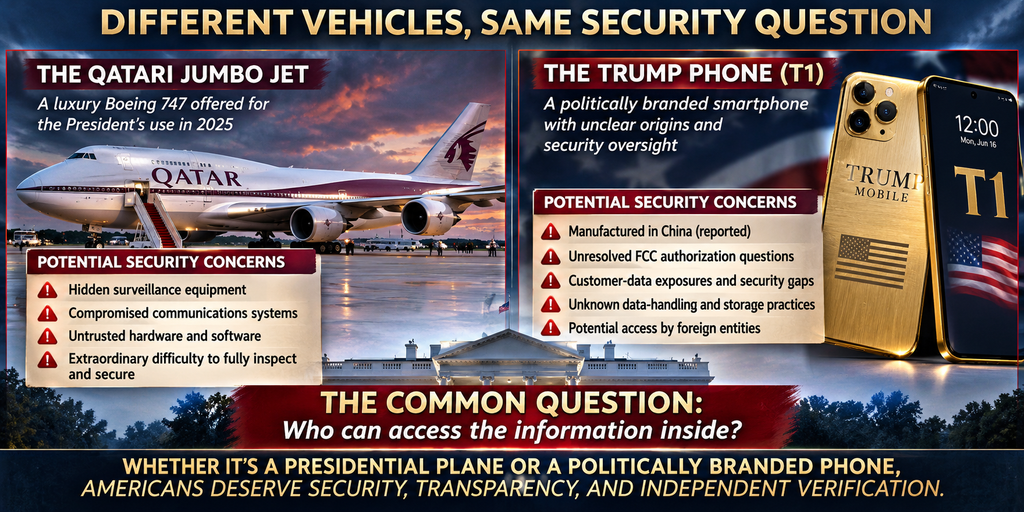
The proposed use of a Qatari-provided Boeing 747-8 as a presidential aircraft raised concerns about the extraordinary counterintelligence inspection and modification such an aircraft would require.
Likewise, controversies surrounding access to sensitive federal databases during the Department of Government Efficiency initiative illustrated why the identity, authority, and oversight of those controlling information systems matter. I suspect Elon knows as much about you as your mother does now.
Yes, situations differ, yet each returns us to a common question:
Who has access, and how do we independently verify the safeguards?
And, dear reader, there’s one small coincidence I can’t quite bring myself to overlook: in Terminator 3, the T-1 was an early autonomous killing machine. Now we have the Trump T1, a phone surrounded by unanswered security questions.
I’m sure it’s just a coincidence.
Although I do wonder whether Pete Hegseth was consulted on the name.
We have no evidence that the Trump T1 has been compromised—or has Gatling guns. Nor are we suggesting that it has.
Nevertheless, the documented history of weaponized communications technology gives consumers ample reason to remain vigilant.
The consumer sees the brand on the outside. What matters for security is who controls what’s inside.
The irony is that the fundamental problem of trusting a seller’s promises is much older than smartphones, cybersecurity, or telecommunications regulation.
It reaches back to the American frontier.
From Soapy Smith to the Smartphone
More than a century ago, Jefferson Randolph “Soapy” Smith made a career of separating customers from their money through the theatrical promise of something more valuable than what they were actually buying.
Smith became notorious for confidence schemes involving bars of soap, supposed prizes, and carefully managed expectations.
His activities took him into the world of the Klondike Gold Rush, where prospectors, merchants, and opportunists converged in pursuit of fortune.
Friedrich Trump, Donald Trump’s grandfather, was also part of that commercial world, operating businesses that served prospectors along the routes toward the goldfields.
Friedrich Trump and the infamous Soapy Smith were contemporaries in the Klondike Gold Rush. Given Smith’s notoriety among the prospectors and merchants of that era, it is difficult to imagine Friedrich Trump was unaware of him.
That is a historical inference, not evidence that the two men met, collaborated, or engaged in the same activities.
The technology has changed considerably since Smith worked the crowds of the American West.
The underlying principles of deceptive marketing have not.
Trump Mobile advertised an American-made smartphone at $499, invited customers to secure promotional pricing with a $100 deposit, and subsequently revised its contractual terms to disclaim any guarantee of the advertised price or even the eventual availability of the device.
By September 2026, the advertised price had risen to $749.
The original promise had attracted the customer.
The contractual language preserved the seller’s options.
As a marketing professional, I recognize this pattern as bearing the hallmarks of bait-and-switch advertising. Whether it constitutes an actionable violation is a matter for regulators and courts, but the contradiction between the promotional message and the company’s reserved contractual rights is visible in the record.
Soapy Smith sold 5 cent bars of soap for five dollars; with a promise you could “wash your sins away.” Trump Mobile sold two-year-old gold-painted Taiwanese cellphones, with the promise of “Made in the USA,” and a “price lock.”
The question becomes, what did customers actually receive for their money? Or, how badly were they gouged?
November 2026: The Phone Has Arrived. The Answers Have Not.
As this investigation reaches November 2026, Trump Mobile is no longer merely a story about a promised smartphone that failed to appear on schedule.
Phones have reached at least some customers and reviewers.
Independent technical examinations have raised substantial questions about the handset’s origins, which have now been proven to be from Taiwan, via China.
The advertised (and originally promised/locked-in) price has climbed from $499 to $749, a whopping 50% increase in less than a year.
The company faces congressional questions about consumer protection, telecommunications compliance, corporate relationships, and the security of customers’ personal information.
And the most consequential financial questions remain unresolved.
How many customers actually paid $100 deposits?
How much money was collected?
Who controlled those funds?
Were they held in dedicated accounts, used as operating capital, or transferred to affiliated entities?
Who benefited financially during the months customers waited?
How much licensing revenue, if any, was generated from the preorder program?
And I should mention that it has crossed this authors mind that those initial $100 deposits may have financed the entire operation. Imagine, if you will, what I have after gobs and bunches of research into this investigation; that is, what if the 2024 model phone could be liquid purchased in 2026 for $80 per unit. This would be quite reasonable if the lot were classified as “distressed inventory.” If that was the negotiated unit price, they would have not had to put any of their own money at risk. Think of a pre-paid t-shirt print-on-demand service. I do like that example. I hope that you, my reader gets it.
And if refunds become necessary, which company has both the legal responsibility and the financial resources to honor them?
These are all very important questions that could be addressed through corporate records, banking documentation, payment-processing records, licensing agreements, and testimony from the people responsible for operating the business.
The answers should not depend on speculation about a gold-colored telephone.
They should depend on evidence.
The FTC has authority to investigate deceptive marketing practices. Telecommunications regulators can examine compliance and consumer protections. Congressional investigators can pursue relevant records through their oversight processes and the power of subpoena.
Customers, meanwhile, deserve accurate information about what they purchased, the terms governing their deposits, and the company responsible for fulfilling those terms.
This investigation does not establish that Trump Mobile is operating a fraudulent deposit scheme, secretly invested customers’ funds, or planning to abandon its customer obligations through bankruptcy.
What it establishes is a documented pattern of changing promotional representations, broken promises, delayed fulfillment, revised contractual protections, a substantial advertised price increase, and significant unanswered questions about the business behind the brand.
Those findings warrant scrutiny on their own.
Because the essential question is not whether the Trump name can sell a phone.
It plainly can.
The question is whether the companies benefiting from that name can demonstrate that the promises used to obtain customers’ money were honored, despite evidence they were not, and that the financial obligations created by those promises remain enforceable.
November 10, 2026 | Trumportunity Investigative Report
What happens when the president sues his own government—and his former personal defense attorney signs the agreement on behalf of the government?
That is the question at the center of the Trump–IRS settlement. Subsequent attempts to narrow the agreement have not resolved the fundamental question of whether Acting Attorney General Todd Blanche possessed the legal authority to enter it.
But the story begins more than fifty years earlier.
1. The Cohn Playbook: From Counterattack to Switcheroo
In 1973, the Justice Department sued Donald Trump, his father, and their real estate company for racial discrimination in housing. Trump hired Roy Cohn, who famously represented Mafia bosses and an infamous pedophile Cardinal; Cohn counterattacked the US Government with a $100 million claim against the federal government.
The counterclaim was dismissed. The underlying discrimination case ended in a 1975 consent decree without an admission of liability.
The lesson of Cohn’s approach was unmistakable: when challenged through the courts, turn the litigation against the challenger.
More than half a century later, the strategy presents a remarkable variation.
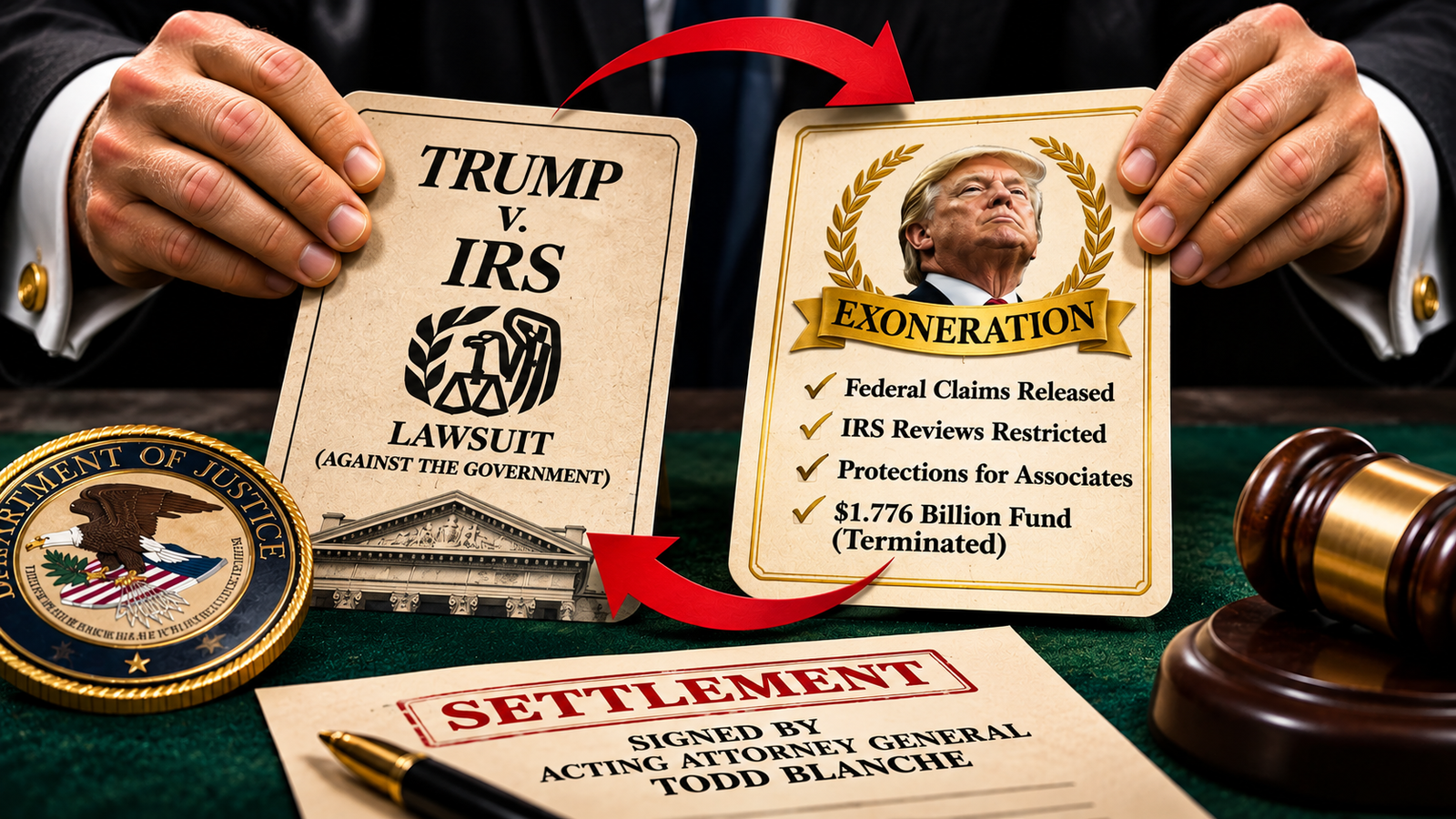
The switcheroo: Trump sues federal agencies he oversees as president. The Justice Department is responsible for defending federal interests. Yet the official signing the agreement for the government is Todd Blanche—Trump’s former personal criminal-defense attorney.
The old strategy was to counterattack the government. The new strategy is the “switcheroo:” turning the government’s own legal machinery into a means of securing protections for the president.
The frivolous IRS lawsuit provided a procedural vehicle for granting protections that the executive branch could not lawfully grant independently.
Rather than attempting to issue a presidential self-pardon, Trump pursued a settlement through litigation against agencies within his own administration, with his former personal attorney acting for the government. Essentially what Trump and Blanche are trying to impose is a civil-liability equivalent of a self-pardon.
That possibility lies at the heart of this investigation.
2. The Conflict: From Personal Attorney to Government Signatory
In May 2026, Acting Attorney General Todd Blanche signed an agreement resolving President Trump’s lawsuit against the Internal Revenue Service.
The agreement included sweeping language, concerning federal claims, audits, and protections involving Trump, other plaintiffs, and associated individuals or entities. The outlined protections for the Trump family and regime were the pork that came with dismissing the claim against the IRS. The claim was likely just a way to get Blanche involved in the shenanigan.
It also formed part of an arrangement involving a proposed $1.776 billion Anti-Weaponization Fund, intended for individuals claiming harm from government investigations. There were legit concerns that the fund would be used to enrichen pardoned January 6 rioters.
Blanche was no ordinary government lawyer. He had represented Trump personally in federal criminal proceedings.
That relationship raises an unavoidable question:
Who was protecting the federal government’s interests when its chief legal officer had previously represented the person receiving the protections?
3. The Warning: Blanche Had Been Told to Recuse
On May 14, CNN reported that Joseph Tirrell, then a senior Justice Department ethics official, had advised Blanche in March 2025 that he needed to recuse himself from legal cases involving Trump personally.
Blanche had also signed an ethics pledge restricting his participation in matters involving former clients.
During his February 2025 confirmation hearing, Blanche promised Senator Adam Schiff that he would follow the department’s ethics experts regarding recusal.
On May 19, Senators Schiff, Dick Durbin, and Richard Blumenthal sought records concerning Blanche’s recusal obligations, including his participation in lawsuits where Trump sought personal financial compensation from the government.
The Justice Department maintained that Blanche was complying with his ethical obligations.
But the essential question remains unanswered in the records examined here:
Did Blanche receive specific authorization to participate in the Trump–IRS settlement? If so, who granted it, when, and under what authority?
4. The Judge: If You Can’t Win in Court, Go After the Judge
On July 13, U.S. District Judge Kathleen Williams found that the Trump–IRS litigation had improperly used the judicial process to pursue benefits unavailable through genuinely adverse litigation.
She imposed sanctions and referred attorneys’ conduct to professional disciplinary authorities.
Trump’s attorneys challenged the ruling (creating another Gapportunity™), arguing that the court exceeded its authority and denied appropriate procedural protections.
On September 29, the Eleventh Circuit declined to stay the sanctions order. That decision did not finally resolve the appeal.
Then came another familiar turn.
On October 22, Republican Representatives Jim Jordan and Darrell Issa called for the Judicial Conference to examine Judge Williams’s conduct, alleging judicial partiality and procedural irregularities.
Their objections may be examined on their merits. The request does not itself establish improper retaliation.
Nevertheless, the sequence recalls a recurring motif in Trump’s litigation history: when a judge challenges the conduct, the judge becomes the subject of a challenge.
The tactic was captured in James D. Zirin’s 2025 commentary on Trump’s approach to unfavorable judicial proceedings: If you can’t win in court, threaten the judge.
Here, the original scrutiny concerned the government’s agreement with the president. The subsequent congressional scrutiny concerned the judge who questioned the arrangement.
That reversal deserves public attention.
5. The Revision: “Settlement Lite,” but by Whose Authority?
By August, the settlement had generated objections from both Democrats and Republicans.
Republican Senators John Cornyn and Thom Tillis demanded written limitations before supporting Blanche’s nomination as attorney general.
On August 3, they announced that the Justice Department had issued a formal order terminating the Anti-Weaponization Fund and a binding written clarification limiting the tax settlement to the plaintiffs and the IRS and Treasury as defendants.
The senators then expressed their willingness to advance Blanche’s nomination.
Call it Settlement Lite: the original arrangement, narrowed after political and legal objections.
But why was the administration willing to retreat from protections it had already agreed to grant?
Did Blanche and the administration recognize that the original settlement was a legal house of cards?
The August revision raises that possibility. What had been presented as an extraordinary legal settlement was subsequently narrowed under political pressure. The administration’s willingness to restrict its own agreement invites scrutiny of how defensible the original arrangement was in the first place.
And narrowing the agreement does not necessarily make it lawful.
A house of cards does not become structurally sound simply because someone removes a few cards.
The August action raises questions of its own.
Who authorized the clarification? Did it amend the original agreement or merely interpret it? What protections remain questionably enforceable? And did Blanche’s potential recusal conflict extend to the subsequent order?
This may be the crux of the entire matter.
A century-old Supreme Court decision, United States v. Beebe, 180 U.S. 343 (1901), illustrates that unauthorized compromises of government claims can be challenged. The Court did not automatically invalidate every such agreement, and Beebe does not establish that Blanche’s settlement is void.
But the principle warrants examination: the government’s authority to compromise its claims cannot simply be assumed because a senior official signed an agreement.
Nor does a later clarification necessarily cure a defect in the original signatory’s authority.
The fundamental question remains unanswered: If Blanche lacked the authority to enter the original settlement, what authority did the administration possess to salvage it?
6. The Accountability Question
Congress has ample reason to investigate both the original settlement and its subsequent revision.
Four questions require documentary answers:
What recusal instructions, ethics restrictions, and authorizations applied to Blanche when he signed the May agreement?
What statutory or delegated authority permitted DOJ to release or restrict federal claims and tax-related liabilities involving Trump and associated parties?
What precisely changed in August, who authorized those changes, and what legal protections are still on the table under examination?
What judicial or congressional remedies are available if either agreement exceeded lawful authority?
Congress should obtain the complete May settlement, Blanche’s signed implementation document, the August orders, relevant ethics records, and the legal opinions supporting both actions.
Depending on what those records establish, lawmakers could examine disciplinary referrals, challenges to the agreement’s enforceability, or impeachment proceedings. None follows automatically from an apparent conflict.
The issue is not whether a president may sue the government. Nor is it whether the Justice Department may settle legitimate litigation.
The issue is whether federal settlement authority was used to provide benefits to a president through an agreement signed by his former personal attorney, despite a reported recusal warning.
The larger pattern is troubling: litigation against the government, a change in who controls the government’s defense, extraordinary settlement provisions, judicial intervention, attacks on the judge’s conduct, and a subsequent agreement narrowing the original protections.
Each development has its own legal explanation and contested facts. Together, they present a mechanism Congress cannot responsibly ignore.
The August clarification may have narrowed the agreement. It has not, on the evidence examined here, answered the question of Blanche’s authority.
If Todd Blanche was prohibited from participating in a matter involving his former client, why should the American public be bound by the agreement he signed in service to him?
The president now holds tens of millions in pharmaceutical stocks. His administration makes decisions affecting the companies behind those stocks. Meanwhile, Americans face the possibility of paying thousands more for medicines they cannot live without.
There is something profoundly disturbing about a government that can protect a drug company’s profits while leaving a patient struggling to afford the treatment that keeps them alive.
For that patient, a prescription is not an investment opportunity. It is not a quarterly earnings report. It is not a bargaining chip in a trade negotiation.
It may be the difference between life and death.
Yet President Donald Trump’s financial disclosures reveal extensive investments in pharmaceutical companies whose revenues, costs, and competitive positions can be directly affected by decisions made in Washington.
The timing deserves scrutiny.
In 2025, Trump signed legislation expanding an exemption from Medicare drug-price negotiations for certain expensive medicines. His administration simultaneously negotiated pharmaceutical pricing agreements that offered drugmakers substantial regulatory and tariff concessions.
Throughout this period, Trump’s investment portfolio accumulated pharmaceutical stocks.
The question is no longer simply what the president owns. It is what happens when the president exercises governmental authority over industries in which he has substantial financial interests.
The $56 Million Pharmaceutical Portfolio
On October 16, 2026, Democratic staff of Congress’s Joint Economic Committee released an analysis of Trump’s financial disclosures.
Their findings were extraordinary.
According to the committee, the maximum disclosed value of Trump’s pharmaceutical holdings increased from approximately $1.7 million in 2024 to $56.2 million in 2025.
As much as $39.1 million was held in companies identified by the committee as beneficiaries of changes to Medicare drug-price negotiations.
These are upper-bound estimates based on financial disclosure ranges, not exact portfolio valuations or realized investment profits. Nevertheless, they establish the magnitude of the financial interests involved.
The committee also found that pharmaceutical companies benefiting from the legislative exemption reported at least $54 billion in 2025 U.S. sales of affected medicines.
These figures demand more than a passing acknowledgment. They demand examination of the relationship between presidential power, corporate financial interests, and public health.
July 2025: The Orphan Cures Act
The pivotal legislative development occurred during the passage of the 2025 federal tax and spending legislation.
On July 1, the Senate passed legislation containing the Orphan Cures Act provision.
Three days later, on July 4, President Trump signed the legislation into law.
The provision expanded an existing exception to Medicare’s drug-price negotiation program for certain medications developed to treat rare diseases.
Previously, the exception was narrower. The revised provision allowed qualifying medicines approved for multiple rare diseases to remain outside the negotiation program under conditions established by the legislation.
Supporters argued that the change would encourage pharmaceutical research into rare diseases.
But the exemption also provided a significant financial benefit to manufacturers of certain costly medicines, including products already generating substantial revenue.
And the Trump portfolio has been very busy buying pharmaceutical stocks, very busy.
According to reporting based on the congressional analysis, Trump’s investments included as much as $950,000 in pharmaceutical-stock purchases on July 1, 2025, the same day the Senate passed the legislation.
Across three dates preceding Trump’s signature, the reported purchases reached as much as $2.55 million.
The precise time of the July 1 transactions relative to the Senate vote has not been established. The purchases therefore do not prove advance knowledge or improper trading.
But the coincidence of dates is plainly relevant to an investigation of presidential financial interests.
The president signed legislation benefiting an industry in which his portfolio was accumulating substantial investments.
That is a documented intersection of private financial exposure and public authority.
Who Pays for the Exemption?
The consequences of Medicare’s inability to negotiate certain drug prices are not abstract.
The Joint Economic Committee’s Democratic staff estimated that the expanded exemption could increase annual out-of-pocket costs for some Medicare beneficiaries by thousands of dollars compared with a scenario in which Medicare negotiated the affected drug prices.
Among its estimates:
Ultomiris: approximately $21,800 more for certain patients.
Adcetris: approximately $9,000 more.
Keytruda: approximately $5,200 more.
These are modeled increases, not verified bills already paid by every patient taking these medications. Actual costs depend on coverage, eligibility, treatment, and Medicare’s benefit rules.
But the underlying issue is unmistakable: preventing Medicare from negotiating a lower price can preserve pharmaceutical revenue while limiting potential savings for patients and taxpayers.
Consider what that means for someone confronting cancer.
A diagnosis can already destroy a family’s financial security. Treatment may require months or years of appointments, travel, missed employment, and mounting expenses.
The patient does not get to negotiate the price of survival.
The manufacturer, however, may receive protection from federal price negotiations.
And the president whose signature helped establish that protection owns investments in companies operating within the affected industry.
Whose financial security is the government protecting?
The 2026 Trading Record: The Buying Continued
The purchases did not end with the 2025 legislation.
Trump’s official OGE Form 278-T, received in May 2026, contains hundreds of transactions from the first quarter of 2026.
The report identifies purchases involving Eli Lilly, Pfizer, AbbVie, Merck, Johnson & Johnson, Bristol Myers Squibb, and other pharmaceutical and healthcare companies.
Among the directly documented transactions:
Company
Purchase date
Disclosed transaction range
Bristol Myers Squibb
January 8, 2026
$100,001–$250,000
Eli Lilly
March 2, 2026
$100,001–$250,000
Abbott Laboratories
February 24, 2026
$100,001–$250,000
Abbott Laboratories
March 18, 2026
$100,001–$250,000
Zoetis
January 12, 2026
$250,001–$500,000
Source: Donald J. Trump, OGE Form 278-T, May 2026, transaction entries 265, 180, 168, 174, and 87, respectively.
The filing contains additional pharmaceutical transactions, including repeated purchases across multiple companies and dates.
This is not merely a record of an inherited stock portfolio sitting untouched while its owner holds public office.
It is a record of active securities transactions during the presidency.
The disclosures identify the transactions, their dates, and their value ranges. They do not establish who selected each investment or whether the president personally directed any trade.
But they do establish something fundamental: the president continued to have financial exposure to an industry subject to decisions by his own administration.
Pfizer: Drug Pricing, Tariffs, and Presidential Power
On September 30, 2025, the Trump administration announced a pharmaceutical pricing agreement with Pfizer.
The White House presented the agreement as an initiative to reduce American prescription-drug prices by linking certain prices to those paid in other developed countries.
But the arrangement also involved concessions to Pfizer.
The company subsequently disclosed that the agreement provided a three-year period of protection from certain pharmaceutical tariffs, conditioned on additional domestic manufacturing investment.
Tariff relief has financial value.
It can reduce business costs, protect margins, and provide greater certainty for investment decisions.
That does not mean the agreement lacked benefits for patients. Some provisions were intended to produce lower prices, particularly through Medicaid arrangements.
The important question is whether the benefits claimed for patients justify the concessions granted to manufacturers—and whether the complete terms allow independent verification.
The publicly disclosed financial arrangements have not always provided the transparency necessary to answer that question.
Documents obtained through public-records requests subsequently exposed additional provisions in pharmaceutical agreements involving Pfizer and Eli Lilly. Significant portions remained redacted.
The public was being asked to accept claims of lower prices without access to all the information necessary to measure the agreements’ full financial consequences.
Meanwhile, Trump’s portfolio contained investments in major pharmaceutical companies, including Pfizer.
The currently examined transaction records establish Pfizer purchases in 2026. They do not yet establish the precise size of his Pfizer holdings on September 30, 2025.
That distinction matters.
But so does the larger question:
Why should the public have to reconstruct the president’s financial exposure from scattered disclosure reports while his administration negotiates arrangements worth potentially billions to the pharmaceutical industry?
Eli Lilly: A Company at the Intersection of Pricing Policy and Investment
Eli Lilly provides another example of the overlap between federal pharmaceutical policy and presidential investments.
The company entered a drug-pricing arrangement with the Trump administration in November 2025.
A subsequent definitive agreement was dated February 23, 2026.
Trump’s financial disclosure identifies a purchase of Eli Lilly shares on March 2, 2026, valued between $100,001 and $250,000.
Additional Lilly transactions appear in the same filing.
The agreements involved efforts to align certain American drug prices with international benchmarks, alongside negotiated terms affecting participating manufacturers.
The policy cannot be assessed simply by accepting the administration’s description of its objectives.
It must be examined through the actual terms: which drugs qualify, which patients receive discounts, what concessions manufacturers obtain, and how much money patients ultimately save.
A discount advertised in a presidential announcement is not the same thing as affordable access to treatment.
And a pharmaceutical agreement that benefits some patients does not automatically eliminate concerns about financial conflicts.
The Human Cost Is Not a Footnote
There is a tendency in financial investigations to let the numbers overwhelm the people.
Millions in stock purchases. Billions in pharmaceutical revenue. Percentages of market movement. Negotiated exemptions. Regulatory concessions.
But these figures represent decisions with consequences in hospitals, pharmacies, nursing homes, and family kitchens across America.
A patient who cannot afford a necessary medication may delay treatment, reduce doses, skip prescriptions, or abandon treatment altogether.
Depending on the disease and medication, the consequences can be devastating.
The financial interests of drug manufacturers and shareholders are measurable. The suffering of patients denied affordable treatment is harder to calculate.
That does not make it less real.
Nor does it make it less deserving of governmental attention.
When government policy protects pharmaceutical revenue, potentially at the expense of patient savings, the public has every right to ask who is being protected—and why.
When the president also holds investments in the affected industry, that question becomes more urgent.
The Conflict That Financial Disclosures Cannot Resolve
The White House has stated that Trump’s securities portfolio is managed by independent financial institutions and that neither Trump nor his family directs the transactions.
That assertion addresses who makes the trades.
It does not, by itself, resolve the broader concern about a president maintaining financial interests in companies affected by presidential decisions.
A financial conflict does not disappear simply because someone else presses the purchase button.
The relevant questions include whether the president benefits financially from corporate performance, whether the public can evaluate the government’s decisions independently, and whether adequate safeguards prevent private financial interests from compromising public responsibilities.
The available evidence does not establish that Trump directed pharmaceutical trades using confidential information. Nor does it prove that a particular drug-pricing decision was made to increase his personal wealth.
Those are questions for further investigation, not findings this report can honestly claim.
But the documented overlap is substantial.
The portfolio expanded dramatically. Purchases continued. The administration made consequential pharmaceutical policy decisions. Some of those decisions provided identifiable financial benefits to manufacturers in the sector.
The public deserves an accounting of those intersections.
Follow the Money. Then Follow the Medicine.
The pharmaceutical investigation reveals a troubling convergence of financial ownership and executive authority.
The president’s portfolio accumulated substantial investments in drug manufacturers.
His administration negotiated arrangements affecting those manufacturers’ prices, tariffs, and market conditions.
He signed legislation expanding an exemption from Medicare drug-price negotiations.
And congressional analysts have warned that the exemption could leave some patients paying thousands more for essential treatments.
No single stock transaction proves corruption. No single presidential agreement proves that patients were sacrificed for investment returns.
But the accumulation of documented facts makes the need for scrutiny impossible to dismiss.
The public deserves to know the complete terms of pharmaceutical agreements, the extent of the president’s financial exposure when consequential decisions were made, and the actual effects of those decisions on patients’ costs.
Above all, Americans deserve a government that treats access to lifesaving medicine as a public responsibility—not merely another variable in the financial performance of an industry.
When the president owns shares in the companies whose profits his administration can influence, whose interests are being served—and who bears the cost?
For shareholders, the answer may be measured in dollars.
For patients, it may be measured in years of life.
And that is why these transactions deserve investigation, public disclosure, and accountability.
Sources and evidentiary record
U.S. Office of Government Ethics, Donald J. Trump, Periodic Transaction Report, OGE Form 278-T, May 2026, 113 pages. Original financial disclosure supplied and examined for this investigation.
U.S. Congress, Joint Economic Committee, Democratic staff, October 16, 2026, analysis of Trump’s pharmaceutical holdings and the projected consequences of the Orphan Cures Act exemption.
Associated Press, October 2026, reporting on the congressional analysis and Trump’s pharmaceutical investments.
Public Law 119-21, July 4, 2025, §71203, Orphan Cures Act provision.
The White House, September 30, 2025, fact sheet announcing the Pfizer most-favored-nation pricing agreement.
Pfizer, 2026 annual reporting, discussion of the September 2025 administration agreement and conditional tariff relief.
Public Citizen, documents obtained under the Freedom of Information Act concerning the Pfizer and Eli Lilly pharmaceutical pricing agreements.
Health Affairs, analysis of the Trump administration’s pharmaceutical pricing agreements and their policy implications.
When presidential financial interests intersect with presidential decisions, the chronology matters.
President Donald Trump’s investment accounts have been buying and selling energy stocks while his administration makes decisions that move energy markets, opens foreign oil reserves, and directs hundreds of millions of dollars in federal financing.
Three Trump Investment cases illustrate the concern: an ExxonMobil sale before an Iran ceasefire announcement, multimillion-dollar oil-stock purchases before a Venezuela agreement, and a Trump-family-linked investment that preceded extraordinary federal financing.
The evidence raises a fundamental question: How can the public distinguish national policy made in the public interest from decisions that also benefit the president’s private financial interests?
1. ExxonMobil: The Sale Before the Ceasefire
On April 7, 2026, an investment account disclosed by President Trump sold between $500,000 and $1 million in ExxonMobil shares.
That evening, Trump announced a two-week ceasefire in the war with Iran.
ExxonMobil closed April 7 at $163.91 per share. On April 8, following the announcement, the stock opened at $153.52—a decline of approximately 6.34%.
That opening decline erased an estimated $43.1 billion in ExxonMobil’s stock-market capitalization, based on approximately 4.145 billion shares outstanding. This was a decline in shareholder market value, not a realized operating loss for ExxonMobil.
The sequence is documented:
April 7: Trump’s investment account sells ExxonMobil shares.
April 7, evening: Trump announces the Iran ceasefire.
April 8: ExxonMobil opens sharply lower, losing approximately $43.1 billion in market capitalization at the opening bell.
Selling before a decline avoids the loss that would have occurred on those shares had they been retained through the opening price the following morning.
The president’s account sold before an announcement that preceded a roughly $43 billion decline in the company’s market valuation at the following day’s opening bell.
Thus, for the American polity, a central conflict remains: the president exercises extraordinary authority over events that can dramatically affect the market value of securities held or traded for in his name, and to his benefit.
2. Venezuela: Millions Invested Before the Oil Agreement
On January 9, 2026, President Trump assembled oil executives at the White House to discuss American investment in Venezuela.
ExxonMobil Chairman and CEO Darren Woods raised serious objections to the country’s existing investment conditions. ExxonMobil had already experienced two seizures of its Venezuelan assets.
Woods explained:
“If we look at the legal and commercial constructs—frameworks—in place today in Venezuela, today it’s uninvestable.”
He called for substantial changes to Venezuela’s legal and commercial framework, including durable protections for investors and changes to the country’s hydrocarbon laws.
These were not casual objections. They were the stated conditions under which ExxonMobil would consider returning to a country where it had already suffered substantial losses.
Two days later, on January 11, President Trump publicly threatened to exclude ExxonMobil from his Venezuela plans.
Speaking to reporters aboard Air Force One, Trump said:
“I’d probably be inclined to keep Exxon out. I didn’t like their response.”
He also accused the company of playing “too cute.”
This is significant evidence of Trump’s expressed intent toward ExxonMobil.
The president was not merely discussing national energy policy. He publicly indicated that a company’s response to his initiative could influence whether it would be permitted to participate.
Was access to Venezuela’s (stolen) oil opportunities being conditioned, at least in part, on satisfying the president personally?
Trump’s own words make that a legitimate investigative question.
The January exchange does not establish that ExxonMobil was subsequently excluded, or that the confrontation determined which companies received later agreements. But it establishes that Trump publicly contemplated exclusion because he disliked a company’s response.
That history becomes particularly relevant when examining the president’s subsequent investments in other oil companies.
August: Trump’s Oil Investments Precede His Venezuela Agreement
On August 21, 2026, Trump’s disclosed investment accounts purchased between $1 million and $5 million each in Chevron and ConocoPhillips stock.
An additional Chevron purchase of $15,001 to $50,000 followed on August 26.
On August 28, Trump announced a major oil agreement with Venezuela.
Five days later, on September 2, the Department of Energy announced new agreements involving Chevron, Eni, and GE Vernova.
Chevron’s agreements contemplated more than $7 billion in investment over five years, expanded development rights, and substantially increased Venezuelan oil production.
The chronology:
January 9: ExxonMobil’s CEO publicly challenges the investment conditions in Venezuela.
January 11: Trump threatens to exclude ExxonMobil because he disliked its response.
August 21: Trump’s Chevron and ConocoPhillips purchases totaling between $2 million and $10 million.
August 26: Additional Chevron purchase.
August 28: Trump announces the Venezuela oil agreement.
September 2: The administration announces expanded Chevron operations and investment plans.
October 8: Trump’s August 21 Chevron and ConocoPhillips stock purchases are finally publicly disclosed—48 days after the transactions and 41 days after his August 28 Venezuela oil agreement announcement.
Chevron’s September agreements are distinct from the August 28 binational agreement, but the administration expressly described them as building upon it.
Nor does the evidence establish that ConocoPhillips received equivalent benefits from those agreements.
The Chevron connection is nevertheless direct: a company whose shares (up to $10,000,000) had recently been purchased for Donald Trump’s account subsequently received expanded commercial opportunities under an administration-led energy initiative.
The August 21 purchases were not publicly disclosed until October 8—48 days after the transactions and 41 days after Trump’s announcement!
That delay certainly matters. The public learned about the president’s financial position only after the consequential Trump government decisions had already been announced.
And now we have another question.
Did Trump’s publicly expressed hostility toward ExxonMobil influence the administration’s subsequent treatment of competing oil companies—including Chevron, in which his investment accounts had acquired millions of dollars in shares?
The evidence does not establish that connection. But Trump’s January statements provide a documented reason to investigate it.
3. Vulcan Elements: A Family Investment and a $620 Million Federal Loan
The third case involves Donald Trump Jr., the investment firm 1789 Capital, and Vulcan Elements, a manufacturer of rare-earth magnets.
In August 2025, Vulcan announced a financing round that included an investment by 1789 Capital, where Trump Jr. is a partner. The size of the firm’s ownership interest was not publicly disclosed.
In November 2025, the Pentagon announced plans for a $620 million loan to Vulcan Elements, accompanied by additional financing and incentives involving its partner and the Commerce Department.
In May 2026, ProPublica reported that White House adviser Peter Navarro had initiated the request for Vulcan’s financing and that Pentagon personnel were directed to process it at an unusually rapid pace.
The financial implications were substantial! ProPublica reported estimates suggesting that Vulcan’s valuation increased from approximately $200 million around the period of 1789 Capital’s (Donald Trump Jr.) investment to roughly $2 billion after the federal deal was announced.
That is an estimated valuation increase, not proof of a realized profit for Trump Jr. or 1789 Capital. Good Luck finding transparency and accountability here, folks.
Trump Jr.’s representatives denied that he intervened in the financing decision. The firm also denied involvement in securing the loan, and the Pentagon denied preferential treatment.
Nevertheless, the documented sequence presents a serious public-interest question:
Why was a company backed by the president’s son’s investment firm singled out for White House-initiated, accelerated federal financing?
The Recurring Mechanism
These cases are not identical, and the distinctions are important.
In the ExxonMobil case, a sale preceded a presidential announcement and a subsequent market decline—an estimated $43.1 billion in market capitalization at the opening bell.
In Venezuela, purchases preceded a presidential agreement and expanded commercial opportunities for one of the companies involved. The Public notices of Trump’s up to $10 million stock investment in Chevron were filed 1.5 months after the Presidential action of consequence. This kept the public from knowing about this scandalous behavior until well after the deed was complete. How very Trump Extraction/Gapportunistic of them.
And the Venezuela story now contains another documented element: months before those transactions, Trump publicly threatened to exclude ExxonMobil because he disliked its CEO’s response.
In the Vulcan Elements case, a Trump-family-linked investment preceded a major federal financing commitment initiated through the White House.
Together, they reveal three points where presidential power and private financial interests intersect:
Financial position. Government decision. Economic consequence.
The existence of that sequence does not, by itself, establish criminal conduct, insider trading, or improper direction of investment accounts.
But neither do claims of using “outside investment managers” eliminate the underlying conflict of interest. The president still exercises authority over policies that assuredly affect the value of his holdings.
The American public should not have to wait weeks and months to discover that the president held substantial financial interests in companies affected by his own administration’s decisions.
And when federal financing benefits companies connected to the president’s family, the public deserves a transparent account of how those decisions were initiated, evaluated, approved, and funded.
The question is not merely whether the transactions were legal. It is whether the presidency is being exercised with sufficient independence from the private fortunes of the family occupying the White House.
That is the pattern worth investigating.
Sources
CBS News, Kathryn Watson, Trump’s Oil and Gas Stock Trades Continued During Iran War, Filings Show, August 29, 2026.
Donald Trump, statement announcing a two-week Iran ceasefire, April 7, 2026, reproduced by the American Presidency Project.
ExxonMobil, Our Perspective Regarding the Situation in Venezuela as Shared with President Trump, January 9, 2026.
Associated Press, Trump ‘Inclined’ to Keep ExxonMobil Out of Venezuela After CEO’s Skeptical Response at White House Meeting, January 12, 2026.
Yahoo Finance, ExxonMobil (XOM) historical share prices, April 7–8, 2026.
ExxonMobil, quarterly SEC filing for March 31, 2026, shares outstanding.
Capitol Markets, Trump’s August Stock Trades Reached the Public in October, October 2026, drawing on Office of Government Ethics Form 278-T disclosures.
U.S. Department of Energy, Delivering on President Trump’s Promise to Unleash Prosperity and Security for the United States and Venezuela, September 2, 2026.
ProPublica, Robert Faturechi, The White House Intervened to Get a $620 Million Deal for a Company Tied to Donald Trump Jr., May 28, 2026.
October 21, 2026 | Trumportunity — Close of the Age
Freedom 250 was a central subject of my investigative report, The Trump Extraction: An Investigative Triptych, published September 11, 2026.
My research documented how the Trump administration established a parallel celebration initiative alongside the congressionally authorized America250 effort, redirected federal resources toward Freedom 250, and accelerated contracting and administrative approvals while the National Park Service faced substantial staffing and project backlogs, due to Trump and DOGE firings and buyouts.
Among the findings were a $150 million federal allocation divided between America250 ($50 million) and Freedom 250 ($100 million), the National Park Foundation’s involvement in managing public resources, and millions in federal contracts connected to the celebrations. There was an additional $150 million allocated for the Freedom 250; buried with the other pork and gravy in the One Big, Beautiful Bill. Where is that second $150 million today? How was it dispersed? At the time of this posting, the requisite paperwork is not in order.
The central question was not simply how much the festivities cost. It was how public authority, taxpayer resources, private organizations, and federal contracting became interconnected.
Now, newly released records raise another question: Where did the private money go?
July 2026: Allegations of Donor Deception and Potential Wire Fraud
On July 2, Democrats on the House Natural Resources Committee released findings alleging that donors intending to contribute to America250 were instead directed to Freedom 250.
According to the congressional investigation, which drew upon whistleblower interviews and documents, prospective donors were allegedly provided banking and routing information for Freedom 250 rather than the congressionally authorized initiative they intended to support.
The allegations raise a potentially serious question under federal criminal law.
Under 18 U.S.C. § 1343, federal wire fraud generally involves a scheme to obtain money or property through material deception, intentional fraud, and the use of interstate electronic communications to advance that scheme.
Simply encouraging donors to support Freedom 250 instead of America250 would not, by itself, constitute wire fraud.
However, knowingly misleading donors about the identity of the recipient, and using electronic communications or wire transfers to obtain their money through that deception, could potentially satisfy the elements of the offense.
The distinction is critical.
If donors believed they were contributing to America250 but were deliberately induced to send money to Freedom 250 through false representations, the transaction could involve more than political fundraising. It could constitute federal wire fraud.
Freedom 250 has denied the allegations. No criminal violation is established by the congressional report, and determining whether fraud occurred requires examination of the actual communications, donor intentions, financial transfers, and evidence of fraudulent intent.
Nevertheless, the allegations introduce a significant new dimension to the financial relationships examined in The Trump Extraction.
September 2026: Congress Demands an Accounting
On September 14, Senators Adam Schiff, Elizabeth Warren, Alex Padilla, and Richard Blumenthal demanded disclosure of Freedom 250’s corporate donations, expenditures, and potential conflicts of interest.
Their inquiry followed reports that Freedom 250 had received more than $50 million from over 20 corporate sponsors, including companies with substantial interests before the federal government.
The senators sought identification of donors, contribution amounts, expenditure records, remaining assets, and information concerning possible preferential treatment.
The financial relationships warrant scrutiny, although corporate donations and government contracts do not, by themselves, establish improper influence.
October 2026: The Financial Picture Becomes More Complicated
On October 8, Public Employees for Environmental Responsibility (PEER) released documents obtained through the Freedom of Information Act.
A National Park Foundation budget estimate identified:
$128.5 million in estimated costs for major Freedom 250 events.
$114.2 million in anticipated federal funding.
Approximately $14.3 million in additional funding needed.
Meanwhile, Freedom 250 reportedly raised more than $50 million in private contributions.
The newly disclosed budget does not clearly account for how those private contributions were allocated.
That does not establish that funds were stolen, diverted, or improperly spent. Nor do budget estimates constitute an audit of final expenditures.
But the records leave a substantial unanswered question about the relationship between private fundraising and public expenditures.
If taxpayers were expected to finance most of the major celebrations, how was the privately raised money actually used?
Another Finding: Competition Was Waived
The newly released records also reveal that the National Park Foundation sought permission to bypass competitive procurement procedures.
Its justification cited immovable deadlines, production requirements, and White House requests involving particular contractors.
The National Park Service approved the waiver in December 2025.
This development is especially significant in light of the original Triptych investigation, which documented unusually compressed approval timelines and the concentration of administrative authority surrounding Freedom 250.
The recurring question is whether urgency became a means of reducing ordinary opportunities for scrutiny.
An Open Investigation
Taken together, these developments present three interconnected areas of investigation:
Donor deception: Were contributions intended for America250 deliberately redirected through misleading representations, potentially constituting wire fraud?
Financial accountability: How were Freedom 250’s private donations allocated, particularly when federal funding was expected to cover most major event costs?
Contracting and executive authority: Who selected the contractors, who authorized exceptions to competitive procurement, and what opportunities for independent oversight existed?
The answers require documentary evidence, not assumptions about criminal intent or wrongdoing.
This post establishes a continuing public discussion of Freedom 250 and its financial and administrative consequences.
Future developments, newly released documents, congressional inquiries, contract records, and independently verified findings will be examined in the comments below.
Who provided the private money? Who received the public money? Who authorized the expenditures? Were donors misled? And can every dollar be accounted for?
When the president buys stock in companies receiving military contracts from his administration, whose interests are being served?
The public pays for the weapons. The president owns shares in the companies supplying them. His administration helps determine which companies receive the business. His public statements can move their stock prices.
Follow the dates.
On February 10, 2026, Donald Trump’s investment accounts purchased between $250,001 and $500,000 in GE Aerospace stock. That transaction appears on page 4, row 86, of his periodic financial disclosure.
Thirteen days later, on February 23, GE Aerospace and Kratos announced a $12.4 million joint U.S. Air Force contract to design the GEK1500 engine for expendable collaborative combat aircraft.
Purchase. Military contract announcement.
The purchase is documented. The announcement is documented. February 23 is the announcement date; the underlying contract’s signing date still needs to be established.
This is very important because the question is what happened inside government before the public learned about it.
Now follow Palantir.
During the first quarter of 2026, Trump’s disclosed accounts bought and sold shares in the company. On April 10, Trump publicly praised Palantir’s war-fighting capabilities and identified its stock ticker, PLTR. Financial reporting documented an immediate favorable price response to the post.
The president had a financial interest in a company. He used the presidential platform to praise it. Its shares responded.
Whether anyone sold into that movement is a further question. The overlap itself is already there.
In June, the military procurement record and the investment record converge again.
June 3: a disclosed Palantir purchase of $1,001–$15,000.
June 16: a disclosed Palantir sale of $15,001–$50,000.
June 18: a much larger disclosed Palantir sale of $500,001–$1 million.
June 18 is also the performance-start date recorded for a separate Army order involving Palantir’s support for the 4th Infantry Division’s Next Generation Command and Control prototyping. Its reported value was approximately $15.71 million.
The Palantir order was W9128Z-26-F-A025. Anduril had its own NGC2 prototyping order, W9128Z-26-F-A022, issued in the same June interval. They were separate orders under separate parent contracts. Their precise award and reporting dates require reconciliation.
June 22: the Army publicly announced the NGC2 common-data architecture incorporating Anduril’s Lattice and Palantir’s Foundry.
June 23: Trump’s accounts purchased Palantir again, this time $1,001–$15,000.
June 24: another Palantir purchase, $100,001–$250,000.
A large sale during the procurement interval. A public Army announcement. Purchases afterward.
What was decided, when was it decided, and who knew before the announcement?
Those questions become more consequential as the government business expands.
On October 5, Anduril announced a five-year NGC2 contract with an initial base value of $162.8 million and options that could bring the total to $1.8 billion. Its announcement connected the expansion to the Army’s June selection. On October 7, the Army separately confirmed that Palantir remained among the companies providing the system’s data-layer and core artificial-intelligence capabilities.
The $1.8 billion is potential contract value, including options. It is not all money already paid, and it is not a documented $1.8 billion award to Palantir.
It does show the scale of the military business developing around the architecture we began tracing through those June orders.
The White House says independent financial institutions manage Trump’s accounts through automated portfolios that replicate recognized indexes. It says neither Trump nor his family directs the trades.
That explanation needs examination. So does the trading. Donald Trump’s names are on the trades and profits from his trades swell Donald Trump’s bank accounts.
The disclosures show large purchases and sales in many companies, including companies outside defense. Palantir was already experiencing market weakness. Its participation in Army experimentation was public before June 22. The announcement was not its first appearance in NGC2.
Those facts belong in the record. So do the names of the managers, their instructions, and any communications concerning the accounts.
We have not established that Trump personally ordered the trades or that a trader used nonpublic government information. But independent execution does not erase the president’s financial interest. Whoever presses the button, the investment remains his.
It looks like the presidency and the portfolio have become far too comfortable sharing the same business.
I have zero tolerance for profiteering from war. Decisions about bombing, weapons and military spending carry human consequences that cannot be reduced to a quarterly return.
The records deserve public examination precisely because the stakes are this high.
Put the transactions beside the decisions. Identify the beneficiaries. Establish when information became public. Follow the gains and the losses, including findings that complicate the argument.
One sequence at a time, the Trump Funnel comes into focus.
October 16, 2026 — Investigative Report, Robert “Peace” Wright
In August 2025, a venture-capital firm associated with the president’s eldest son invested in a small American manufacturer of rare-earth magnets.
Three months later, that manufacturer was the beneficiary of a $620 million conditional Pentagon loan commitment, accompanied by a proposed $50 million Commerce Department investment.
Between those events, according to an investigation by ProPublica, a senior White House adviser personally initiated the Pentagon financing request and officials instructed staff to accelerate its consideration.
The company was Vulcan Elements. The investment firm was 1789 Capital, where Donald Trump Jr. is a partner. The White House adviser was Peter Navarro, President Trump’s senior counselor for trade and manufacturing.
The documented sequence raises a question that extends beyond one company: When the federal government finances private businesses, how does it protect public investment decisions from the private financial interests of the president’s family?
From Startup to Federal Financing Priority
Founded in 2023 by John Maslin and Piotr Kulik, Vulcan Elements set out to manufacture rare-earth permanent magnets in the United States.
These magnets are important components in drones, aircraft, electric motors, and military systems. Developing domestic production is a legitimate national-security objective, given American dependence on foreign processing and manufacturing.
In March 2025, Vulcan opened its initial manufacturing facility in North Carolina.
By August, it was raising $65 million in private investment. The round was led by Altimeter Capital and included 1789 Capital.
The company’s August 11, 2025 financing carried a reported post-money valuation of approximately $205.83 million, according to Forge Global’s funding database. Contemporary financial-news accounts placed its valuation around $250 million, illustrating the uncertainty surrounding private-company estimates.
Congressional investigators subsequently reported that Vulcan employed approximately 30 people when 1789 Capital invested.
The company had already obtained military business. Its youth and size do not establish that it was unqualified for federal support. They do, however, make the scale and selection process of the subsequent financing particularly important.
Four Months That Changed the Financial Picture
The chronology reconstructed by congressional investigators and ProPublica is revealing.
July 2025: Vulcan CEO John Maslin met with representatives of 1789 Capital. According to an August 2026 congressional document demand, Donald Trump Jr. was discussed during the meeting.
August 11, 2025: Vulcan announced its $65 million Series A financing. 1789 Capital became an investor.
September–October 2025: According to ProPublica’s review of Defense Department records and interviews, White House adviser Peter Navarro initiated a request for Pentagon financing. Officials directed staff to process the proposed transaction unusually quickly.
November 3, 2025: The Commerce Department announced a preliminary, nonbinding arrangement proposing $50 million in incentives and a corresponding federal equity interest.
November 21, 2025: The Pentagon’s Office of Strategic Capital formally announced a joint $700 million conditional loan package: $620 million for Vulcan Elements and $80 million for its intended supply-chain partner, ReElement Technologies.
The Pentagon announcement made clear that the loans remained subject to financial, technical, legal, and other conditions. A conditional commitment is not evidence that the full loan proceeds have been disbursed.
Nevertheless, Vulcan had moved from a privately financed startup to the recipient of the largest conditional loan commitment in the Office of Strategic Capital’s history at that time.
The White House Intervention
The most consequential finding emerged in ProPublica’s May 28, 2026 investigation.
Based on interviews and Defense Department records, the newsroom reported that Navarro personally initiated the request for Vulcan’s financing.
One Pentagon official told ProPublica that Vulcan was the only company among dozens being evaluated whose financing request had originated with a senior White House aide.
Another source described officials directing staff to work at an unusually accelerated pace.
These accounts matter because they identify a specific reported intervention in an identifiable federal financial decision—not merely a relationship between investors and political officials.
Navarro rejected the reporting. The White House defended its work with private industry to strengthen American critical-minerals supply chains.
The Pentagon said political relationships do not influence its financing decisions.
Trump Jr.’s spokesperson said he did not discuss Vulcan with Navarro or other federal officials and had no knowledge of how the deal was arranged. A representative of 1789 Capital likewise denied participating in obtaining the financing or having advance knowledge of its announcement.
Those denials are part of the evidentiary record. They do not resolve the separate question of how the financing was selected, evaluated, and accelerated.
The Valuation Question
The financing also coincided with a dramatic change in Vulcan’s reported private-market valuation.
Forge Global identifies the August 2025 financing round at approximately $205.83 million post-money.
ProPublica subsequently reported estimates of approximately $2 billion after the federal financing announcement.
Those figures suggest a roughly 9.7-fold increase between the reported valuations.
The estimates are not equivalent to a completed sale of the company or realized investment profits. Nor does their sequence establish that the Pentagon commitment alone caused the increase.
But the potential financial implications are substantial.
1789 Capital acquired an undisclosed ownership interest before the federal commitment. If the company’s value increased materially while that investment was held, the value of the fund’s interest may also have increased.
How much?
The public record does not establish 1789 Capital’s exact investment amount, ownership percentage, subsequent transactions, or realized returns.
Without those figures, a dollar estimate of Trump Jr.’s personal benefit would be speculative. It is safe to assume that it is a lot!
The central financial question therefore remains unanswered: What was the value of 1789 Capital’s Vulcan investment before and after the federal financing announcement, and what economic interest did Donald Trump Jr. hold in that investment?
The Pentagon’s New Role as Investor
The Vulcan transaction is part of a broader shift in federal industrial policy.
Through the Office of Strategic Capital, the Pentagon is using loans and other financial instruments to support private companies considered important to national security.
The Vulcan–ReElement announcement also contemplated federal financial interests in the companies, while Commerce proposed an equity investment in Vulcan.
This structure creates responsibilities beyond conventional government purchasing.
Federal officials must assess not only whether a product serves a military requirement but also whether a private enterprise merits public financing, whether its financial projections are credible, whether alternatives were fairly considered, and whether private investors may receive disproportionate benefits from government decisions.
That responsibility becomes especially sensitive when politically connected investors are involved.
A related ProPublica investigation in October 2026 examined approximately $350 million in Pentagon consulting agreements involving Alvarez & Marsal Federal, a business associated with the broader Alvarez & Marsal organization where senior Pentagon official George Kollitides previously held a private-sector role.
The report raised questions about overlapping professional relationships and the participation of consultants in Pentagon financing evaluations.
It has not been established that Kollitides personally approved the Vulcan financing or held a financial interest in Vulcan. Those matters require separate documentation.
The relevance here is institutional: Who evaluated these investments, who controlled the process, and how were potential conflicts identified and managed?
Congress Demands the Records
The Vulcan financing has generated sustained congressional scrutiny.
In June 2026, lawmakers questioned the White House about Navarro’s reported involvement.
On August 11, Representatives Robert Garcia and Jared Huffman demanded documents from Vulcan CEO John Maslin covering communications with 1789 Capital, White House officials, the Pentagon, and other participants.
The lawmakers sought information concerning the investment chronology, the company’s representations about political involvement, and the government’s selection and evaluation process.
Congressional investigators also raised questions about ReElement Technologies, whose separate $80 million conditional loan did not proceed as originally contemplated following due-diligence difficulties. The Pentagon subsequently announced a different $25 million investment in ReElement.
On September 30, the Congressional Record included a Senate resolution addressing the risk that senior officials or their immediate families might profit from federal equity transactions. The resolution expressly referenced the Vulcan Elements financing and 1789 Capital’s investment.
These inquiries establish that the transactions have become subjects of formal oversight. They do not, by themselves, establish misconduct.
Beyond Vulcan: Another Trump Jr.-Linked Financing Proposal
Vulcan is not the only company connecting the president’s family to Pentagon financial decisions.
On October 9, 2026, ProPublica reported that the Office of Strategic Capital was considering a $220 million loan to drone-components manufacturer Unusual Machines.
Trump Jr. serves on that company’s advisory board and has held shares in the publicly traded business.
The proposed loan had not been established as finalized in the reporting.
Unusual Machines presents a separate investigative trail involving direct personal share ownership, defense-related commercial orders, and the Pentagon’s financing process.
That trail merits its own examination rather than being treated as proof of what occurred at Vulcan.
What the Public Still Does Not Know
The outstanding evidence is identifiable.
Who first proposed Vulcan’s $620 million financing, and what written communications accompanied Navarro’s reported intervention?
Which Pentagon officials evaluated and approved the conditional commitment? What competing applications or proposals were considered?
Did Vulcan receive expedited treatment unavailable to similarly situated applicants?
What financial-interest disclosures and conflict screenings were performed concerning its investors?
What portion of 1789 Capital’s investment was held for the economic benefit of Donald Trump Jr.?
And how much federal money, if any, had actually been disbursed to Vulcan by October 16, 2026?
The answers should be found in the financing application, evaluation memoranda, approval chain, conflict reviews, capitalization records, and subsequent loan-closing documents.
The national-security rationale for domestic rare-earth magnet production is substantial. That rationale does not eliminate the obligation to demonstrate that public financing decisions were made through an accountable process.
The documented chronology is already significant: a presidential family-associated investment, reported White House intervention, an accelerated Pentagon financing process, and a substantial subsequent increase in estimated private-company value.
The remaining question is not simply who received the government’s support. It is who influenced the decision, who owned the beneficiary, and who stood to gain.
That is where the public financial record must lead.
Principal Sources
ProPublica, Robert Faturechi, May 28, 2026, investigation of White House intervention in Vulcan Elements’ financing.
U.S. Department of Defense, Office of Strategic Capital, November 21, 2025, joint $700 million conditional loan announcement.
U.S. Department of Commerce, November 3, 2025, preliminary CHIPS incentives announcement.
Vulcan Elements, August 11, 2025, Series A financing announcement.
Forge Global, Vulcan Elements funding and valuation history.
U.S. House Committee on Oversight and Accountability, August 11, 2026, Garcia–Huffman document demand.
Congressional Record, September 30, 2026, Senate resolution concerning federal equity transactions and conflicts.
The Washington Post, July 13 and August 5, 2026, investigations of Trump-family-associated defense investments.
ProPublica, October 9, 2026, investigation of Kollitides, Alvarez & Marsal, and Pentagon consulting contracts.
Corporate benefactors, mysterious donors, and a glass slipper that reveals how the White House arranged its own fairy-tale fundraiser.
GRAND JUNCTION, Colo., October 15, 2026 — Once upon a time in Washington, a president with a pumpkin-colored face decided he needed a ballroom.
Not just any ballroom. A magnificent ballroom, with gilded splendor, grand entrances, and enough room for the most influential guests in the kingdom.
Cinderella had a fairy godmother. Donald Trump had corporate benefactors.
And while Cinderella’s magic disappeared at midnight, the money behind this particular fairy-tale has proven considerably harder to make disappear—or fully explain.
On October 15, 2026, Public Citizen released new findings drawn from the Trust for the National Mall’s 2025 tax filing. According to its analysis, ten major contributors supplied approximately $169.7 million of the roughly $320 million the Trust received for the ballroom and other projects during that year.
Two of those major contributors remained unidentified in Public Citizen’s analysis.
Their reported contributions totaled $37.5 million.
Who were these mysterious guests? And why does a ballroom at the People’s House need a guest list the public cannot fully examine?
The Fairy Godmothers Have Names
According to Public Citizen’s October 15 findings, the ten largest contributions included three of $25 million, one of $22 million, one of approximately $20.2 million, one of $12.5 million, and four of approximately $10 million each.
Public Citizen identified eight major contributors using public reporting, court documents, tax records, and a corporate press release.
Contributor
Reported contribution
Apple
$25 million
Adelson Family Foundation
$25 million
Unidentified contributor
$25 million
Alphabet/Google
$22 million
Laura and Isaac Perlmutter Foundation
$20.2 million
Unidentified contributor
$12.5 million
Lockheed Martin
$10 million
Microsoft
$10 million
Palantir
$10 million
Paolo Tiramani, BOXABL CEO
Approximately $10 million
The Trust’s public tax filing reportedly disclosed contribution amounts but not the corresponding names. Public Citizen reconstructed eight identities from other sources.
That distinction matters. The absence of a name from a public filing does not establish that the donor was unknown to the Trust, the Internal Revenue Service, or the White House.
Nevertheless, it leaves the American public unable to identify two of the largest reported contributors to a project involving one of the nation’s most recognizable public buildings.
And the identified contributors raise questions of their own.
Public Citizen’s earlier Ballroom Billions analysis found that five corporate contributors—Apple, Alphabet/Google, Lockheed Martin, Microsoft, and Palantir—had received a combined $241 billion in federal contracts over five years.
That figure represents historical federal contracting, not payments shown to have resulted from ballroom donations. Nor does the overlap establish that contributions purchased favorable treatment. As well, it is not difficult to connect these dots.
But it does establish why public identification of donors, contracting relationships, and the rules governing their contributions matter.
Cinder-fella’s Golden Slipper
Every Cinderella story has a glass slipper.
When the clock struck midnight, the mysterious guest fled the ball, leaving behind the one object that could reveal her identity.
Washington’s ballroom has a glass slipper of its own.
It is called the Philanthropic Support Agreement.
Executed in October 2025 among the National Park Service, the Executive Residence at the White House, and the Trust for the National Mall, the agreement establishes the framework for collecting and administering private contributions to the East Wing Modernization and State Ballroom Project.
The agreement eventually became public following a Freedom of Information Act lawsuit pursued by Public Citizen.
And what does our glass slipper reveal?
Something rather different from the original fairy tale.
In Cinderella, the slipper helped identify the mysterious guest.
In Washington, the agreement establishes procedures for protecting the identities of guests who prefer to remain anonymous.
Article III requires the parties to preserve requested donor anonymity to the maximum extent practicable under law.
The Trust is also instructed not to publicly recognize project donors without written authorization from the Executive Residence.
But the agreement reveals something else.
The Executive Residence itself is responsible for identifying potential donors, referring them to the Trust, and communicating whether they wish to remain anonymous.
In other words, the White House does not simply wait for contributions to arrive.
Under the agreement, it helps identify the prospective benefactors and directs them to the organization that processes their donations.
The Trust, in turn, must enter into donation or gift agreements with contributors before receiving their funds.
There should therefore be a documentary record of those transactions, even when the public cannot see the donors’ names.
The glass slipper may not identify every guest. But it tells us who arranged the invitations and where the records should exist.
The Price of Admission—and the Cost of Collecting It
The Trust for the National Mall is a tax-exempt nonprofit organization with an established philanthropic relationship with the National Park Service.
Under the ballroom agreement, it is authorized to retain an administrative fee of 2.5 percent on the first $200 million in qualifying contributions, or up to $5 million.
For contributions beyond that threshold, the fee drops to 2 percent.
This is not evidence that the Trust improperly diverted funds. The fee is expressly authorized by the agreement.
It does, however, mean that administering the ballroom’s contributions can itself generate millions of dollars in revenue for the nonprofit.
The agreement also establishes how funds are to move.
The Trust receives and processes contributions, then transfers money to the federal parties upon written requests identifying project costs, products, or services.
The agreement further provides for financial records, reporting, and applicable inspections or audits.
And even there, the anonymity provisions reappear: audits are required to preserve requested donor privacy to the maximum extent practicable under law.
The question is not whether an administrative fee or donor confidentiality is inherently improper.
It is whether the combination of presidential fundraising, federal contractors, donor confidentiality, and limited public access provides adequate transparency for a project at the White House.
Who Checks the Guest List?
Attachment A of the agreement establishes a donation-review process.
For donations or planned series of donations exceeding $25,000, the Trust must make reasonable efforts to determine whether a donor has certain conflicts or disqualifying circumstances.
Among the specified considerations are litigation or controversy involving the National Park Service or Interior Department, business or permit relationships with the National Park Service, federal debarment, and a recent public history of violations.
The attachment also prohibits contributions from foreign nationals and foreign entities.
These safeguards are significant.
But so is their scope.
The agreement expressly addresses business relationships involving the National Park Service and Department of the Interior. It does not expressly require an equivalent review of every donor’s contracting relationships throughout the federal government.
That distinction becomes important when reported contributors include Lockheed Martin and Palantir, companies with substantial Defense Department business.
The agreement does not establish that either company received preferential treatment, nor that its donation violated any rule.
It does, however, leave a question worth asking:
Who examines potential conflicts when a ballroom contributor’s most significant federal business lies outside the department administering the donation agreement?
The answer may depend on additional ethics requirements, internal reviews, and donor records that have not yet been examined in this investigation.
The Midnight Question
Cinderella’s fairy tale was about transformation.
A pumpkin became a carriage. Ordinary clothes became a magnificent gown. An overlooked young woman entered a royal ballroom, and one forgotten slipper eventually revealed who she was.
The White House ballroom presents a different kind of transformation.
Private corporate and individual wealth is being directed toward a public presidential project through a nonprofit intermediary operating under an agreement with the federal government.
Some contributors are publicly identified. Others remain unidentified in the available reporting.
Some identified contributors also conduct billions of dollars in business with the federal government.
None of these facts, individually or together, establishes corruption. But they create a compelling public-interest case for examining the full financial arrangements.
The next questions are straightforward.
Who are the remaining unidentified major contributors? What do their donation agreements provide? What conflict reviews were conducted? Who approved the contributions? And what financial relationships exist between those benefactors and the government officials overseeing federal spending?
Those questions deserve documentary answers.
Because in Cinderella, the prince searched the kingdom to discover who had attended the ball.
In Washington, investigators are still trying to establish who paid for it.
And when the clock finally strikes midnight, the glass slipper may tell us more than the guest list ever did.
Principal sources
Public Citizen, “White House Ballroom Megadonors Revealed,” October 15, 2026, reproduced by States News Service, Nexis Uni.
Philanthropic Support Agreement, National Park Service, Executive Residence at the White House, and Trust for the National Mall, October 2025, particularly Article III and Attachment A.
Public Citizen, Ballroom Billions, 2026, as cited in its October 15 release.
Public Citizen, Freedom of Information Act litigation concerning the ballroom funding agreement, 2025–2026.
This article examines documented funding arrangements and questions of public accountability. Reported donations and federal contracting relationships are not, without additional evidence, proof of improper influence or unlawful conduct.