
November 10, 2026 | Trumportunity Investigative Report
What happens when the president sues his own government—and his former personal defense attorney signs the agreement on behalf of the government?
That is the question at the center of the Trump–IRS settlement. Subsequent attempts to narrow the agreement have not resolved the fundamental question of whether Acting Attorney General Todd Blanche possessed the legal authority to enter it.
But the story begins more than fifty years earlier.
1. The Cohn Playbook: From Counterattack to Switcheroo
In 1973, the Justice Department sued Donald Trump, his father, and their real estate company for racial discrimination in housing. Trump hired Roy Cohn, who famously represented Mafia bosses and an infamous pedophile Cardinal; Cohn counterattacked the US Government with a $100 million claim against the federal government.
The counterclaim was dismissed. The underlying discrimination case ended in a 1975 consent decree without an admission of liability.
The lesson of Cohn’s approach was unmistakable: when challenged through the courts, turn the litigation against the challenger.
More than half a century later, the strategy presents a remarkable variation.
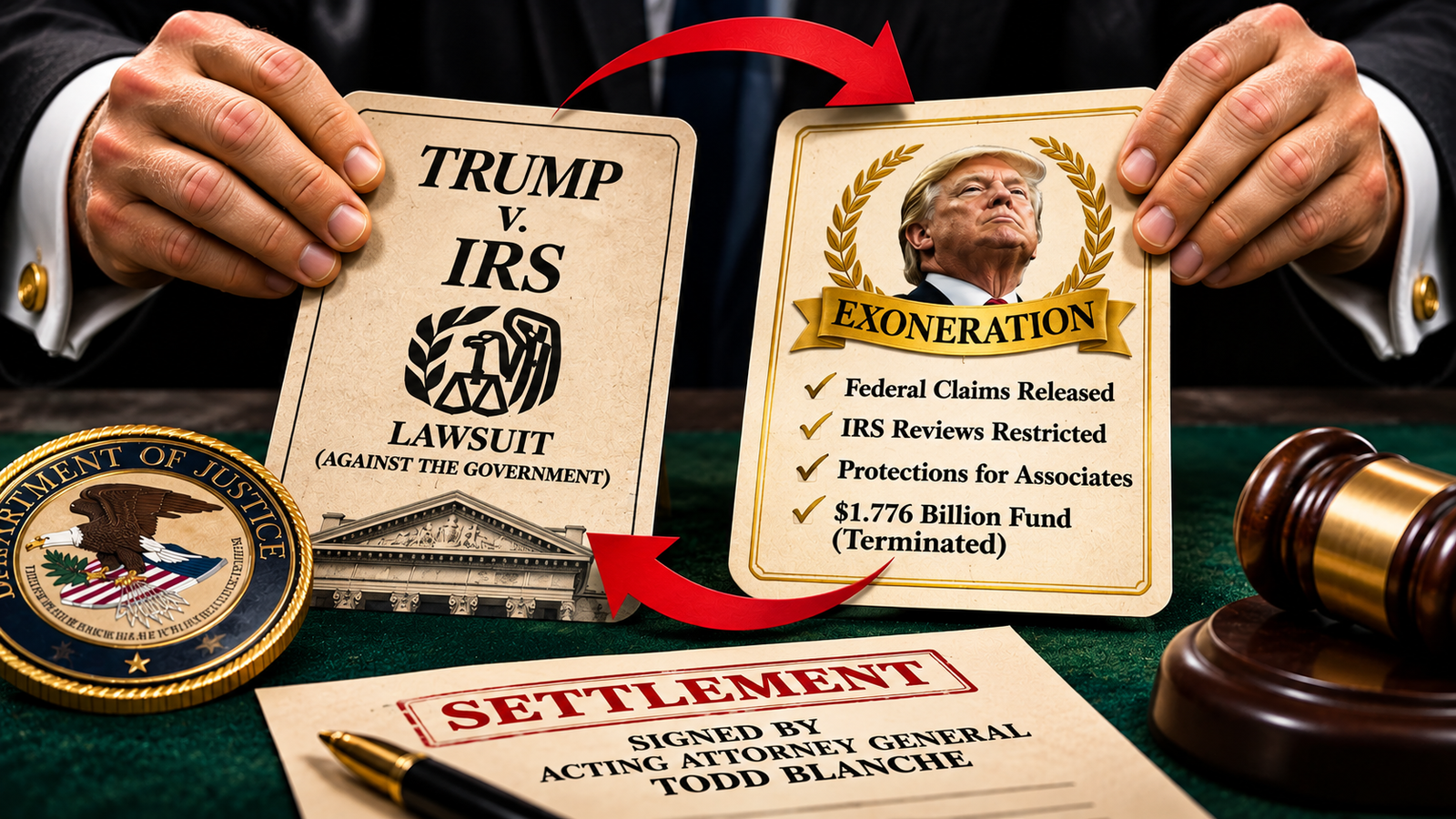
The switcheroo: Trump sues federal agencies he oversees as president. The Justice Department is responsible for defending federal interests. Yet the official signing the agreement for the government is Todd Blanche—Trump’s former personal criminal-defense attorney.
The old strategy was to counterattack the government. The new strategy is the “switcheroo:” turning the government’s own legal machinery into a means of securing protections for the president.
The frivolous IRS lawsuit provided a procedural vehicle for granting protections that the executive branch could not lawfully grant independently.
Rather than attempting to issue a presidential self-pardon, Trump pursued a settlement through litigation against agencies within his own administration, with his former personal attorney acting for the government. Essentially what Trump and Blanche are trying to impose is a civil-liability equivalent of a self-pardon.
That possibility lies at the heart of this investigation.
2. The Conflict: From Personal Attorney to Government Signatory
In May 2026, Acting Attorney General Todd Blanche signed an agreement resolving President Trump’s lawsuit against the Internal Revenue Service.
The agreement included sweeping language, concerning federal claims, audits, and protections involving Trump, other plaintiffs, and associated individuals or entities. The outlined protections for the Trump family and regime were the pork that came with dismissing the claim against the IRS. The claim was likely just a way to get Blanche involved in the shenanigan.
It also formed part of an arrangement involving a proposed $1.776 billion Anti-Weaponization Fund, intended for individuals claiming harm from government investigations. There were legit concerns that the fund would be used to enrichen pardoned January 6 rioters.
Blanche was no ordinary government lawyer. He had represented Trump personally in federal criminal proceedings.
That relationship raises an unavoidable question:
Who was protecting the federal government’s interests when its chief legal officer had previously represented the person receiving the protections?
3. The Warning: Blanche Had Been Told to Recuse
On May 14, CNN reported that Joseph Tirrell, then a senior Justice Department ethics official, had advised Blanche in March 2025 that he needed to recuse himself from legal cases involving Trump personally.
Blanche had also signed an ethics pledge restricting his participation in matters involving former clients.
During his February 2025 confirmation hearing, Blanche promised Senator Adam Schiff that he would follow the department’s ethics experts regarding recusal.
On May 19, Senators Schiff, Dick Durbin, and Richard Blumenthal sought records concerning Blanche’s recusal obligations, including his participation in lawsuits where Trump sought personal financial compensation from the government.
The Justice Department maintained that Blanche was complying with his ethical obligations.
But the essential question remains unanswered in the records examined here:
Did Blanche receive specific authorization to participate in the Trump–IRS settlement? If so, who granted it, when, and under what authority?
4. The Judge: If You Can’t Win in Court, Go After the Judge
On July 13, U.S. District Judge Kathleen Williams found that the Trump–IRS litigation had improperly used the judicial process to pursue benefits unavailable through genuinely adverse litigation.
She imposed sanctions and referred attorneys’ conduct to professional disciplinary authorities.
Trump’s attorneys challenged the ruling (creating another Gapportunity™), arguing that the court exceeded its authority and denied appropriate procedural protections.
On September 29, the Eleventh Circuit declined to stay the sanctions order. That decision did not finally resolve the appeal.
Then came another familiar turn.
On October 22, Republican Representatives Jim Jordan and Darrell Issa called for the Judicial Conference to examine Judge Williams’s conduct, alleging judicial partiality and procedural irregularities.
Their objections may be examined on their merits. The request does not itself establish improper retaliation.
Nevertheless, the sequence recalls a recurring motif in Trump’s litigation history: when a judge challenges the conduct, the judge becomes the subject of a challenge.
The tactic was captured in James D. Zirin’s 2025 commentary on Trump’s approach to unfavorable judicial proceedings: If you can’t win in court, threaten the judge.
Here, the original scrutiny concerned the government’s agreement with the president. The subsequent congressional scrutiny concerned the judge who questioned the arrangement.
That reversal deserves public attention.
5. The Revision: “Settlement Lite,” but by Whose Authority?
By August, the settlement had generated objections from both Democrats and Republicans.
Republican Senators John Cornyn and Thom Tillis demanded written limitations before supporting Blanche’s nomination as attorney general.
On August 3, they announced that the Justice Department had issued a formal order terminating the Anti-Weaponization Fund and a binding written clarification limiting the tax settlement to the plaintiffs and the IRS and Treasury as defendants.
The senators then expressed their willingness to advance Blanche’s nomination.
Call it Settlement Lite: the original arrangement, narrowed after political and legal objections.
But why was the administration willing to retreat from protections it had already agreed to grant?
Did Blanche and the administration recognize that the original settlement was a legal house of cards?
The August revision raises that possibility. What had been presented as an extraordinary legal settlement was subsequently narrowed under political pressure. The administration’s willingness to restrict its own agreement invites scrutiny of how defensible the original arrangement was in the first place.
And narrowing the agreement does not necessarily make it lawful.
A house of cards does not become structurally sound simply because someone removes a few cards.
The August action raises questions of its own.
Who authorized the clarification? Did it amend the original agreement or merely interpret it? What protections remain questionably enforceable? And did Blanche’s potential recusal conflict extend to the subsequent order?
This may be the crux of the entire matter.
A century-old Supreme Court decision, United States v. Beebe, 180 U.S. 343 (1901), illustrates that unauthorized compromises of government claims can be challenged. The Court did not automatically invalidate every such agreement, and Beebe does not establish that Blanche’s settlement is void.
But the principle warrants examination: the government’s authority to compromise its claims cannot simply be assumed because a senior official signed an agreement.
Nor does a later clarification necessarily cure a defect in the original signatory’s authority.
The fundamental question remains unanswered: If Blanche lacked the authority to enter the original settlement, what authority did the administration possess to salvage it?
6. The Accountability Question
Congress has ample reason to investigate both the original settlement and its subsequent revision.
Four questions require documentary answers:
- What recusal instructions, ethics restrictions, and authorizations applied to Blanche when he signed the May agreement?
- What statutory or delegated authority permitted DOJ to release or restrict federal claims and tax-related liabilities involving Trump and associated parties?
- What precisely changed in August, who authorized those changes, and what legal protections are still on the table under examination?
- What judicial or congressional remedies are available if either agreement exceeded lawful authority?
Congress should obtain the complete May settlement, Blanche’s signed implementation document, the August orders, relevant ethics records, and the legal opinions supporting both actions.
Depending on what those records establish, lawmakers could examine disciplinary referrals, challenges to the agreement’s enforceability, or impeachment proceedings. None follows automatically from an apparent conflict.
The issue is not whether a president may sue the government. Nor is it whether the Justice Department may settle legitimate litigation.
The issue is whether federal settlement authority was used to provide benefits to a president through an agreement signed by his former personal attorney, despite a reported recusal warning.
The larger pattern is troubling: litigation against the government, a change in who controls the government’s defense, extraordinary settlement provisions, judicial intervention, attacks on the judge’s conduct, and a subsequent agreement narrowing the original protections.
Each development has its own legal explanation and contested facts. Together, they present a mechanism Congress cannot responsibly ignore.
The August clarification may have narrowed the agreement. It has not, on the evidence examined here, answered the question of Blanche’s authority.
If Todd Blanche was prohibited from participating in a matter involving his former client, why should the American public be bound by the agreement he signed in service to him?
Leave a Reply