Political Pressure, Corporate Accommodation and the End of Independent Fact-Checking
A Trumportunity Investigative Report
By Robert “Peace” Wright
What happens when the president of the United States threatens the head of one of the world’s most powerful communications enterprises with life imprisonment, and that enterprise subsequently dismantles its independent fact-checking program?
What happens when the corporation responsible for distributing information to billions of people discovers that questionable information can also be extraordinarily profitable?
And what happens when the anticipated financial penalties for permitting fraudulent activity are considerably less than the revenue generated by permitting it?
These questions arise from documented events, corporate policy decisions, financial disclosures, investigative journalism and mounting litigation involving Meta Platforms, Inc., the parent company of Facebook, Instagram, WhatsApp and Threads.
Our investigation begins with a threat.
I. The Threat
During the 2024 presidential campaign, Donald Trump directed an extraordinary warning toward Meta founder and chief executive officer Mark Zuckerberg.
In his book Save America, released in September 2024, Trump wrote:
“We are watching him closely, and if he does anything illegal this time he will spend the rest of his life in prison.”
Trump was referring to Zuckerberg’s previous involvement in funding election administration and his suspicions concerning Zuckerberg’s conduct during the 2020 presidential election.
Just days before Trump’s threat became public, Zuckerberg had sent a letter to House Judiciary Committee Chairman Jim Jordan on August 26, 2024, expressing regret over Meta’s response to pressure from the Biden administration concerning COVID-19 content moderation.
Zuckerberg maintained that Meta should not compromise its content standards in response to political pressure from any administration and expressed a willingness to resist such pressure in the future.
It was a commendable declaration of corporate independence.
Its durability would soon be tested.
On January 7, 2025, Meta announced sweeping changes to its content moderation policies, including the forthcoming termination of its independent American fact-checking program.
During a press conference at Mar-a-Lago that same day, CNN correspondent Steve Contorno asked Trump whether Zuckerberg’s actions were directly responsive to the threats Trump had previously made against him.
Trump’s answer:
“Yeah, probably.”
While that answer does not establish Zuckerberg’s private motivations, we need not speculate about whether Trump believed his threats had influenced Zuckerberg’s decisions.
Trump publicly supplied his own assessment.
Sources: Politico — Trump’s warning to Zuckerberg; January 7, 2025, presidential press conference transcript.
II. The Accommodation
Following Trump’s November 2024 electoral victory, Zuckerberg’s relationship with the incoming president underwent a conspicuous transformation.
| Date | Development |
| August 26, 2024 | Zuckerberg declares Meta should resist political pressure from any administration. |
| August 28, 2024 | Trump’s prison threat is reported publicly. |
| November 27, 2024 | Zuckerberg dines with Trump at Mar-a-Lago. |
| December 30, 2024 | Trump‘s inaugural committee receives a $1 million contribution from Meta. |
| January 2025 | Republican political veteran Joel Kaplan succeeds Nick Clegg as Meta’s chief global affairs officer. |
| January 6, 2025 | Trump ally Dana White joins Meta’s board of directors. |
| January 7, 2025 | Meta announces the termination of its American third-party fact-checking program. |
| January 20, 2025 | Trump returns to the presidency. |
| January 29, 2025 | Meta agrees to a $25 million settlement of Trump’s lawsuit against the company. |
| January 30, 2025 | Zuckerberg discusses the opportunities presented by a productive relationship with the United States government. |
The $1 million inaugural contribution is documented in Federal Election Commission records.
The $25 million settlement resolved litigation originating from Facebook’s suspension of Trump’s account following the events of January 6, 2021. Approximately $22 million was designated for Trump’s future presidential library, with the remainder allocated to legal expenses and other plaintiffs.
Neither payment establishes an unlawful transaction, nor does the combined $26 million represent personal income received directly by Trump.
Nevertheless, the sequence warrants scrutiny.
A corporation whose chief executive had recently been threatened with life imprisonment was now financially supporting the incoming president’s inauguration, resolving his litigation against the company, restructuring its leadership and substantially revising its information-distribution policies.
During a January 30 internal company meeting reported by Business Insider, Zuckerberg described an opportunity to establish a productive partnership with the United States government.
He maintained that the company was not abandoning its principles.
The question, of course, is whether the principles had changed.
Meanwhile, Inside Meta
Meta’s newly emphasized commitment to freedom of expression was accompanied by reports in January and February 2025 that employees responsible for leaking confidential information could be terminated, that employee communications were being monitored and that certain forms of internal criticism could adversely affect performance evaluations.
Protecting confidential information is legitimate. Punishing substantive disagreement is another matter.
Pay attention when a corporation publicly presents greater freedom of expression as a central organizational principle while restricting some forms of expression within its own workforce.
Sources: Federal Election Commission inaugural committee disclosure; Business Insider, January 30, 2025; Benzinga, January 31, 2025; iPhone in Canada, February 14, 2025.
III. A Thirty-Billion-Dollar Reason for Accommodation
As Trump returned to office, Meta faced federal antitrust litigation threatening its ownership of Instagram and WhatsApp, acquired in 2012 and 2014 for approximately $1 billion and $19 billion, respectively.
The Federal Trade Commission’s case originated in December 2020, during Trump’s first administration, alleging that Facebook had unlawfully maintained monopoly power through acquisitions and other anticompetitive practices.
Meta disputed the allegations, arguing that the government’s market definition failed to reflect contemporary competition.
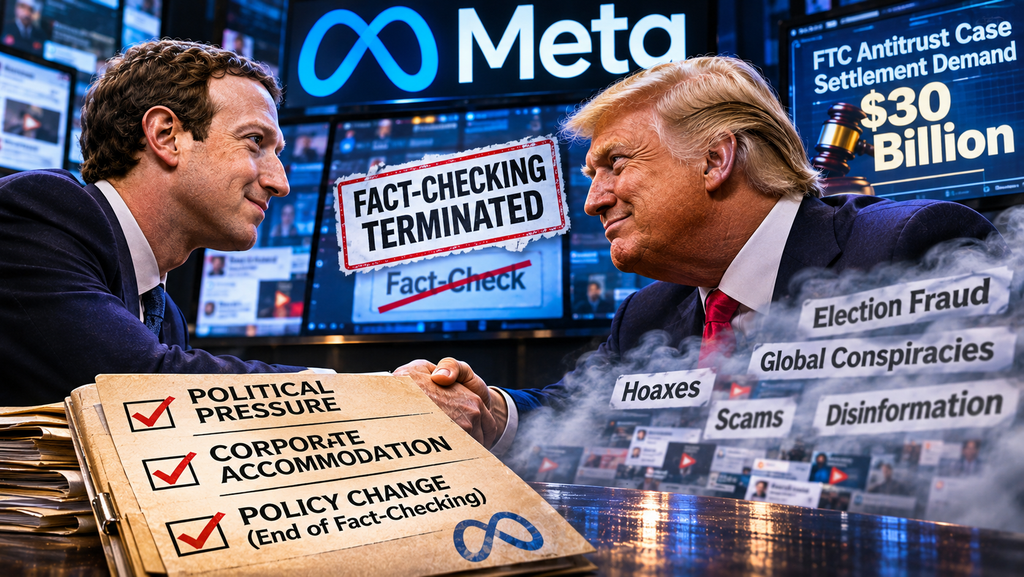
With the trial approaching, Zuckerberg personally lobbied the incoming administration.
On April 2, 2025, The New York Times reported that Zuckerberg had made repeated visits to Trump and his advisers seeking a resolution to the antitrust case.
Subsequent reporting originating with The Wall Street Journal described remarkable settlement negotiations.
| Negotiating position | Reported amount |
| Zuckerberg’s initial offer | $450 million |
| Meta’s subsequent offer | Approximately $1 billion |
| FTC chairman’s reported minimum | $18 billion |
| FTC’s reported demand | $30 billion |
The original offer represented just 1.5 percent of the government’s reported demand. Meta also reportedly offered unspecified policy changes during settlement discussions.
Former FTC Chair Lina Khan responded pointedly:
“Mark bought his way out of competing, so I’m not surprised that he thinks he can buy his way out of law enforcement, too.”
Consider the chronology:
- April 7, 2025: Meta officially ends independent third-party fact-checking in the United States.
- April 8, 2025: Trump reportedly meets with FTC Chairman Andrew Ferguson and other administration officials concerning the antitrust litigation. Although reportedly receptive to a settlement, Trump is persuaded to allow the case to proceed.
- April 14, 2025: The antitrust trial commences.
The litigation continued. Meta prevailed at trial in November 2025, and the FTC appealed in January 2026.
What the record does show us is that Meta was pursuing favorable treatment from the administration while undertaking substantial changes to its information policies.
Zuckerberg had considerable financial reasons to cultivate a favorable presidential relationship.
Sources: The New York Times, April 2, 2025; India Today and The Independent, April 16, 2025, reporting on the original Wall Street Journal investigation; Federal Trade Commission — Meta monopolization case; FTC appeal announcement.
IV. Dismantling Independent Oversight
In January 2025, Trump removed numerous federal inspectors general responsible for investigating waste, fraud, abuse and misconduct within government agencies.
Meanwhile, Meta was preparing to eliminate its independent American fact-checking apparatus.
Although their functions and legal responsibilities differ, both developments reduced established mechanisms of independent scrutiny.
Meta’s January 7 announcement outlined several significant policy changes:
- Termination of American third-party fact-checking.
- Introduction of a crowdsourced Community Notes system modeled on X.
- Removal of distribution penalties previously imposed on fact-checked content.
- Relaxation of certain content restrictions.
- Increased availability of political content in users’ feeds.
- Changes to automated content enforcement.
- Relocation of certain trust and safety operations outside California.
Meta argued that its previous moderation system had made excessive enforcement mistakes and that independent fact-checkers had introduced political bias.
However, professional fact-checkers evaluated claims; Meta itself determined how those findings affected content distribution.
On April 7, 2025, the company’s independent American fact-checking program officially ended.
Under the replacement system, even when a Community Note successfully identifies misinformation, the underlying content can continue circulating without the distribution penalty previously associated with independent fact-checking.
That distinction becomes especially important when engagement itself possesses commercial value.
Sources: Meta — More Speech and Fewer Mistakes, January 7, 2025; Meta — Community Notes testing announcement.
V. Replacing Professional Verification with Public Consensus
Meta’s previous fact-checking program was imperfect. A January 2025 NewsGuard investigation examined 457 posts containing 30 false narratives originating from Russian, Chinese and Iranian disinformation sources.
Only 14 percent carried fact-checking labels.
Was its replacement an improvement?
Community Notes require consensus among contributors with differing perspectives before corrections become visible. Meanwhile, misinformation can continue circulating.
During the first six months of Meta’s American Community Notes program, approximately 15,000 notes were written, but only 900 were published.
During approximately the same period, International Fact-Checking Network director Angie Drobnic Holan reported that Meta’s European professional fact-checking program generated labels on approximately 35 million Facebook posts.
Although not directly comparable, the disparity is striking.
An October 2026 NewsGuard investigation found that 93.1 percent of the false American midterm election claims examined on X—the platform upon which Meta modeled its replacement system—remained without corrective notes. These included at least four false claims posted by Elon Musk himself.
A 2026 study published in Science Advances found that approximately 53 million American Facebook accounts received 80 percent of the content originating from identified repeat misinformation offenders.
An experiment involving approximately 16,000 volunteers demonstrated that removing content from those sources reduced exposure by approximately 70 percent, although no measurable changes in political beliefs or attitudes were detected.
Under Meta’s revised fact-checking policies, researchers could no longer conduct the same intervention.
Sources: Mashable, January 23, 2025; Nieman Journalism Lab, March 26, 2026; Marian-Andrei Rizoiu, The Conversation, July 2026; Agence France-Presse, October 21, 2026.
VI. Monetizing Misfortune: When Free Speech Comes With a Paid Exemption
One provision of Meta’s proposed Community Notes system received considerably less public attention than the termination of professional fact-checking.
Paid advertisements were to be excluded.
In January 2025, The Wall Street Journal, Reuters and Social Media Today reported that Meta intended Community Notes to apply to ordinary posts rather than paid advertisements.
Interestingly, X, whose system Meta was adopting, permitted Community Notes on advertisements.
Although separate advertising standards and fraud-prevention measures remained applicable, Meta’s proposed replacement for professional fact-checking would not initially extend to the very content for which Meta was being paid.
Subsequent investigative reporting revealed why this deserves particular attention.
Credit Where Credit Is Due
This portion of our investigation draws substantially upon the exceptional investigative journalism of Reuters reporters Jeff Horwitz and Engen Tham, whose reporting on Meta earned them the 2026 Pulitzer Prize for Beat Reporting.
We encourage readers to examine Horwitz’s November 6, 2025 investigation:
Meta is earning a fortune on a deluge of fraudulent ads, documents show.
Additional investigations are available through the Pulitzer Prize winning-work archive.
Is allowing fraudulent and misleading but paid to place advertising to freely circulate corrupt? In this case, corruption is paying Meta extremely well.
The Economics of Deception
According to internal corporate documents examined by Reuters, Meta projected that approximately 10 percent of its 2024 annual revenue would originate from advertisements promoting scams or prohibited products.
Approximately $16 billion.
The documents also identified approximately $7 billion in annualized revenue associated with advertising presenting particularly elevated fraud or legal risks.
Another internal estimate placed the daily number of higher-risk advertising impressions at approximately 15 billion.
| Estimated higher-risk advertising impressions | Frequency |
| Per day | 15 billion |
| Per hour | 625 million |
| Per minute | 10.4 million |
| Per second | 173,611 |
These are estimated advertising impressions, not individual advertisements or unique victims. The revenue categories overlap and should not be added together.
Meta disputes the interpretation of its internal estimates, describing them as overly broad and the reporting as selective.
Importantly, these projections preceded the termination of independent American fact-checking. They reveal a preexisting financial incentive within the corporation at the time its moderation policies were being reconsidered.
Pay More, Stay Online
Perhaps one of the most disturbing findings concerns Meta’s reported treatment of suspected fraudulent advertisers.
According to Reuters, its automated systems generally required approximately 95 percent confidence before certain advertisers would be removed.
Suspected offenders falling below that threshold could face another consequence: higher advertising costs.
Meta maintained that the higher costs were intended to discourage questionable advertisers by making their advertisements less competitive.
When those advertisers continued purchasing advertisements, Meta received even more revenue per successful purchase.
The blurring of deterrence verses monetization becomes uncomfortable.
Reuters also found that users who interacted with suspicious advertisements could subsequently receive more of them through Meta’s advertising personalization system.
An individual who demonstrates susceptibility to a fraudulent financial offer may thereby become a more commercially valuable target for similar offers.
The very data that could help identify and protect vulnerable consumers can also help advertisers locate them.
VII. The Price of Compliance Versus the Profit of Noncompliance
Reporting published by TheNextWeb on April 22, 2026, drawing upon Reuters investigations and subsequent litigation, described Meta’s internal assessments of advertiser verification and regulatory exposure.
Implementing universal advertiser verification was reportedly estimated to cost approximately $2 billion, with potential revenue reductions of up to 4.8 percent.
A subsequent Santa Clara County lawsuit alleged that Meta had anticipated potential penalties of up to $1 billion while estimating approximately $7 billion in annual revenue from advertising categorized internally as “violating revenue.”
Although revenue is not net profit, the alleged corporate reasoning raises an obvious question.
When the anticipated financial consequences of permitting questionable advertising amount to a fraction of the revenue generated, what incentive does a corporation possess to eliminate it voluntarily?
Under such circumstances, regulatory settlements risk becoming predictable operating expenses rather than effective deterrents.
Making the Evidence More Difficult to Find
Reuters’ investigation into Meta’s dealings with international regulators revealed another disturbing practice.
In Japan, authorities had been examining Meta’s publicly accessible advertising library to determine whether fraudulent advertisements remained prevalent.
Meta reportedly identified the searches regulators were likely to conduct and repeatedly removed suspicious advertisements appearing in those results.
According to Reuters, the technique became part of a broader international strategy intended to manage regulatory perceptions and delay mandatory advertiser verification.
Meta disputed the suggestion that removing fraudulent advertisements from its library was misleading.
But removing fraudulent content because it is fraudulent and selectively removing it because regulators are likely to discover it serve different purposes.
One improves safety. The other can improve the appearance of safety.
China’s Advertising Pipeline
Despite restrictions preventing ordinary public access to Meta’s platforms within China, Chinese businesses can purchase advertising aimed at consumers elsewhere.
According to Reuters, Meta’s Chinese advertising revenue grew from approximately $7.4 billion in 2022 to $18.4 billion in 2024.
Internal assessments reportedly associated approximately 19 percent of its 2024 Chinese advertising revenue—more than $3 billion—with scams and other prohibited advertising.
An initiative to combat such advertising achieved substantial reductions during the latter half of 2024. Subsequent corporate decisions reportedly reversed aspects of that initiative, and problematic advertising increased again.
Internal documents indicated that revenue considerations influenced enforcement discussions concerning Chinese advertising partners, some of whom enjoyed special protections delaying the removal of suspicious advertisements.
In a separate journalistic experiment, Horwitz obtained advertising services through agencies associated with Meta’s partner network and successfully published advertisements promoting implausible investment returns.
Meta’s artificial intelligence systems even offered to generate alternative advertising content intended to improve the campaign’s effectiveness.
The issue was no longer simply whether Meta could identify fraudulent advertisements.
It was whether its commercial infrastructure could help questionable advertisers create, distribute and improve them.
From Where I sit and observe, things do not look good for Facebook.
Sources: Reuters investigations reproduced in the 2026 Pulitzer Prize archive; TheNextWeb, April 22, 2026; USA TODAY, May 12, 2026.
VIII. The Artificial Intelligence Dimension
AI-generated impersonations enable fraudulent advertisers to manufacture endorsements from trusted public figures who have never authorized them.
Fabricated endorsements involving Donald Trump, Elon Musk, Bernie Sanders and Alexandria Ocasio-Cortez have reportedly been used to promote fraudulent government benefit schemes.
In Brazil, manipulated images and voices of physicians have been used to sell questionable healthcare products. Financial professionals have similarly been impersonated to promote fabricated investment opportunities.
The Tech Transparency Project identified 63 alleged scam advertisers associated with more than 150,600 political advertisements and approximately $49 million in lifetime advertising expenditures on Meta.
Political misinformation, financial fraud and identity impersonation can therefore converge within the same advertisement.
And a successful deception can generate the same commercially desirable engagement metrics as a successful legitimate advertisement.
IX. Exporting the Experiment
In November 2025, Meta sought guidance from its own Oversight Board concerning the international expansion of Community Notes.
In March 2026, the Board warned that replacing professional fact-checking with Community Notes could create significant human rights risks, particularly in societies experiencing political repression, intense electoral conflict, discrimination or inadequate access to reliable information.
The Board recommended additional testing, transparency and careful evaluation of national circumstances.
Nevertheless, in September 2026, Meta announced testing in 16 Spanish-speaking Latin American countries:
Argentina, Bolivia, Chile, Colombia, Costa Rica, Ecuador, El Salvador, Guatemala, Honduras, Mexico, Nicaragua, Panama, Paraguay, Peru, Uruguay and Venezuela.
Professional fact-checking remained operational during the initial testing phase, with no definitive timetable announced for its termination.
By September 2026, Meta reportedly had more than 1.4 million registered Community Notes contributors.
Yet Community Notes themselves frequently rely upon professional journalists and fact-checkers to substantiate their corrections.
There is an inherent contradiction in undermining the institutions that produce reliable verification while introducing a system that depends upon their continued existence.
Wouldn’t you agree?
Sources: Nieman Journalism Lab, March 26, 2026; Agence France-Presse, September 9, 2026; International Fact-Checking Network statement on Latin American expansion.
X. The Reckoning: From Corporate Policy to Civil Prosecution
By November 2026, Meta faced mounting litigation and regulatory actions involving allegations of fraudulent advertising, inadequate consumer protections and misleading corporate representations.
These proceedings extend across jurisdictions beyond the direct authority of the Trump administration.
California
A federal class action concerning an alleged stock manipulation operation involving Jayud Global Logistics alleged that fraudulent Facebook and Instagram advertisements helped inflate the stock’s price before its collapse, producing losses exceeding $500 million.
On March 25, 2026, a federal judge dismissed the case, reportedly without prejudice, finding that the plaintiffs had not sufficiently alleged Meta’s participation in creating the advertisements.
A separate civil prosecution brought by Santa Clara County in May 2026 alleged that Meta’s role extended beyond passive distribution.
The county alleged that Meta participated in the creation, optimization, targeting and dissemination of fraudulent advertisements while deriving substantial income from them.
The distinction could prove legally consequential: hosting fraudulent content is not necessarily the same as participating in its creation.
Rhode Island
On October 22, 2026, Rhode Island Attorney General Peter F. Neronha filed a lawsuit against Meta in Providence County Superior Court under the state’s Deceptive Trade Practices Act.
The complaint alleged that Meta knowingly profited from fraudulent advertisements despite representing to consumers that it employed sophisticated measures to prevent them.
The alleged fraudulent activities included:
- Fabricated investment opportunities.
- False Medicare and Social Security benefit offers.
- Impersonation of trusted institutions and individuals.
- Ineffective or dangerous medical products.
- Other deceptive goods and services.
Particularly significant was the allegation that Meta knowingly used extensive information about its account holders to help advertisers identify and repeatedly target consumers most susceptible to fraudulent offers, especially senior citizens.
The state seeks restitution, civil penalties, injunctive relief, disgorgement of allegedly unlawful profits with interest and the appointment of an independent receiver, auditor or monitor.
A corporation that eliminated one form of independent oversight may ultimately find itself confronted with another imposed through judicial proceedings.
Source: Rhode Island Attorney General — Attorney General Neronha sues Meta for fraudulent advertisements.
Beyond American Borders
Australian consumer protection authorities have pursued Meta over cryptocurrency advertisements featuring unauthorized likenesses of prominent Australians. One victim identified in the litigation reportedly lost more than A$650,000.
In Britain, financial regulators identified 1,052 illegal financial advertisements on Meta’s platforms during a single week in November 2025.
Additional litigation includes actions involving the impersonation of financial professionals, a lawsuit brought by the attorney general of the United States Virgin Islands and litigation by the Consumer Federation of America alleging that Meta profited from fraudulent advertising while misrepresenting its prevention efforts.
These proceedings remain subject to judicial determination. But to their surprise is that Zuckerberg’s relationship with the American president cannot insulate Meta from every jurisdiction in which it conducts business. There still may be a threat of prison, not a tactical threat, but a founded one.
XI. Meta’s Defense
Meta disputes the interpretation of its internal financial assessments and maintains that fraudulent advertising harms its business by undermining consumer and advertiser confidence.
The corporation has reported substantial enforcement activities (according to Meta):
| Reported enforcement measure | Magnitude |
| Scam advertisements removed during 2025 | 159 million |
| Accounts associated with scam operations removed | 10.9 million |
| Detected scam advertisements removed before user reports | 92% |
| Target percentage of revenue from verified advertisers by the end of 2026 | 90% |
Meta has also reported developing facial recognition safeguards, pursuing litigation against fraudulent advertisers, cooperating with international law enforcement and introducing scam-detection features.
However, the 92 percent proactive removal figure concerns advertisements Meta successfully detected. It does not establish the percentage of all fraudulent advertising detected.
Nor can the number of advertisements removed be directly compared with the number of advertising impressions delivered (that is, how many times the ad was presented for view).
The outstanding question is whether commercial considerations improperly influenced the consistency and effectiveness of Meta’s safeguards.
XII. Cui Bono, Who Benefits?
The convergence of political and commercial interests revealed throughout this investigation deserves particular attention.
A presidential candidate threatened a powerful corporate executive with life imprisonment. That executive subsequently cultivated a relationship with the incoming administration while seeking relief from potentially devastating antitrust litigation.
His corporation dismantled its independent American fact-checking program while operating an advertising business whose internal documents reportedly revealed extraordinary financial incentives for permitting questionable advertising.
This evidence does not prove an unlawful arrangement between Zuckerberg and Trump. It does, however, reveal a convergence of interests from which both could potentially benefit. Direct profit for one, and a twisted sense of cover in a financial arena ruled by mayhem, at least, for the other.
More importantly, a political administration can benefit from diminished independent scrutiny.
A communications enterprise can benefit from favorable political relationships.
Questionable advertisers benefit from reduced obstacles to distributing misleading information.
And the corporation selling access to the public benefits financially from the resulting engagement.
The public, meanwhile, assumes the risks, and consumes the loss.
Freedom of expression is an essential democratic principle.
But freedom of expression should not be confused with a corporate entitlement to profit from deception.
Nor should a commitment to political independence be measured solely by a corporation’s willingness to resist the administration it opposes.
The more meaningful test is whether it possesses the same willingness to resist the administration whose favor it seeks.
This investigation is part of Trumportunity’s continuing examination of the intersections between presidential authority, corporate influence and private financial interests.
The author gratefully acknowledges the original reporting of the journalists and researchers whose work is referenced throughout this article.
Allegations contained in pending litigation remain allegations unless established through judicial findings or other competent evidence.

Leave a Reply