October 16, 2026 — Investigative Report, Robert “Peace” Wright
In August 2025, a venture-capital firm associated with the president’s eldest son invested in a small American manufacturer of rare-earth magnets.
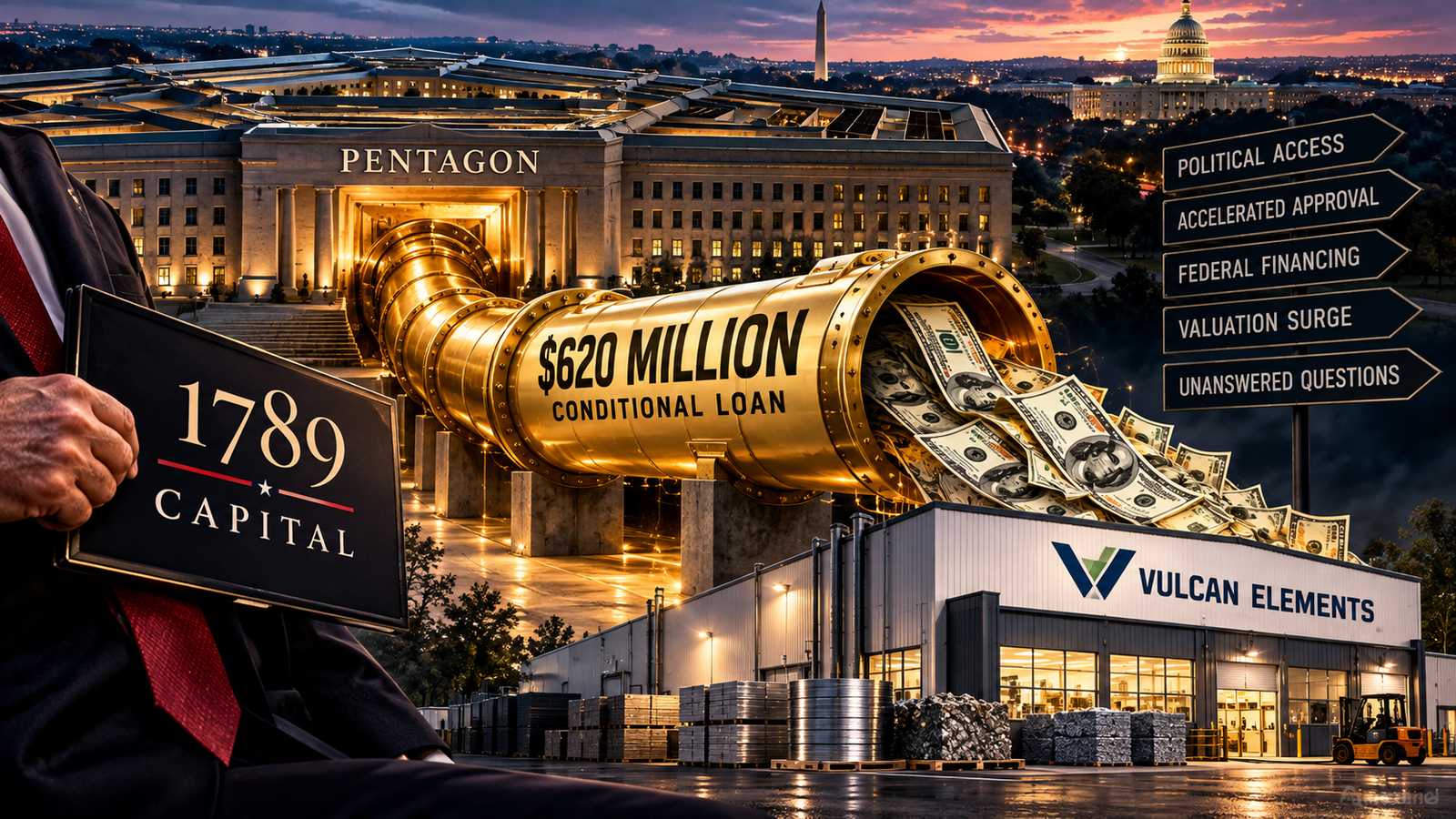
Three months later, that manufacturer was the beneficiary of a $620 million conditional Pentagon loan commitment, accompanied by a proposed $50 million Commerce Department investment.
Between those events, according to an investigation by ProPublica, a senior White House adviser personally initiated the Pentagon financing request and officials instructed staff to accelerate its consideration.
The company was Vulcan Elements. The investment firm was 1789 Capital, where Donald Trump Jr. is a partner. The White House adviser was Peter Navarro, President Trump’s senior counselor for trade and manufacturing.
The documented sequence raises a question that extends beyond one company: When the federal government finances private businesses, how does it protect public investment decisions from the private financial interests of the president’s family?
From Startup to Federal Financing Priority
Founded in 2023 by John Maslin and Piotr Kulik, Vulcan Elements set out to manufacture rare-earth permanent magnets in the United States.
These magnets are important components in drones, aircraft, electric motors, and military systems. Developing domestic production is a legitimate national-security objective, given American dependence on foreign processing and manufacturing.
In March 2025, Vulcan opened its initial manufacturing facility in North Carolina.
By August, it was raising $65 million in private investment. The round was led by Altimeter Capital and included 1789 Capital.
The company’s August 11, 2025 financing carried a reported post-money valuation of approximately $205.83 million, according to Forge Global’s funding database. Contemporary financial-news accounts placed its valuation around $250 million, illustrating the uncertainty surrounding private-company estimates.
Congressional investigators subsequently reported that Vulcan employed approximately 30 people when 1789 Capital invested.
The company had already obtained military business. Its youth and size do not establish that it was unqualified for federal support. They do, however, make the scale and selection process of the subsequent financing particularly important.
Four Months That Changed the Financial Picture
The chronology reconstructed by congressional investigators and ProPublica is revealing.
July 2025: Vulcan CEO John Maslin met with representatives of 1789 Capital. According to an August 2026 congressional document demand, Donald Trump Jr. was discussed during the meeting.
August 11, 2025: Vulcan announced its $65 million Series A financing. 1789 Capital became an investor.
September–October 2025: According to ProPublica’s review of Defense Department records and interviews, White House adviser Peter Navarro initiated a request for Pentagon financing. Officials directed staff to process the proposed transaction unusually quickly.
November 3, 2025: The Commerce Department announced a preliminary, nonbinding arrangement proposing $50 million in incentives and a corresponding federal equity interest.
November 21, 2025: The Pentagon’s Office of Strategic Capital formally announced a joint $700 million conditional loan package: $620 million for Vulcan Elements and $80 million for its intended supply-chain partner, ReElement Technologies.
The Pentagon announcement made clear that the loans remained subject to financial, technical, legal, and other conditions. A conditional commitment is not evidence that the full loan proceeds have been disbursed.
Nevertheless, Vulcan had moved from a privately financed startup to the recipient of the largest conditional loan commitment in the Office of Strategic Capital’s history at that time.
The White House Intervention
The most consequential finding emerged in ProPublica’s May 28, 2026 investigation.
Based on interviews and Defense Department records, the newsroom reported that Navarro personally initiated the request for Vulcan’s financing.
One Pentagon official told ProPublica that Vulcan was the only company among dozens being evaluated whose financing request had originated with a senior White House aide.
Another source described officials directing staff to work at an unusually accelerated pace.
These accounts matter because they identify a specific reported intervention in an identifiable federal financial decision—not merely a relationship between investors and political officials.
Navarro rejected the reporting. The White House defended its work with private industry to strengthen American critical-minerals supply chains.
The Pentagon said political relationships do not influence its financing decisions.
Trump Jr.’s spokesperson said he did not discuss Vulcan with Navarro or other federal officials and had no knowledge of how the deal was arranged. A representative of 1789 Capital likewise denied participating in obtaining the financing or having advance knowledge of its announcement.
Those denials are part of the evidentiary record. They do not resolve the separate question of how the financing was selected, evaluated, and accelerated.
The Valuation Question
The financing also coincided with a dramatic change in Vulcan’s reported private-market valuation.
Forge Global identifies the August 2025 financing round at approximately $205.83 million post-money.
ProPublica subsequently reported estimates of approximately $2 billion after the federal financing announcement.
Those figures suggest a roughly 9.7-fold increase between the reported valuations.
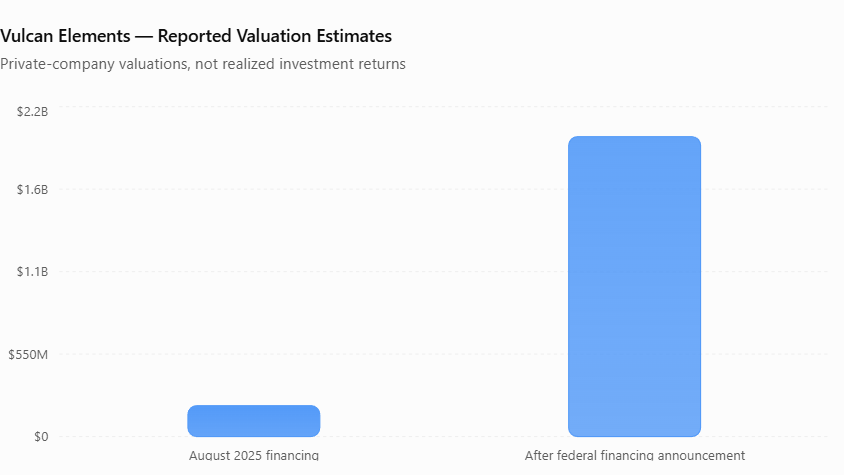
The estimates are not equivalent to a completed sale of the company or realized investment profits. Nor does their sequence establish that the Pentagon commitment alone caused the increase.
But the potential financial implications are substantial.
1789 Capital acquired an undisclosed ownership interest before the federal commitment. If the company’s value increased materially while that investment was held, the value of the fund’s interest may also have increased.
How much?
The public record does not establish 1789 Capital’s exact investment amount, ownership percentage, subsequent transactions, or realized returns.
Without those figures, a dollar estimate of Trump Jr.’s personal benefit would be speculative. It is safe to assume that it is a lot!
The central financial question therefore remains unanswered: What was the value of 1789 Capital’s Vulcan investment before and after the federal financing announcement, and what economic interest did Donald Trump Jr. hold in that investment?
The Pentagon’s New Role as Investor
The Vulcan transaction is part of a broader shift in federal industrial policy.
Through the Office of Strategic Capital, the Pentagon is using loans and other financial instruments to support private companies considered important to national security.
The Vulcan–ReElement announcement also contemplated federal financial interests in the companies, while Commerce proposed an equity investment in Vulcan.
This structure creates responsibilities beyond conventional government purchasing.
Federal officials must assess not only whether a product serves a military requirement but also whether a private enterprise merits public financing, whether its financial projections are credible, whether alternatives were fairly considered, and whether private investors may receive disproportionate benefits from government decisions.
That responsibility becomes especially sensitive when politically connected investors are involved.
A related ProPublica investigation in October 2026 examined approximately $350 million in Pentagon consulting agreements involving Alvarez & Marsal Federal, a business associated with the broader Alvarez & Marsal organization where senior Pentagon official George Kollitides previously held a private-sector role.
The report raised questions about overlapping professional relationships and the participation of consultants in Pentagon financing evaluations.
It has not been established that Kollitides personally approved the Vulcan financing or held a financial interest in Vulcan. Those matters require separate documentation.
The relevance here is institutional: Who evaluated these investments, who controlled the process, and how were potential conflicts identified and managed?
Congress Demands the Records
The Vulcan financing has generated sustained congressional scrutiny.
In June 2026, lawmakers questioned the White House about Navarro’s reported involvement.
On August 11, Representatives Robert Garcia and Jared Huffman demanded documents from Vulcan CEO John Maslin covering communications with 1789 Capital, White House officials, the Pentagon, and other participants.
The lawmakers sought information concerning the investment chronology, the company’s representations about political involvement, and the government’s selection and evaluation process.
Congressional investigators also raised questions about ReElement Technologies, whose separate $80 million conditional loan did not proceed as originally contemplated following due-diligence difficulties. The Pentagon subsequently announced a different $25 million investment in ReElement.
On September 30, the Congressional Record included a Senate resolution addressing the risk that senior officials or their immediate families might profit from federal equity transactions. The resolution expressly referenced the Vulcan Elements financing and 1789 Capital’s investment.
These inquiries establish that the transactions have become subjects of formal oversight. They do not, by themselves, establish misconduct.
Beyond Vulcan: Another Trump Jr.-Linked Financing Proposal
Vulcan is not the only company connecting the president’s family to Pentagon financial decisions.
On October 9, 2026, ProPublica reported that the Office of Strategic Capital was considering a $220 million loan to drone-components manufacturer Unusual Machines.
Trump Jr. serves on that company’s advisory board and has held shares in the publicly traded business.
The proposed loan had not been established as finalized in the reporting.
Unusual Machines presents a separate investigative trail involving direct personal share ownership, defense-related commercial orders, and the Pentagon’s financing process.
That trail merits its own examination rather than being treated as proof of what occurred at Vulcan.
What the Public Still Does Not Know
The outstanding evidence is identifiable.
Who first proposed Vulcan’s $620 million financing, and what written communications accompanied Navarro’s reported intervention?
Which Pentagon officials evaluated and approved the conditional commitment? What competing applications or proposals were considered?
Did Vulcan receive expedited treatment unavailable to similarly situated applicants?
What financial-interest disclosures and conflict screenings were performed concerning its investors?
What portion of 1789 Capital’s investment was held for the economic benefit of Donald Trump Jr.?
And how much federal money, if any, had actually been disbursed to Vulcan by October 16, 2026?
The answers should be found in the financing application, evaluation memoranda, approval chain, conflict reviews, capitalization records, and subsequent loan-closing documents.
The national-security rationale for domestic rare-earth magnet production is substantial. That rationale does not eliminate the obligation to demonstrate that public financing decisions were made through an accountable process.
The documented chronology is already significant: a presidential family-associated investment, reported White House intervention, an accelerated Pentagon financing process, and a substantial subsequent increase in estimated private-company value.
The remaining question is not simply who received the government’s support. It is who influenced the decision, who owned the beneficiary, and who stood to gain.
That is where the public financial record must lead.
Principal Sources
- ProPublica, Robert Faturechi, May 28, 2026, investigation of White House intervention in Vulcan Elements’ financing.
- U.S. Department of Defense, Office of Strategic Capital, November 21, 2025, joint $700 million conditional loan announcement.
- U.S. Department of Commerce, November 3, 2025, preliminary CHIPS incentives announcement.
- Vulcan Elements, August 11, 2025, Series A financing announcement.
- Forge Global, Vulcan Elements funding and valuation history.
- U.S. House Committee on Oversight and Accountability, August 11, 2026, Garcia–Huffman document demand.
- Congressional Record, September 30, 2026, Senate resolution concerning federal equity transactions and conflicts.
- The Washington Post, July 13 and August 5, 2026, investigations of Trump-family-associated defense investments.
- ProPublica, October 9, 2026, investigation of Kollitides, Alvarez & Marsal, and Pentagon consulting contracts.

Leave a Reply