When presidential financial interests intersect with presidential decisions, the chronology matters.
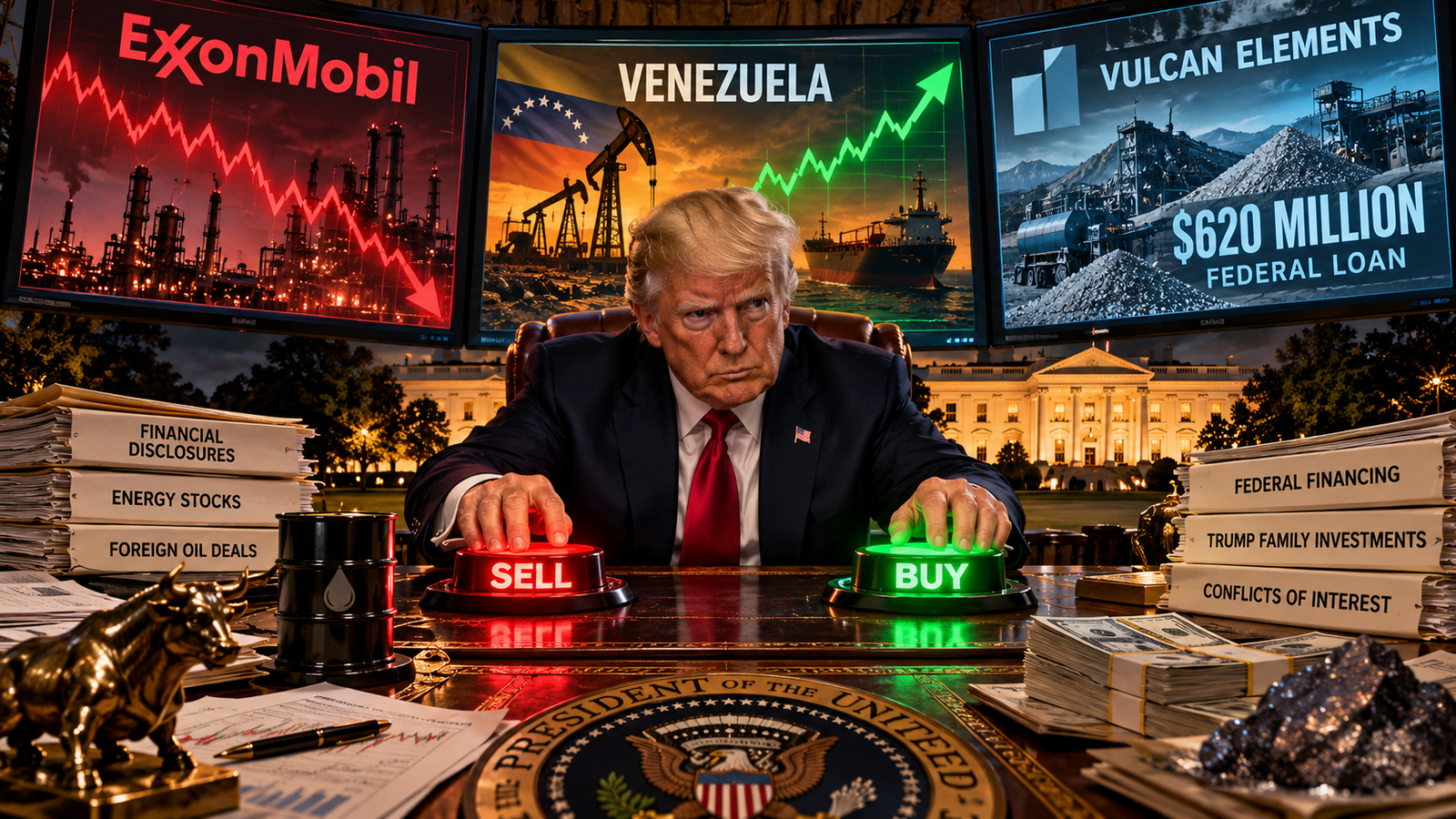
President Donald Trump’s investment accounts have been buying and selling energy stocks while his administration makes decisions that move energy markets, opens foreign oil reserves, and directs hundreds of millions of dollars in federal financing.
Three Trump Investment cases illustrate the concern: an ExxonMobil sale before an Iran ceasefire announcement, multimillion-dollar oil-stock purchases before a Venezuela agreement, and a Trump-family-linked investment that preceded extraordinary federal financing.
The evidence raises a fundamental question: How can the public distinguish national policy made in the public interest from decisions that also benefit the president’s private financial interests?
1. ExxonMobil: The Sale Before the Ceasefire
On April 7, 2026, an investment account disclosed by President Trump sold between $500,000 and $1 million in ExxonMobil shares.
That evening, Trump announced a two-week ceasefire in the war with Iran.
ExxonMobil closed April 7 at $163.91 per share. On April 8, following the announcement, the stock opened at $153.52—a decline of approximately 6.34%.
That opening decline erased an estimated $43.1 billion in ExxonMobil’s stock-market capitalization, based on approximately 4.145 billion shares outstanding. This was a decline in shareholder market value, not a realized operating loss for ExxonMobil.
The sequence is documented:
- April 7: Trump’s investment account sells ExxonMobil shares.
- April 7, evening: Trump announces the Iran ceasefire.
- April 8: ExxonMobil opens sharply lower, losing approximately $43.1 billion in market capitalization at the opening bell.
Selling before a decline avoids the loss that would have occurred on those shares had they been retained through the opening price the following morning.
The president’s account sold before an announcement that preceded a roughly $43 billion decline in the company’s market valuation at the following day’s opening bell.
Thus, for the American polity, a central conflict remains: the president exercises extraordinary authority over events that can dramatically affect the market value of securities held or traded for in his name, and to his benefit.
2. Venezuela: Millions Invested Before the Oil Agreement
January: ExxonMobil Objects, Trump Threatens Exclusion
On January 9, 2026, President Trump assembled oil executives at the White House to discuss American investment in Venezuela.
ExxonMobil Chairman and CEO Darren Woods raised serious objections to the country’s existing investment conditions. ExxonMobil had already experienced two seizures of its Venezuelan assets.
Woods explained:
“If we look at the legal and commercial constructs—frameworks—in place today in Venezuela, today it’s uninvestable.”
He called for substantial changes to Venezuela’s legal and commercial framework, including durable protections for investors and changes to the country’s hydrocarbon laws.
These were not casual objections. They were the stated conditions under which ExxonMobil would consider returning to a country where it had already suffered substantial losses.
Two days later, on January 11, President Trump publicly threatened to exclude ExxonMobil from his Venezuela plans.
Speaking to reporters aboard Air Force One, Trump said:
“I’d probably be inclined to keep Exxon out. I didn’t like their response.”
He also accused the company of playing “too cute.”
This is significant evidence of Trump’s expressed intent toward ExxonMobil.
The president was not merely discussing national energy policy. He publicly indicated that a company’s response to his initiative could influence whether it would be permitted to participate.
Was access to Venezuela’s (stolen) oil opportunities being conditioned, at least in part, on satisfying the president personally?
Trump’s own words make that a legitimate investigative question.
The January exchange does not establish that ExxonMobil was subsequently excluded, or that the confrontation determined which companies received later agreements. But it establishes that Trump publicly contemplated exclusion because he disliked a company’s response.
That history becomes particularly relevant when examining the president’s subsequent investments in other oil companies.
August: Trump’s Oil Investments Precede His Venezuela Agreement
On August 21, 2026, Trump’s disclosed investment accounts purchased between $1 million and $5 million each in Chevron and ConocoPhillips stock.
An additional Chevron purchase of $15,001 to $50,000 followed on August 26.
On August 28, Trump announced a major oil agreement with Venezuela.
Five days later, on September 2, the Department of Energy announced new agreements involving Chevron, Eni, and GE Vernova.
Chevron’s agreements contemplated more than $7 billion in investment over five years, expanded development rights, and substantially increased Venezuelan oil production.
The chronology:
- January 9: ExxonMobil’s CEO publicly challenges the investment conditions in Venezuela.
- January 11: Trump threatens to exclude ExxonMobil because he disliked its response.
- August 21: Trump’s Chevron and ConocoPhillips purchases totaling between $2 million and $10 million.
- August 26: Additional Chevron purchase.
- August 28: Trump announces the Venezuela oil agreement.
- September 2: The administration announces expanded Chevron operations and investment plans.
- October 8: Trump’s August 21 Chevron and ConocoPhillips stock purchases are finally publicly disclosed—48 days after the transactions and 41 days after his August 28 Venezuela oil agreement announcement.
Chevron’s September agreements are distinct from the August 28 binational agreement, but the administration expressly described them as building upon it.
Nor does the evidence establish that ConocoPhillips received equivalent benefits from those agreements.
The Chevron connection is nevertheless direct: a company whose shares (up to $10,000,000) had recently been purchased for Donald Trump’s account subsequently received expanded commercial opportunities under an administration-led energy initiative.
The August 21 purchases were not publicly disclosed until October 8—48 days after the transactions and 41 days after Trump’s announcement!
That delay certainly matters. The public learned about the president’s financial position only after the consequential Trump government decisions had already been announced.
And now we have another question.
Did Trump’s publicly expressed hostility toward ExxonMobil influence the administration’s subsequent treatment of competing oil companies—including Chevron, in which his investment accounts had acquired millions of dollars in shares?
The evidence does not establish that connection. But Trump’s January statements provide a documented reason to investigate it.
3. Vulcan Elements: A Family Investment and a $620 Million Federal Loan
The third case involves Donald Trump Jr., the investment firm 1789 Capital, and Vulcan Elements, a manufacturer of rare-earth magnets.
In August 2025, Vulcan announced a financing round that included an investment by 1789 Capital, where Trump Jr. is a partner. The size of the firm’s ownership interest was not publicly disclosed.
In November 2025, the Pentagon announced plans for a $620 million loan to Vulcan Elements, accompanied by additional financing and incentives involving its partner and the Commerce Department.
In May 2026, ProPublica reported that White House adviser Peter Navarro had initiated the request for Vulcan’s financing and that Pentagon personnel were directed to process it at an unusually rapid pace.
The financial implications were substantial! ProPublica reported estimates suggesting that Vulcan’s valuation increased from approximately $200 million around the period of 1789 Capital’s (Donald Trump Jr.) investment to roughly $2 billion after the federal deal was announced.
That is an estimated valuation increase, not proof of a realized profit for Trump Jr. or 1789 Capital. Good Luck finding transparency and accountability here, folks.
Trump Jr.’s representatives denied that he intervened in the financing decision. The firm also denied involvement in securing the loan, and the Pentagon denied preferential treatment.
Nevertheless, the documented sequence presents a serious public-interest question:
Why was a company backed by the president’s son’s investment firm singled out for White House-initiated, accelerated federal financing?
The Recurring Mechanism
These cases are not identical, and the distinctions are important.
In the ExxonMobil case, a sale preceded a presidential announcement and a subsequent market decline—an estimated $43.1 billion in market capitalization at the opening bell.
In Venezuela, purchases preceded a presidential agreement and expanded commercial opportunities for one of the companies involved. The Public notices of Trump’s up to $10 million stock investment in Chevron were filed 1.5 months after the Presidential action of consequence. This kept the public from knowing about this scandalous behavior until well after the deed was complete. How very Trump Extraction/Gapportunistic of them.
And the Venezuela story now contains another documented element: months before those transactions, Trump publicly threatened to exclude ExxonMobil because he disliked its CEO’s response.
In the Vulcan Elements case, a Trump-family-linked investment preceded a major federal financing commitment initiated through the White House.
Together, they reveal three points where presidential power and private financial interests intersect:
Financial position. Government decision. Economic consequence.
The existence of that sequence does not, by itself, establish criminal conduct, insider trading, or improper direction of investment accounts.
But neither do claims of using “outside investment managers” eliminate the underlying conflict of interest. The president still exercises authority over policies that assuredly affect the value of his holdings.
The American public should not have to wait weeks and months to discover that the president held substantial financial interests in companies affected by his own administration’s decisions.
And when federal financing benefits companies connected to the president’s family, the public deserves a transparent account of how those decisions were initiated, evaluated, approved, and funded.
The question is not merely whether the transactions were legal. It is whether the presidency is being exercised with sufficient independence from the private fortunes of the family occupying the White House.
That is the pattern worth investigating.
Sources
- CBS News, Kathryn Watson, Trump’s Oil and Gas Stock Trades Continued During Iran War, Filings Show, August 29, 2026.
- Donald Trump, statement announcing a two-week Iran ceasefire, April 7, 2026, reproduced by the American Presidency Project.
- ExxonMobil, Our Perspective Regarding the Situation in Venezuela as Shared with President Trump, January 9, 2026.
- Associated Press, Trump ‘Inclined’ to Keep ExxonMobil Out of Venezuela After CEO’s Skeptical Response at White House Meeting, January 12, 2026.
- Yahoo Finance, ExxonMobil (XOM) historical share prices, April 7–8, 2026.
- ExxonMobil, quarterly SEC filing for March 31, 2026, shares outstanding.
- Capitol Markets, Trump’s August Stock Trades Reached the Public in October, October 2026, drawing on Office of Government Ethics Form 278-T disclosures.
- U.S. Department of Energy, Delivering on President Trump’s Promise to Unleash Prosperity and Security for the United States and Venezuela, September 2, 2026.
- ProPublica, Robert Faturechi, The White House Intervened to Get a $620 Million Deal for a Company Tied to Donald Trump Jr., May 28, 2026.


Leave a Reply