An investigation into broken marketing promises, corporate accountability, customer deposits, and the unanswered questions behind Trump’s gold-colored smartphone.
By Robert D. Wright : Trumportunity : November 2026
On June 16, 2025, the Trump family entered the American telecommunications market with an announcement seemingly designed to appeal to every patriotic consumer who had ever complained about foreign manufacturing.
A new wireless service. A gold-colored smartphone. An American brand.
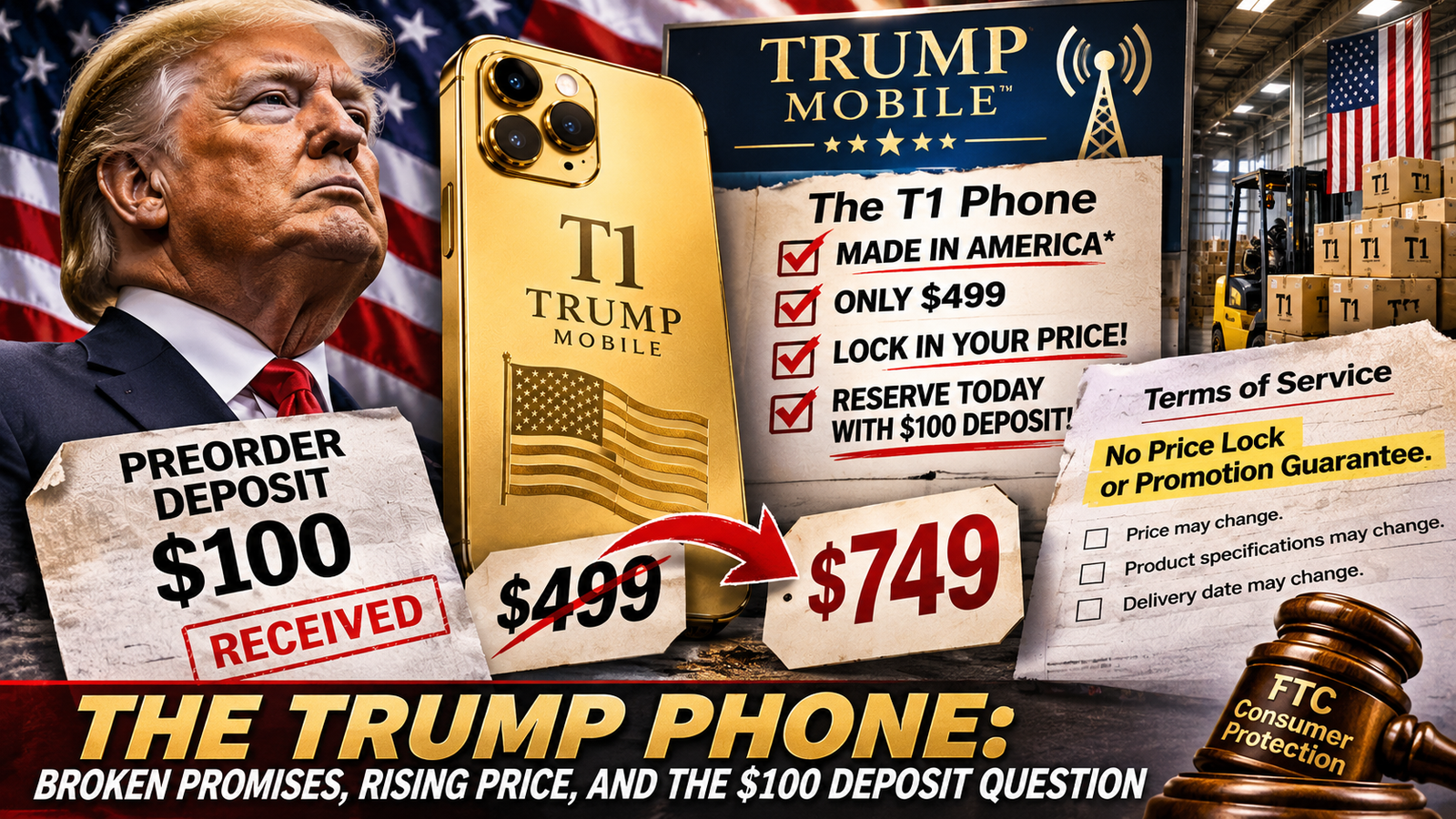
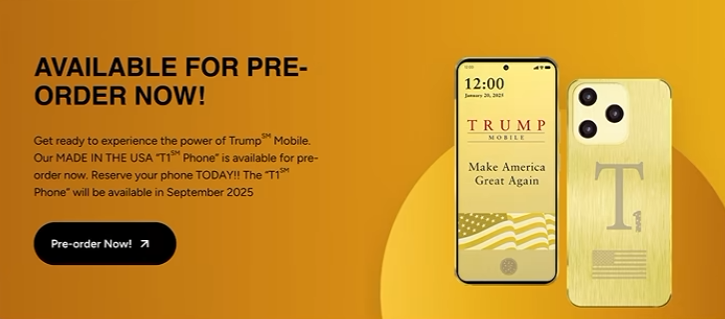
The T1 Phone would cost only $499, and customers could reserve their place in line with just a $100 deposit. The device was initially promoted as MADE IN AMERICA, with availability advertised for September 2025.
THE FIRST BROKEN DEADLINE: SEPTEMBER 2025
Trump Mobile’s original advertisement did more than promise an American-made smartphone. It explicitly announced that the T1 Phone would be available in September 2025. That deadline came and went without delivery. October passed, then November, then December. By January 2026, customers were still waiting.
It was not until May 13, 2026—more than seven months after the advertised September deadline—that Trump Mobile announced shipments were beginning. Even then, the company declined to disclose how many phones had been ordered or shipped.
For customers who paid $100 deposits in anticipation of a September 2025 release, the question is unavoidable: What happened to their money during those additional months, and what obligations did Trump Mobile incur by failing to meet its advertised delivery date?
Clearly, the proposition was straightforward: be a patriot, support an American enterprise, purchase an American-made smartphone, and secure promotional pricing before the opportunity disappeared.
It was a powerful combination of patriotism, brand loyalty, and purchasing urgency.
But behind the gold finish and American flags, the promises began changing.
Delivery dates slipped. Manufacturing claims evolved. Product specifications shifted. And the company’s contractual terms eventually made clear that placing a deposit did not guarantee the advertised price, the originally described product, or even the opportunity to purchase a completed phone. Remember the ‘ol switcheroo?
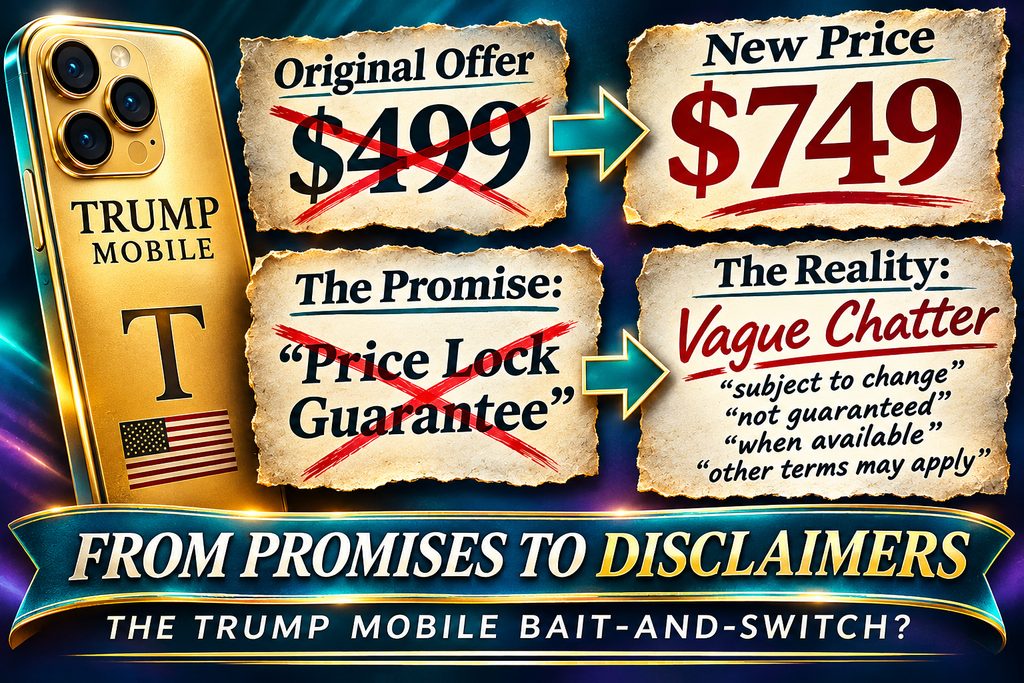
By September 2026, the advertised price had increased to $749, a 50% increase over the “locked in” price offer.
That alone would justify examining the company’s marketing practices. But the more consequential questions concern the money collected from customers, the businesses behind the Trump Mobile name, and the obligations those businesses may ultimately have to honor.
Because a smartphone can be manufactured, rebranded, delayed, or replaced.
A customer’s money is another matter.
Fraud by Design: A Marketing Professional’s Assessment
The first message prospective customers encountered was unmistakable:
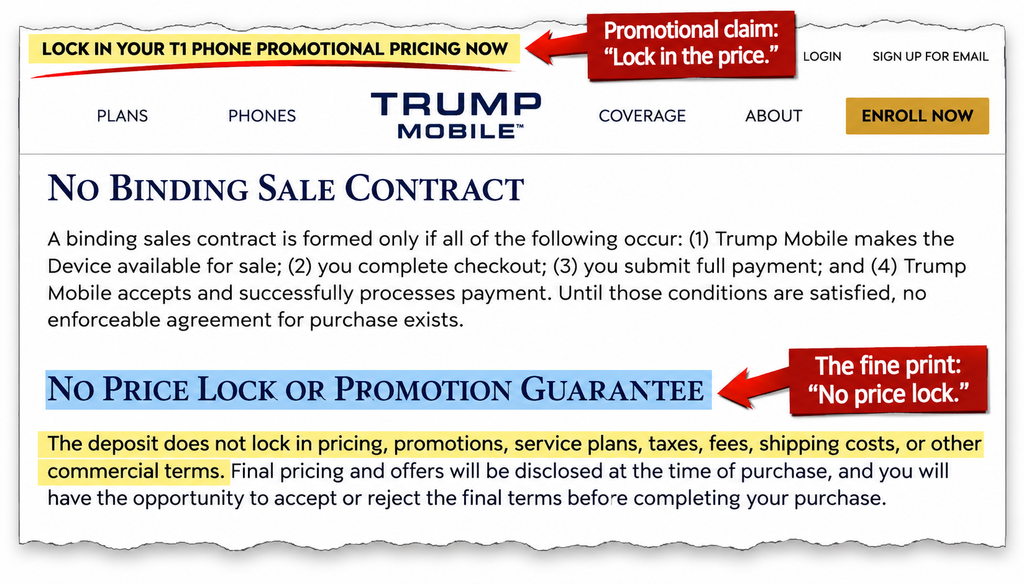
Yet Trump Mobile’s subsequently revised contractual terms declared:
“No Price Lock or Promotion Guarantee.”
The terms explicitly stated that a deposit did not secure the advertised price.
As a career marketing professional, I recognize the significance of that arrangement. Advertising placement, messaging hierarchy, and calls to action are fundamental elements of consumer decision-making. A prominent promise can induce a purchase decision long before a customer encounters the qualifying language farther down the page.
Based on my professional experience and my examination of the evidence, it is my opinion that a deliberately engineered deception in the customer’s purchasing journey occurred.
I do not regard this as an innocent inconsistency. In my assessment, the promotional message was designed to create an expectation that the contractual terms expressly refused to honor.
The company invited consumers to commit their money on the strength of a promise it simultaneously disclaimed.
The promise was made at the top of the page, as was the call to action/enroll now button. The escape clause was waiting below.
What Does Federal Advertising Law Say?
The Federal Trade Commission has long recognized the problem of attracting customers with an appealing offer that the seller does not genuinely intend to fulfill on the advertised terms.
Its Guides Against Bait Advertising, 16 CFR Part 238, describe deceptive practices involving advertised offers that are not bona fide efforts to sell the represented merchandise.
The regulation addresses more than an outright refusal to sell. It also examines misleading representations concerning a product’s characteristics, origin, availability, and the conditions under which it is offered.
Importantly, is it a legitimate promotional offer? Or an offer designed to secure a consumer’s commitment under expectations the seller does not intend to honor? This is a scab that needs to be removed.
A price increase, by itself, does not establish bait advertising. Nor does the existence of contractual qualifications automatically make an advertisement unlawful. In a nutshell, the question is whether the overall purchasing experience materially misled consumers and whether the offer was genuine.
That question became particularly relevant when the company swapped the marketing narrative while subsequently changing the advertised price. A double-switcheroo, masterfully parlayed.
The Price-Lock Promise Meets Reality
What initially appeared to be a contradiction between Trump Mobile’s advertising and contractual terms became considerably more consequential in September 2026.
The company had promoted its T1 smartphone at $499 while soliciting $100 preorder deposits. Customers were promised a locked-in preorder price.
Trump Mobile’s original June 16, 2025 Terms of Service also warned that “Prices and fees may change.” Meanwhile, its separate Terms of Use contained mandatory arbitration and a class-action waiver. Customers were encouraged to secure promotional pricing while the company’s legal documents reserved flexibility over prices and also attempted to contractually restrict how disputes could be pursued.
Its revised terms, dated April 6, 2026, explicitly disclaimed any guarantee that customers would receive the advertised price.
Then the advertised price increased to $749.
That’s $250 more—a 50% increase over the original advertised price.
The significance is not simply that a company raised its price. It is that customers were encouraged to commit money through promotional messaging about locking in pricing while the contractual language denied them that protection.
The later price increase demonstrates why that distinction mattered.
Whether individual customers who deposited $100 were ultimately required to pay the higher price remains a separate question requiring verification. The April 2026 terms also cannot automatically be applied to deposits made under earlier agreements; the company’s own language states that the version in effect when a deposit was placed governs that deposit.
Nevertheless, the contradiction between the promotional promise and the revised contractual disclaimer was no longer merely theoretical.
The price changed. The promised protection was nowhere to be found in the revised terms.
But pricing was only one element of the original offer that changed.
Made in America—Until the Language Changed
When Trump Mobile introduced the T1, American manufacturing was central to its appeal.
The device was presented as an American-made alternative to smartphones assembled overseas. For consumers motivated by domestic manufacturing, that distinction was not incidental. It was part of the product’s identity.
As the months passed, the company’s descriptions became less definitive.
Language emphasizing American manufacture gave way to references to American innovation, American teams, and American involvement in design and quality.
Those are not equivalent claims.
A phone can be designed in the United States, inspected by an American company, sold under an American trademark, and still be manufactured primarily overseas.
The distinction matters because consumers were not merely purchasing technical specifications. They were being invited to make a patriotic purchasing decision.
Independent examinations of the T1 subsequently raised questions about the handset’s origins. Technology reviewers identified substantial similarities between the Trump-branded device and HTC’s U24 Pro, a smartphone introduced for 2024 before Trump Mobile announced its product.
The resemblance extends beyond a superficial similarity in appearance. Reviewers have pointed to shared hardware characteristics and design elements that suggest the T1 may be based on an existing device rather than an entirely new American-engineered platform.
That does not conclusively establish the handset’s manufacturing arrangements or prove that HTC supplied Trump Mobile directly.
But it creates an obvious question.
If the T1 is substantially derived from an existing overseas smartphone, what exactly did Trump Mobile contribute beyond its branding, distribution arrangements, and marketing?
The answer should be relatively simple to document: identify the manufacturer, the assembly facilities, the supply chain, and the extent of American production.
Instead, those details have remained a source of public controversy.
The phone did eventually begin reaching customers and reviewers in May 2026, nearly a year after its announcement. Its existence is no longer hypothetical.
Its commercial history, however, remains difficult to reconcile with the simplicity of the original sales pitch.
And that brings us to the business itself.
Behind the Trump Name: Who Actually Runs Trump Mobile?
To understand Trump Mobile, it is necessary to distinguish the brand customers recognize from the legal entities responsible for operating the business.
The name on the product is Trump.
But the company identified in customer agreements is T1 Mobile LLC, doing business as Trump Mobile.
Reporting has also identified Liberty Mobile as a significant operational participant, while questions have arisen concerning the involvement of Ensurety Ventures and other associated businesses.
The Trump Organization’s role includes licensing the Trump name and related intellectual property. It has disclaimed responsibility for designing, manufacturing, or selling the handset.
These distinctions are not merely administrative.
In a corporate arrangement involving multiple entities, the business that advertises a product, the business that processes a payment, the business that fulfills an order, and the business that receives licensing revenue may not be the same. These functions are segregated by design. Segregation creates Gapportunity™.
Nor does a familiar brand necessarily guarantee the obligations of a separately organized company using its name.
Consider the implications for a customer who paid a $100 deposit because the product carried the Trump name.
Which company received that payment?
Which company holds it?
Which company must refund it?
And which company, if any, has already received revenue generated by the transaction?
The available public record does not establish the complete movement of preorder funds among these entities.
That is precisely why the corporate relationships deserve examination.
A trademark license can generate revenue for the owner of a brand without making that owner responsible for every debt incurred by the licensee.
There is nothing inherently improper about that arrangement. It is a familiar feature of modern commerce.
The concern arises when customers reasonably associate the financial strength and reputation of a famous brand with a business whose actual obligations may rest elsewhere.
The brand sells the confidence. The contract determines who owes the money.
To determine whether those two things align, we need to follow the deposits.
How Much Money Did Trump Mobile Collect?
The advertised preorder deposit was $100. The claim was that your $100 deposit locks in your $499 price.
That figure sounds modest when considered as an individual transaction. Multiplied across a large customer base, however, it could represent substantial funds.
Although we have yet to obtain Trump Mobile’s financial records, reports circulating from Washington to New Delhi have placed the number of prepaid orders near 590,000—representing approximately $59 million in potential customer deposits. The figure remains unverified, and Trump Mobile has thus far not been willing to publicly confirmed the actual number of paid preorders.
Without a verified customer ledger, the estimate cannot establish the number of completed payments, cancellations, refunds, duplicate orders, or phones delivered.
Nevertheless, the possibility of substantial customer deposits raises a financial question independent of the eventual sale of the handset.
What happened to the money while customers waited?
The Hidden Value(s) of Customer Deposits
A customer deposit has value beyond the purchase it is intended to secure.
Money held by a business is money no longer available to the customer who paid it.
Depending on how those funds are managed, deposits may generate interest, provide working capital, or reduce borrowing costs. Even when a customer eventually receives a full refund, the financial benefit of holding that money in the meantime may remain with someone else.
Consider this hypothetical example.
If a business held $50 million for a full year at a 4 percent annual return, the gross earnings would be $2 million. At 5 percent, the figure would rise to $2.5 million.
At 4.5 percent, the result would be approximately $2.25 million.
Those figures are illustrations, not findings about Trump Mobile. We have not established that the company collected $50 million, retained that amount for a year, invested it, or earned any interest.
The deposits may have been collected gradually, refunded, applied to purchases, or used in ways that generated no investment return.
But the economic principle remains:
A business does not necessarily have to complete a sale to benefit from collecting a customer’s money.
The company’s April 2026 preorder terms expressly state that deposits do not accrue interest for customers.
What the terms do not disclose is whether the funds generate any financial benefit for the business holding them.
Were deposits maintained in segregated accounts? Were they commingled with operating funds? Were they used to purchase inventory or finance business expenses? Were any amounts transferred to affiliated entities?
Who controlled the accounts?
And who ultimately benefited?
Those questions cannot be resolved by examining a promotional website.
They require accounting records.
The Bankruptcy Contingency: Who Gets Left Holding the Bag?
Donald Trump’s businesses have filed for Chapter 11 bankruptcy six times. He knows how bankruptcy can allow a business to shed debts and reorganize.
Could bankruptcy be Trump Mobile’s contingency plan? If T1 Mobile LLC becomes responsible for refunds it cannot afford, bankruptcy could leave customers competing with other creditors for whatever assets remain, while separate companies benefiting from the Trump brand continue operating.
We have no evidence such a plan exists. But the corporate structure raises a consequential question:
If the business responsible for refunding customers is not the same business ultimately benefiting from their payments, what happens when the refunds come due?
The brand survives. But the debts?
Congressional Questions—and the Value of Silence
On October 8, 2026, Senator Maggie Hassan, ranking member of the Joint Economic Committee, publicly challenged Trump Mobile over consumer privacy, security, telecommunications compliance, and its business relationships.
Her inquiry followed reports of customer-data exposure and concerns about whether Trump Mobile and its operating partners had satisfied applicable Federal Communications Commission requirements.
The senator requested information concerning the company’s operations, ownership, customer protections, and financial arrangements, with a response deadline of October 29.
The questions were not limited to whether the T1 worked as advertised.
They concerned who was operating the service, whether customers were adequately protected, and whether the company’s regulatory obligations were being fulfilled.
As of this investigation, we have not located a publicly available response addressing the Senator’s questions.
That does not establish that Trump Mobile failed to answer the senator privately.
But it leaves the public without answers to matters central to understanding the business.
Silence as a Strategy of Delay
One recurring mechanism examined in The Trump Extraction is the strategic value of nonresponse.
When questions about public accountability go unanswered, the resulting delay can benefit those whose conduct is under scrutiny. Deadlines pass, investigators pursue follow-up inquiries, and the burden of obtaining information shifts to those demanding accountability.
Strategic delay can also have economic consequences.
Funds remain under someone else’s control. Customers must decide whether to wait, request refunds, or pursue other remedies. Investigators must work to obtain information that the business itself possesses.
This does not prove that Trump Mobile deliberately adopted silence as a financial strategy. I bring this up to help display why timely disclosure matters. “Houston, we have a serious transparency issue.”
In a business collecting customers’ money, time, information, and energy, delay itself has an economic value.
The concerns raised by Senator Hassan extend beyond financial accountability. They reach into the security of the communications network and the personal information entrusted to it.
When a Communications Device Becomes Someone Else’s Instrument
A smartphone is not simply a telephone.
It can contain a customer’s contacts, photographs, correspondence, location history, authentication credentials, banking applications, and access to personal and professional accounts.
Its security depends on far more than the name printed on the back.
The hardware supply chain, operating system, software updates, network operator, and customer-data infrastructure all matter.
That makes transparency about Trump Mobile’s technical partners particularly important.
The Customer-Data Problem
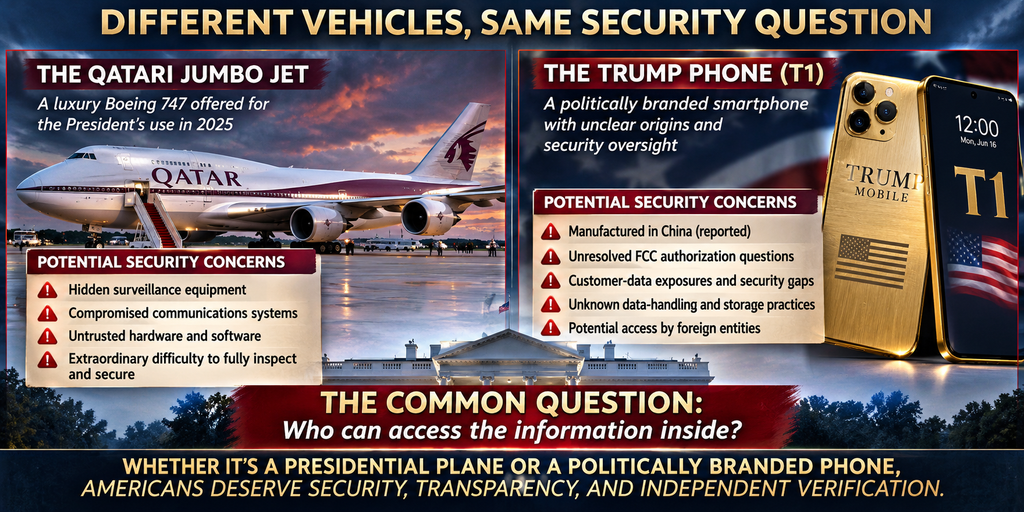
In May 2026, Trump Mobile confirmed that customer information had been exposed in a security incident attributed to a third party.
Subsequent reports described additional claims of compromised customer information, including an October incident in which a ransomware group asserted that it had obtained records associated with thousands of users.
Some exposed records were reportedly corroborated by journalists. But the full scope of the alleged intrusion, the attacker’s method, and the extent of any continuing access have not been independently established.
The available reporting raises questions about the security practices of the businesses handling Trump Mobile customers’ information.
Senator Hassan’s inquiry also identified apparent gaps in publicly available FCC filings involving Trump Mobile and Liberty Mobile, including records relevant to preventing illegal calls and verifying telecommunications authority.
Those concerns require regulatory clarification; and I concede that a seemingly missing filing is not, by itself, a final determination of wrongdoing.
But a telecommunications provider cannot ask consumers to trust its patriotic branding as a substitute for, or in in leu of independently verifiable security protocols and FCC compliance.
Lessons from Compromised Technology
The danger of compromised electronics is not speculative.
As early as 2006, Princeton University researchers demonstrated how malicious software could manipulate certain Diebold voting machines and spread between devices. CNN reported on the findings.
In 2011, researchers at Argonne National Laboratory demonstrated how an inexpensive hardware modification installed on-site, in minutes, could enable remote manipulation of another Diebold voting system.
Those were ethical business attacks involving specific vulnerabilities and access requirements. They did not demonstrate that every electronic device is equally susceptible, but the underlying lesson extends well beyond voting machines:
The person holding an electronic device is not necessarily the person controlling it.
The September 2024 Israeli attacks, involving explosive pagers and walkie-talkies in Lebanon, demonstrated another kind of supply-chain vulnerability: communications equipment physically altered before reaching its intended users. 39+ killed, 3000+ injured including innocent women and children and shoppers at market.
Those devices were not ordinary smartphones. Their destruction depended on concealed explosives and a controllable remote detonation system.
The relevance is the larger principle that a device’s appearance and branding do not establish the integrity of its components or supply chain.
Similar verification questions have arisen in other high-profile Trump arenas.
The proposed use of a Qatari-provided Boeing 747-8 as a presidential aircraft raised concerns about the extraordinary counterintelligence inspection and modification such an aircraft would require.
Likewise, controversies surrounding access to sensitive federal databases during the Department of Government Efficiency initiative illustrated why the identity, authority, and oversight of those controlling information systems matter. I suspect Elon knows as much about you as your mother does now.
Yes, situations differ, yet each returns us to a common question:
Who has access, and how do we independently verify the safeguards?
And, dear reader, there’s one small coincidence I can’t quite bring myself to overlook: in Terminator 3, the T-1 was an early autonomous killing machine. Now we have the Trump T1, a phone surrounded by unanswered security questions.
I’m sure it’s just a coincidence.
Although I do wonder whether Pete Hegseth was consulted on the name.
We have no evidence that the Trump T1 has been compromised—or has Gatling guns. Nor are we suggesting that it has.
Nevertheless, the documented history of weaponized communications technology gives consumers ample reason to remain vigilant.
The consumer sees the brand on the outside. What matters for security is who controls what’s inside.
The irony is that the fundamental problem of trusting a seller’s promises is much older than smartphones, cybersecurity, or telecommunications regulation.
It reaches back to the American frontier.
From Soapy Smith to the Smartphone
More than a century ago, Jefferson Randolph “Soapy” Smith made a career of separating customers from their money through the theatrical promise of something more valuable than what they were actually buying.
Smith became notorious for confidence schemes involving bars of soap, supposed prizes, and carefully managed expectations.
His activities took him into the world of the Klondike Gold Rush, where prospectors, merchants, and opportunists converged in pursuit of fortune.
Friedrich Trump, Donald Trump’s grandfather, was also part of that commercial world, operating businesses that served prospectors along the routes toward the goldfields.
Friedrich Trump and the infamous Soapy Smith were contemporaries in the Klondike Gold Rush. Given Smith’s notoriety among the prospectors and merchants of that era, it is difficult to imagine Friedrich Trump was unaware of him.
That is a historical inference, not evidence that the two men met, collaborated, or engaged in the same activities.
Readers of The Trump Extraction: An Investigative Triptych will recognize Soapy Smith as a figure whose methods illuminate a recurring theme: the exploitation of expectation.
The technology has changed considerably since Smith worked the crowds of the American West.
The underlying principles of deceptive marketing have not.
Trump Mobile advertised an American-made smartphone at $499, invited customers to secure promotional pricing with a $100 deposit, and subsequently revised its contractual terms to disclaim any guarantee of the advertised price or even the eventual availability of the device.
By September 2026, the advertised price had risen to $749.
The original promise had attracted the customer.
The contractual language preserved the seller’s options.
As a marketing professional, I recognize this pattern as bearing the hallmarks of bait-and-switch advertising. Whether it constitutes an actionable violation is a matter for regulators and courts, but the contradiction between the promotional message and the company’s reserved contractual rights is visible in the record.
Soapy Smith sold 5 cent bars of soap for five dollars; with a promise you could “wash your sins away.” Trump Mobile sold two-year-old gold-painted Taiwanese cellphones, with the promise of “Made in the USA,” and a “price lock.”
The question becomes, what did customers actually receive for their money? Or, how badly were they gouged?
November 2026: The Phone Has Arrived. The Answers Have Not.
As this investigation reaches November 2026, Trump Mobile is no longer merely a story about a promised smartphone that failed to appear on schedule.
Phones have reached at least some customers and reviewers.
Independent technical examinations have raised substantial questions about the handset’s origins, which have now been proven to be from Taiwan, via China.
The advertised (and originally promised/locked-in) price has climbed from $499 to $749, a whopping 50% increase in less than a year.
The company faces congressional questions about consumer protection, telecommunications compliance, corporate relationships, and the security of customers’ personal information.
And the most consequential financial questions remain unresolved.
How many customers actually paid $100 deposits?
How much money was collected?
Who controlled those funds?
Were they held in dedicated accounts, used as operating capital, or transferred to affiliated entities?
Who benefited financially during the months customers waited?
How much licensing revenue, if any, was generated from the preorder program?
And I should mention that it has crossed this authors mind that those initial $100 deposits may have financed the entire operation. Imagine, if you will, what I have after gobs and bunches of research into this investigation; that is, what if the 2024 model phone could be liquid purchased in 2026 for $80 per unit. This would be quite reasonable if the lot were classified as “distressed inventory.” If that was the negotiated unit price, they would have not had to put any of their own money at risk. Think of a pre-paid t-shirt print-on-demand service. I do like that example. I hope that you, my reader gets it.
And if refunds become necessary, which company has both the legal responsibility and the financial resources to honor them?
These are all very important questions that could be addressed through corporate records, banking documentation, payment-processing records, licensing agreements, and testimony from the people responsible for operating the business.
The answers should not depend on speculation about a gold-colored telephone.
They should depend on evidence.
The FTC has authority to investigate deceptive marketing practices. Telecommunications regulators can examine compliance and consumer protections. Congressional investigators can pursue relevant records through their oversight processes and the power of subpoena.
Customers, meanwhile, deserve accurate information about what they purchased, the terms governing their deposits, and the company responsible for fulfilling those terms.
This investigation does not establish that Trump Mobile is operating a fraudulent deposit scheme, secretly invested customers’ funds, or planning to abandon its customer obligations through bankruptcy.
What it establishes is a documented pattern of changing promotional representations, broken promises, delayed fulfillment, revised contractual protections, a substantial advertised price increase, and significant unanswered questions about the business behind the brand.
Those findings warrant scrutiny on their own.
Because the essential question is not whether the Trump name can sell a phone.
It plainly can.
The question is whether the companies benefiting from that name can demonstrate that the promises used to obtain customers’ money were honored, despite evidence they were not, and that the financial obligations created by those promises remain enforceable.
The phone may finally have arrived.
The accounting has not.
Principal sources and further reading
- Federal Trade Commission — Guides Against Bait Advertising, 16 CFR Part 238
- Trump Mobile — Device Preorder Deposit Terms and Conditions, updated April 6, 2026
- The Verge — Trump Mobile and Liberty Mobile’s operating relationship
- The Verge — T1 Phone Price Increase
- CBS News — Trump Mobile Says Its Phone Will Ship, May 14, 2026
- U.S. Joint Economic Committee — Senator Hassan’s October 8, 2026 Trump Mobile Inquiry
Leave a Reply