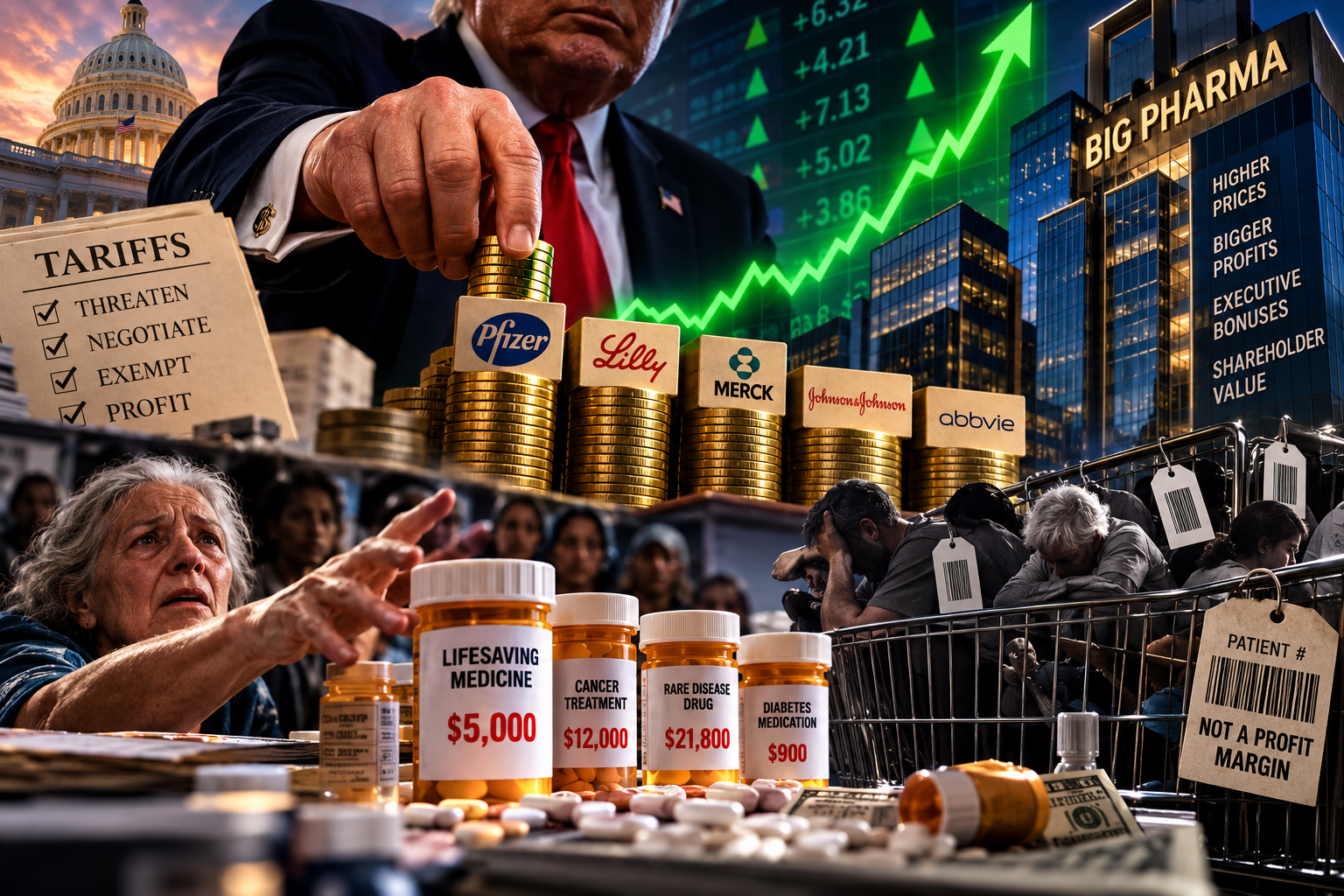
The president now holds tens of millions in pharmaceutical stocks. His administration makes decisions affecting the companies behind those stocks. Meanwhile, Americans face the possibility of paying thousands more for medicines they cannot live without.
There is something profoundly disturbing about a government that can protect a drug company’s profits while leaving a patient struggling to afford the treatment that keeps them alive.
For that patient, a prescription is not an investment opportunity. It is not a quarterly earnings report. It is not a bargaining chip in a trade negotiation.
It may be the difference between life and death.
Yet President Donald Trump’s financial disclosures reveal extensive investments in pharmaceutical companies whose revenues, costs, and competitive positions can be directly affected by decisions made in Washington.
The timing deserves scrutiny.
In 2025, Trump signed legislation expanding an exemption from Medicare drug-price negotiations for certain expensive medicines. His administration simultaneously negotiated pharmaceutical pricing agreements that offered drugmakers substantial regulatory and tariff concessions.
Throughout this period, Trump’s investment portfolio accumulated pharmaceutical stocks.
The question is no longer simply what the president owns. It is what happens when the president exercises governmental authority over industries in which he has substantial financial interests.
The $56 Million Pharmaceutical Portfolio
On October 16, 2026, Democratic staff of Congress’s Joint Economic Committee released an analysis of Trump’s financial disclosures.
Their findings were extraordinary.
According to the committee, the maximum disclosed value of Trump’s pharmaceutical holdings increased from approximately $1.7 million in 2024 to $56.2 million in 2025.
As much as $39.1 million was held in companies identified by the committee as beneficiaries of changes to Medicare drug-price negotiations.
These are upper-bound estimates based on financial disclosure ranges, not exact portfolio valuations or realized investment profits. Nevertheless, they establish the magnitude of the financial interests involved.
The committee also found that pharmaceutical companies benefiting from the legislative exemption reported at least $54 billion in 2025 U.S. sales of affected medicines.
These figures demand more than a passing acknowledgment. They demand examination of the relationship between presidential power, corporate financial interests, and public health.
July 2025: The Orphan Cures Act
The pivotal legislative development occurred during the passage of the 2025 federal tax and spending legislation.
On July 1, the Senate passed legislation containing the Orphan Cures Act provision.
Three days later, on July 4, President Trump signed the legislation into law.
The provision expanded an existing exception to Medicare’s drug-price negotiation program for certain medications developed to treat rare diseases.
Previously, the exception was narrower. The revised provision allowed qualifying medicines approved for multiple rare diseases to remain outside the negotiation program under conditions established by the legislation.
Supporters argued that the change would encourage pharmaceutical research into rare diseases.
But the exemption also provided a significant financial benefit to manufacturers of certain costly medicines, including products already generating substantial revenue.
And the Trump portfolio has been very busy buying pharmaceutical stocks, very busy.
According to reporting based on the congressional analysis, Trump’s investments included as much as $950,000 in pharmaceutical-stock purchases on July 1, 2025, the same day the Senate passed the legislation.
Across three dates preceding Trump’s signature, the reported purchases reached as much as $2.55 million.
The precise time of the July 1 transactions relative to the Senate vote has not been established. The purchases therefore do not prove advance knowledge or improper trading.
But the coincidence of dates is plainly relevant to an investigation of presidential financial interests.
The president signed legislation benefiting an industry in which his portfolio was accumulating substantial investments.
That is a documented intersection of private financial exposure and public authority.
Who Pays for the Exemption?
The consequences of Medicare’s inability to negotiate certain drug prices are not abstract.
The Joint Economic Committee’s Democratic staff estimated that the expanded exemption could increase annual out-of-pocket costs for some Medicare beneficiaries by thousands of dollars compared with a scenario in which Medicare negotiated the affected drug prices.
Among its estimates:
- Ultomiris: approximately $21,800 more for certain patients.
- Adcetris: approximately $9,000 more.
- Keytruda: approximately $5,200 more.
These are modeled increases, not verified bills already paid by every patient taking these medications. Actual costs depend on coverage, eligibility, treatment, and Medicare’s benefit rules.
But the underlying issue is unmistakable: preventing Medicare from negotiating a lower price can preserve pharmaceutical revenue while limiting potential savings for patients and taxpayers.
Consider what that means for someone confronting cancer.
A diagnosis can already destroy a family’s financial security. Treatment may require months or years of appointments, travel, missed employment, and mounting expenses.
The patient does not get to negotiate the price of survival.
The manufacturer, however, may receive protection from federal price negotiations.
And the president whose signature helped establish that protection owns investments in companies operating within the affected industry.
Whose financial security is the government protecting?
The 2026 Trading Record: The Buying Continued
The purchases did not end with the 2025 legislation.
Trump’s official OGE Form 278-T, received in May 2026, contains hundreds of transactions from the first quarter of 2026.
The report identifies purchases involving Eli Lilly, Pfizer, AbbVie, Merck, Johnson & Johnson, Bristol Myers Squibb, and other pharmaceutical and healthcare companies.
Among the directly documented transactions:
| Company | Purchase date | Disclosed transaction range |
|---|---|---|
| Bristol Myers Squibb | January 8, 2026 | $100,001–$250,000 |
| Eli Lilly | March 2, 2026 | $100,001–$250,000 |
| Abbott Laboratories | February 24, 2026 | $100,001–$250,000 |
| Abbott Laboratories | March 18, 2026 | $100,001–$250,000 |
| Zoetis | January 12, 2026 | $250,001–$500,000 |
Source: Donald J. Trump, OGE Form 278-T, May 2026, transaction entries 265, 180, 168, 174, and 87, respectively.
The filing contains additional pharmaceutical transactions, including repeated purchases across multiple companies and dates.
This is not merely a record of an inherited stock portfolio sitting untouched while its owner holds public office.
It is a record of active securities transactions during the presidency.
The disclosures identify the transactions, their dates, and their value ranges. They do not establish who selected each investment or whether the president personally directed any trade.
But they do establish something fundamental: the president continued to have financial exposure to an industry subject to decisions by his own administration.
Pfizer: Drug Pricing, Tariffs, and Presidential Power
On September 30, 2025, the Trump administration announced a pharmaceutical pricing agreement with Pfizer.
The White House presented the agreement as an initiative to reduce American prescription-drug prices by linking certain prices to those paid in other developed countries.
But the arrangement also involved concessions to Pfizer.
The company subsequently disclosed that the agreement provided a three-year period of protection from certain pharmaceutical tariffs, conditioned on additional domestic manufacturing investment.
Tariff relief has financial value.
It can reduce business costs, protect margins, and provide greater certainty for investment decisions.
That does not mean the agreement lacked benefits for patients. Some provisions were intended to produce lower prices, particularly through Medicaid arrangements.
The important question is whether the benefits claimed for patients justify the concessions granted to manufacturers—and whether the complete terms allow independent verification.
The publicly disclosed financial arrangements have not always provided the transparency necessary to answer that question.
Documents obtained through public-records requests subsequently exposed additional provisions in pharmaceutical agreements involving Pfizer and Eli Lilly. Significant portions remained redacted.
The public was being asked to accept claims of lower prices without access to all the information necessary to measure the agreements’ full financial consequences.
Meanwhile, Trump’s portfolio contained investments in major pharmaceutical companies, including Pfizer.
The currently examined transaction records establish Pfizer purchases in 2026. They do not yet establish the precise size of his Pfizer holdings on September 30, 2025.
That distinction matters.
But so does the larger question:
Why should the public have to reconstruct the president’s financial exposure from scattered disclosure reports while his administration negotiates arrangements worth potentially billions to the pharmaceutical industry?
Eli Lilly: A Company at the Intersection of Pricing Policy and Investment
Eli Lilly provides another example of the overlap between federal pharmaceutical policy and presidential investments.
The company entered a drug-pricing arrangement with the Trump administration in November 2025.
A subsequent definitive agreement was dated February 23, 2026.
Trump’s financial disclosure identifies a purchase of Eli Lilly shares on March 2, 2026, valued between $100,001 and $250,000.
Additional Lilly transactions appear in the same filing.
The agreements involved efforts to align certain American drug prices with international benchmarks, alongside negotiated terms affecting participating manufacturers.
The policy cannot be assessed simply by accepting the administration’s description of its objectives.
It must be examined through the actual terms: which drugs qualify, which patients receive discounts, what concessions manufacturers obtain, and how much money patients ultimately save.
A discount advertised in a presidential announcement is not the same thing as affordable access to treatment.
And a pharmaceutical agreement that benefits some patients does not automatically eliminate concerns about financial conflicts.
The Human Cost Is Not a Footnote
There is a tendency in financial investigations to let the numbers overwhelm the people.
Millions in stock purchases. Billions in pharmaceutical revenue. Percentages of market movement. Negotiated exemptions. Regulatory concessions.
But these figures represent decisions with consequences in hospitals, pharmacies, nursing homes, and family kitchens across America.
A patient who cannot afford a necessary medication may delay treatment, reduce doses, skip prescriptions, or abandon treatment altogether.
Depending on the disease and medication, the consequences can be devastating.
The financial interests of drug manufacturers and shareholders are measurable. The suffering of patients denied affordable treatment is harder to calculate.
That does not make it less real.
Nor does it make it less deserving of governmental attention.
When government policy protects pharmaceutical revenue, potentially at the expense of patient savings, the public has every right to ask who is being protected—and why.
When the president also holds investments in the affected industry, that question becomes more urgent.
The Conflict That Financial Disclosures Cannot Resolve
The White House has stated that Trump’s securities portfolio is managed by independent financial institutions and that neither Trump nor his family directs the transactions.
That assertion addresses who makes the trades.
It does not, by itself, resolve the broader concern about a president maintaining financial interests in companies affected by presidential decisions.
A financial conflict does not disappear simply because someone else presses the purchase button.
The relevant questions include whether the president benefits financially from corporate performance, whether the public can evaluate the government’s decisions independently, and whether adequate safeguards prevent private financial interests from compromising public responsibilities.
The available evidence does not establish that Trump directed pharmaceutical trades using confidential information. Nor does it prove that a particular drug-pricing decision was made to increase his personal wealth.
Those are questions for further investigation, not findings this report can honestly claim.
But the documented overlap is substantial.
The portfolio expanded dramatically. Purchases continued. The administration made consequential pharmaceutical policy decisions. Some of those decisions provided identifiable financial benefits to manufacturers in the sector.
The public deserves an accounting of those intersections.
Follow the Money. Then Follow the Medicine.
The pharmaceutical investigation reveals a troubling convergence of financial ownership and executive authority.
The president’s portfolio accumulated substantial investments in drug manufacturers.
His administration negotiated arrangements affecting those manufacturers’ prices, tariffs, and market conditions.
He signed legislation expanding an exemption from Medicare drug-price negotiations.
And congressional analysts have warned that the exemption could leave some patients paying thousands more for essential treatments.
No single stock transaction proves corruption. No single presidential agreement proves that patients were sacrificed for investment returns.
But the accumulation of documented facts makes the need for scrutiny impossible to dismiss.
The public deserves to know the complete terms of pharmaceutical agreements, the extent of the president’s financial exposure when consequential decisions were made, and the actual effects of those decisions on patients’ costs.
Above all, Americans deserve a government that treats access to lifesaving medicine as a public responsibility—not merely another variable in the financial performance of an industry.
When the president owns shares in the companies whose profits his administration can influence, whose interests are being served—and who bears the cost?
For shareholders, the answer may be measured in dollars.
For patients, it may be measured in years of life.
And that is why these transactions deserve investigation, public disclosure, and accountability.
Sources and evidentiary record
- U.S. Office of Government Ethics, Donald J. Trump, Periodic Transaction Report, OGE Form 278-T, May 2026, 113 pages. Original financial disclosure supplied and examined for this investigation.
- U.S. Congress, Joint Economic Committee, Democratic staff, October 16, 2026, analysis of Trump’s pharmaceutical holdings and the projected consequences of the Orphan Cures Act exemption.
- Associated Press, October 2026, reporting on the congressional analysis and Trump’s pharmaceutical investments.
- Public Law 119-21, July 4, 2025, §71203, Orphan Cures Act provision.
- The White House, September 30, 2025, fact sheet announcing the Pfizer most-favored-nation pricing agreement.
- Pfizer, 2026 annual reporting, discussion of the September 2025 administration agreement and conditional tariff relief.
- Public Citizen, documents obtained under the Freedom of Information Act concerning the Pfizer and Eli Lilly pharmaceutical pricing agreements.
- Health Affairs, analysis of the Trump administration’s pharmaceutical pricing agreements and their policy implications.

Leave a Reply