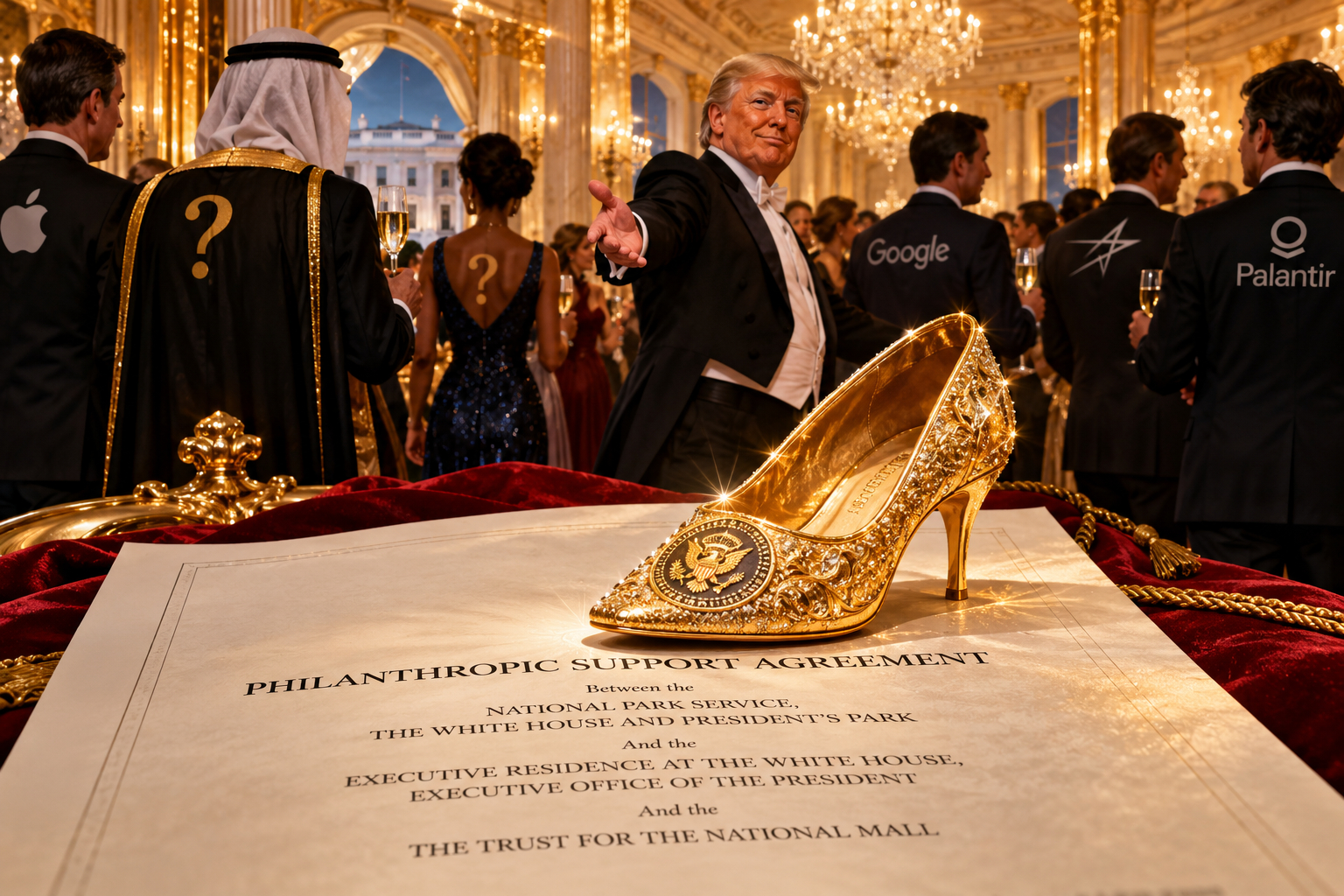
Corporate benefactors, mysterious donors, and a glass slipper that reveals how the White House arranged its own fairy-tale fundraiser.
GRAND JUNCTION, Colo., October 15, 2026 — Once upon a time in Washington, a president with a pumpkin-colored face decided he needed a ballroom.
Not just any ballroom. A magnificent ballroom, with gilded splendor, grand entrances, and enough room for the most influential guests in the kingdom.
Cinderella had a fairy godmother. Donald Trump had corporate benefactors.
And while Cinderella’s magic disappeared at midnight, the money behind this particular fairy-tale has proven considerably harder to make disappear—or fully explain.
On October 15, 2026, Public Citizen released new findings drawn from the Trust for the National Mall’s 2025 tax filing. According to its analysis, ten major contributors supplied approximately $169.7 million of the roughly $320 million the Trust received for the ballroom and other projects during that year.
Two of those major contributors remained unidentified in Public Citizen’s analysis.
Their reported contributions totaled $37.5 million.
Who were these mysterious guests? And why does a ballroom at the People’s House need a guest list the public cannot fully examine?
The Fairy Godmothers Have Names
According to Public Citizen’s October 15 findings, the ten largest contributions included three of $25 million, one of $22 million, one of approximately $20.2 million, one of $12.5 million, and four of approximately $10 million each.
Public Citizen identified eight major contributors using public reporting, court documents, tax records, and a corporate press release.
| Contributor | Reported contribution |
|---|---|
| Apple | $25 million |
| Adelson Family Foundation | $25 million |
| Unidentified contributor | $25 million |
| Alphabet/Google | $22 million |
| Laura and Isaac Perlmutter Foundation | $20.2 million |
| Unidentified contributor | $12.5 million |
| Lockheed Martin | $10 million |
| Microsoft | $10 million |
| Palantir | $10 million |
| Paolo Tiramani, BOXABL CEO | Approximately $10 million |
The Trust’s public tax filing reportedly disclosed contribution amounts but not the corresponding names. Public Citizen reconstructed eight identities from other sources.
That distinction matters. The absence of a name from a public filing does not establish that the donor was unknown to the Trust, the Internal Revenue Service, or the White House.
Nevertheless, it leaves the American public unable to identify two of the largest reported contributors to a project involving one of the nation’s most recognizable public buildings.
And the identified contributors raise questions of their own.
Public Citizen’s earlier Ballroom Billions analysis found that five corporate contributors—Apple, Alphabet/Google, Lockheed Martin, Microsoft, and Palantir—had received a combined $241 billion in federal contracts over five years.
That figure represents historical federal contracting, not payments shown to have resulted from ballroom donations. Nor does the overlap establish that contributions purchased favorable treatment. As well, it is not difficult to connect these dots.
But it does establish why public identification of donors, contracting relationships, and the rules governing their contributions matter.
Cinder-fella’s Golden Slipper
Every Cinderella story has a glass slipper.
When the clock struck midnight, the mysterious guest fled the ball, leaving behind the one object that could reveal her identity.
Washington’s ballroom has a glass slipper of its own.
It is called the Philanthropic Support Agreement.
Executed in October 2025 among the National Park Service, the Executive Residence at the White House, and the Trust for the National Mall, the agreement establishes the framework for collecting and administering private contributions to the East Wing Modernization and State Ballroom Project.
The agreement eventually became public following a Freedom of Information Act lawsuit pursued by Public Citizen.
And what does our glass slipper reveal?
Something rather different from the original fairy tale.
In Cinderella, the slipper helped identify the mysterious guest.
In Washington, the agreement establishes procedures for protecting the identities of guests who prefer to remain anonymous.
Article III requires the parties to preserve requested donor anonymity to the maximum extent practicable under law.
The Trust is also instructed not to publicly recognize project donors without written authorization from the Executive Residence.
But the agreement reveals something else.
The Executive Residence itself is responsible for identifying potential donors, referring them to the Trust, and communicating whether they wish to remain anonymous.
In other words, the White House does not simply wait for contributions to arrive.
Under the agreement, it helps identify the prospective benefactors and directs them to the organization that processes their donations.
The Trust, in turn, must enter into donation or gift agreements with contributors before receiving their funds.
There should therefore be a documentary record of those transactions, even when the public cannot see the donors’ names.
The glass slipper may not identify every guest. But it tells us who arranged the invitations and where the records should exist.
The Price of Admission—and the Cost of Collecting It
The Trust for the National Mall is a tax-exempt nonprofit organization with an established philanthropic relationship with the National Park Service.
Under the ballroom agreement, it is authorized to retain an administrative fee of 2.5 percent on the first $200 million in qualifying contributions, or up to $5 million.
For contributions beyond that threshold, the fee drops to 2 percent.
This is not evidence that the Trust improperly diverted funds. The fee is expressly authorized by the agreement.
It does, however, mean that administering the ballroom’s contributions can itself generate millions of dollars in revenue for the nonprofit.
The agreement also establishes how funds are to move.
The Trust receives and processes contributions, then transfers money to the federal parties upon written requests identifying project costs, products, or services.
The agreement further provides for financial records, reporting, and applicable inspections or audits.
And even there, the anonymity provisions reappear: audits are required to preserve requested donor privacy to the maximum extent practicable under law.
The question is not whether an administrative fee or donor confidentiality is inherently improper.
It is whether the combination of presidential fundraising, federal contractors, donor confidentiality, and limited public access provides adequate transparency for a project at the White House.
Who Checks the Guest List?
Attachment A of the agreement establishes a donation-review process.
For donations or planned series of donations exceeding $25,000, the Trust must make reasonable efforts to determine whether a donor has certain conflicts or disqualifying circumstances.
Among the specified considerations are litigation or controversy involving the National Park Service or Interior Department, business or permit relationships with the National Park Service, federal debarment, and a recent public history of violations.
The attachment also prohibits contributions from foreign nationals and foreign entities.
These safeguards are significant.
But so is their scope.
The agreement expressly addresses business relationships involving the National Park Service and Department of the Interior. It does not expressly require an equivalent review of every donor’s contracting relationships throughout the federal government.
That distinction becomes important when reported contributors include Lockheed Martin and Palantir, companies with substantial Defense Department business.
The agreement does not establish that either company received preferential treatment, nor that its donation violated any rule.
It does, however, leave a question worth asking:
Who examines potential conflicts when a ballroom contributor’s most significant federal business lies outside the department administering the donation agreement?
The answer may depend on additional ethics requirements, internal reviews, and donor records that have not yet been examined in this investigation.
The Midnight Question
Cinderella’s fairy tale was about transformation.
A pumpkin became a carriage. Ordinary clothes became a magnificent gown. An overlooked young woman entered a royal ballroom, and one forgotten slipper eventually revealed who she was.
The White House ballroom presents a different kind of transformation.
Private corporate and individual wealth is being directed toward a public presidential project through a nonprofit intermediary operating under an agreement with the federal government.
Some contributors are publicly identified. Others remain unidentified in the available reporting.
Some identified contributors also conduct billions of dollars in business with the federal government.
None of these facts, individually or together, establishes corruption. But they create a compelling public-interest case for examining the full financial arrangements.
The next questions are straightforward.
Who are the remaining unidentified major contributors? What do their donation agreements provide? What conflict reviews were conducted? Who approved the contributions? And what financial relationships exist between those benefactors and the government officials overseeing federal spending?
Those questions deserve documentary answers.
Because in Cinderella, the prince searched the kingdom to discover who had attended the ball.
In Washington, investigators are still trying to establish who paid for it.
And when the clock finally strikes midnight, the glass slipper may tell us more than the guest list ever did.
Principal sources
- Public Citizen, “White House Ballroom Megadonors Revealed,” October 15, 2026, reproduced by States News Service, Nexis Uni.
- Philanthropic Support Agreement, National Park Service, Executive Residence at the White House, and Trust for the National Mall, October 2025, particularly Article III and Attachment A.
- Public Citizen, Ballroom Billions, 2026, as cited in its October 15 release.
- Public Citizen, Freedom of Information Act litigation concerning the ballroom funding agreement, 2025–2026.
This article examines documented funding arrangements and questions of public accountability. Reported donations and federal contracting relationships are not, without additional evidence, proof of improper influence or unlawful conduct.

Leave a Reply