
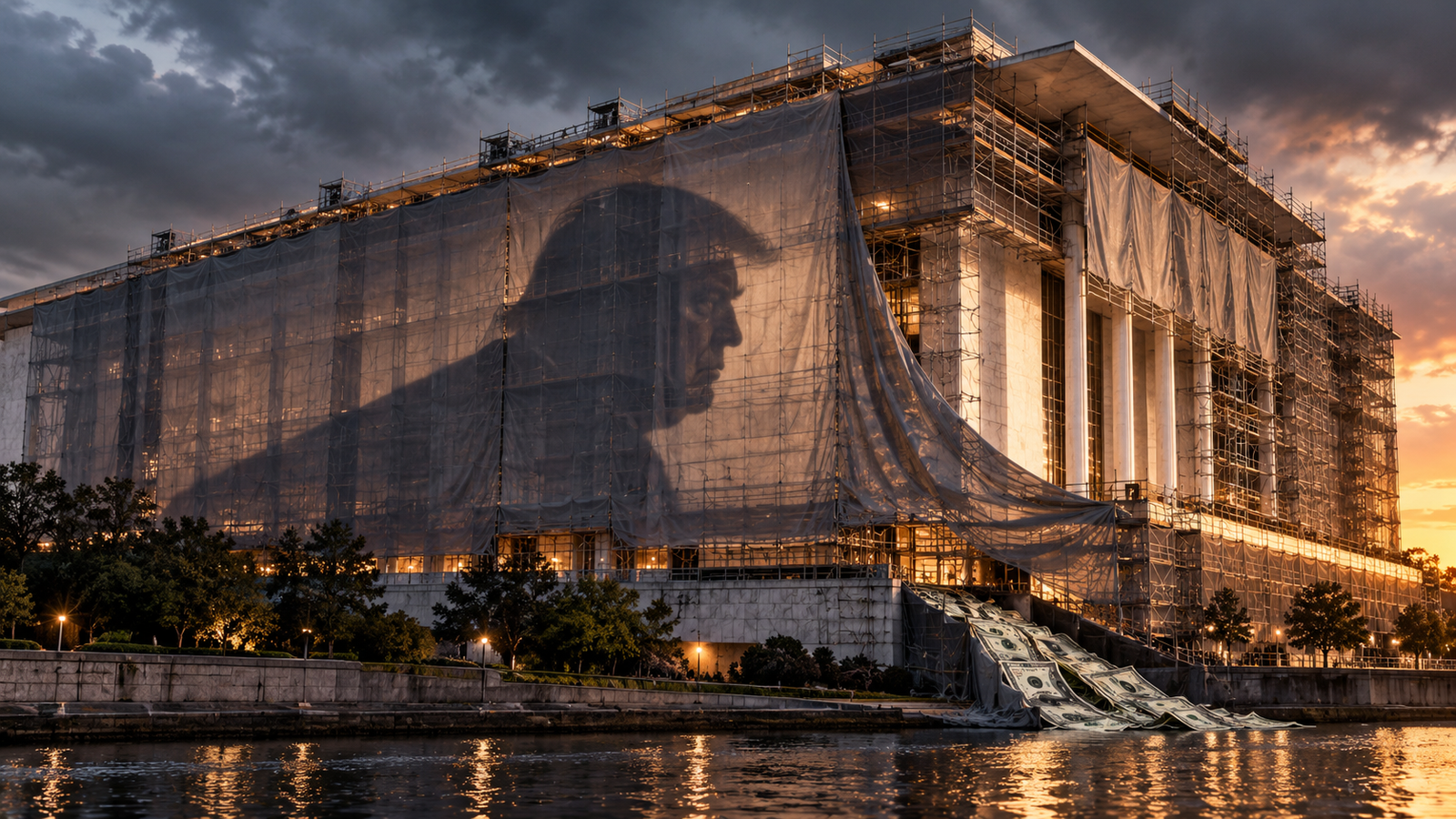
A $256.7 million appropriation, a $4.4 million column painting contract, contested presidential authority, and a federal court demanding answers. The question is no longer simply whose name appears on the building. It is who controls what happens behind the facade.
By Robert Wright | The Trumportunity Report | October 13, 2026
Behind the Curtain
WASHINGTON — The Kennedy Center has become an unusually literal illustration of a familiar problem in public accountability: what the public is permitted to see is not necessarily what the public needs to know.
In June 2026, following a federal court ruling against the addition of President Donald Trump’s name to the John F. Kennedy Center for the Performing Arts, workers reportedly removed the disputed lettering. While scaffolding and a tarp obscured the facade.
The administration maintained that it had complied with the ruling. Photographs subsequently obtained and independently verified by The Washington Post showed that Trump’s name had been removed.
But the covering generated a separate controversy. U.S. District Judge Christopher Cooper ordered the administration to explain its presence, while attorneys challenging the Kennedy Center’s leadership questioned why the public’s view of the national memorial remained obstructed.
The distinction matters. The Washington Post “evidence” supports the removal of the lettering claim; it does not establish that the administration obeyed or disobeyed the removal order. The continuing dispute concerns the covering, its purpose, and the public’s ability to observe the institution.
That is a Gapportunity™: the space between an official account and the independent verification necessary for meaningful accountability.
And behind that curtain lies a considerably larger question.
Congress has appropriated more than a quarter-billion dollars for the Kennedy Center’s physical restoration. Meanwhile, whistleblowers have raised allegations about contracting procedures, redirected maintenance funds, inferior materials, and work that may need to be performed again.
The story has moved beyond a name on a wall.
It now involves the money.
A National Memorial Under Presidential Direction
The Kennedy Center is not merely another performing-arts venue. Congress established it as a living memorial to President John F. Kennedy, with statutory responsibilities for both artistic programming and stewardship of the building and grounds.
During Trump’s second administration, the Center’s governance changed dramatically. Trump became chairman of a board dominated by his appointees. The board moved to incorporate his name into the institution’s identity and pursued extensive changes to its operations and physical facilities.
Those actions prompted litigation, including a challenge brought by Representative Joyce Beatty of Ohio, a Kennedy Center trustee.
On May 29, 2026, Judge Cooper ruled against the disputed renaming. Subsequent orders addressed additional inscriptions and changes to the grounds.
The confrontation escalated in September.
Following the Center’s abrupt closure amid reported structural concerns, Trump publicly discussed the possibility of tearing down the building. Photographs showed him examining material referring to demolition.
On September 17, Cooper ordered that the plaintiffs receive more than 30 days’ written notice before implementation of changes to the renovation plans previously presented to the court, including any demolition of the main building.
The order did not establish that demolition had occurred or that the administration had already violated a demolition prohibition. It established a judicial requirement for advance notice.
That distinction is essential. Courts adjudicate acts and legal obligations, not political atmospherics.
Yet the spectacle was extraordinary: the president publicly contemplating the fate of a national memorial while a federal judge was setting boundaries around what could be done to it.
And then came the marble.
Follow the Marble
And while following it, examine the financial decisions being made inside the institution.
The $256,657,000 Question
Section 60025 of Public Law 119-21, enacted July 4, 2025, appropriated $256,657,000 for necessary capital repairs, restoration, maintenance backlog, and security structures at the Kennedy Center.
The appropriation remains available through September 30, 2029. The law limits administrative costs charged to this appropriation to 3 percent.
The money is substantial. But its existence does not answer the more important questions: Who chooses the projects? Who selects the contractors? Who approves the invoices? Who verifies that taxpayers received the specified work?
Historically, the Department of the Interior and National Park Service played a major role in the Kennedy Center’s building operations.
That structure changed following legislation enacted in 1994. By October 1995, property, contracts, personnel, and related functions were transferred to the Kennedy Center’s Board of Trustees.
Under 20 U.S.C. § 76j, the Board has express authority to negotiate certain repair, maintenance, restoration, and construction contracts with selected contractors, considering qualifications as well as price.
This is an important distinction from the administrative pathways examined in my earlier report, The Trump Extraction: An Investigative Triptych.
The Kennedy Center’s money does not need to pass through the Department of the Interior to become subject to politically influenced decision-making.
The Board already possesses substantial contracting authority, and Donald Trump is now the head of that board.
That does not establish improper influence. It establishes where the authority resides—and where an investigation must look.
The critical question is not simply which government entity holds the appropriation.
It is who exercises practical control over the decisions, and who ultimately benefits from them.
A $4.4 Million Whitewash
One contracting controversy provides a concrete test of those questions.
According to whistleblower disclosures reported by The Washington Post in July, Cypress Painting Systems began repainting the Kennedy Center’s exterior columns in August 2025, allegedly before a written contract was in place.
Weeks later, a reported $4.4 million sole-source contract for the work was awarded to Washington Office Interiors, with Cypress performing the painting as a subcontractor.
Washington Office Interiors is not a newly formed company. It has an established federal contracting history and small-business certifications. Cypress likewise has operated for decades.
Their longevity does not resolve the procurement questions.
Why did work allegedly begin before the written agreement? Why was Washington Office Interiors selected as prime contractor? What qualifications, pricing analysis, and procurement exceptions supported that decision? What portion of the contract did Cypress receive?
The most visually striking allegation concerns the paint itself.
Whistleblowers alleged that Cypress substituted a less expensive consumer-grade primer for the industrial primer specified for the job, without an approved change order.
Within months, according to those disclosures, rust was appearing through the newly painted columns. Corrective work was estimated to cost more than $1.5 million.
The Kennedy Center disputed implications of improper contracting. An official maintained that the prime-contractor and subcontractor arrangement complied with applicable small-business participation requirements and that commercial warranties obligated contractors to correct defective work.
Those responses deserve to be included. They do not, however, eliminate the need to inspect the contract, specifications, material records, inspection reports, and invoices.
If the specified materials were supplied and properly installed, the documentation should help demonstrate that.
If cheaper materials were substituted, the documentation should reveal whether the change was approved and whether the price was adjusted.
If the original work was defective, the warranty records should show who is responsible for correcting it—and whether taxpayers will incur additional costs.
The image is difficult to ignore: millions of dollars committed to painting the columns of a national memorial, followed by allegations that rust is already emerging through the fresh white finish.
The whitewash may be literal.
Whether it becomes an allegory for the contracting process depends on what the records reveal.
The Money That Was Supposed to Fix Something Else
The painting controversy becomes more consequential when considered alongside allegations about the Center’s maintenance priorities.
On September 26, Senator Sheldon Whitehouse, ranking member of the Senate Environment and Public Works Committee and an ex-officio Kennedy Center trustee, expanded his investigation into the Center’s management.
His announcement cited whistleblower allegations that funds intended for waterproofing and other necessary maintenance were redirected toward painting the columns.
The Senate release also described internal documents indicating dwindling cash reserves, a fully drawn line of credit, and capital repairs placed on hold.
These allegations concern the prioritization and management of funds, not merely the appearance of a building.
A national performing-arts center requires functioning roofs, waterproofing, elevators, fire protection, and structural maintenance. Cosmetic improvements cannot substitute for those obligations.
If money was reassigned from essential repairs to highly visible projects, the public deserves to know who authorized the changes, what assessments supported them, and whether the original work remains funded.
There is also a crucial accounting question.
Was the $4.4 million column-painting contract charged to the $256.657 million congressional appropriation, another federal account, or some other source of funds?
The available reporting does not conclusively establish that connection.
Nor have publicly verified invoices and payment records established how much Washington Office Interiors received, how much it paid Cypress, or how much either company retained after expenses.
A contract’s announced value is not proof of the amount ultimately paid, much less evidence of an illicit profit.
But the absence of those answers is precisely why the financial trail matters.
A Court Seeking Financial Answers
The dispute over the Kennedy Center’s operations has also become a dispute over access to information.
In October, lawyers representing Representative Beatty pressed for financial records and testimony concerning the Center’s decisions.
On October 9, The Washington Post reported that Justice Department lawyers had instructed Kennedy Center executive director Matt Floca not to answer certain deposition questions about communications involving Trump, invoking presidential communications privilege.
The legal issue is consequential because Trump’s involvement encompasses both his presidency and his role as chairman of the Kennedy Center’s board.
Whether the asserted privilege properly protects particular communications is a question for the court. The assertion of privilege is not, by itself, evidence of wrongdoing.
But the practical result is unmistakable: information sought in litigation concerning the institution’s governance has become the subject of an additional legal contest.
Gapportunity™ Alert!
Judge Cooper has also required production of additional financial information, although not every record requested by Beatty’s attorneys.
The public is thus witnessing two accountability questions converge.
One concerns who may alter a national memorial.
The other concerns who must disclose the financial and administrative decisions behind those alterations.
The court can compel records and enforce its orders through established legal procedures. Yet the dispute illustrates how difficult public oversight can become when institutional leadership, presidential authority, executive-branch lawyers, and contested disclosure obligations intersect.
The Extraction Funnel Does Not Require a Detour
In The Trump Extraction: An Investigative Triptych, I examined what I call the Extraction Funnel: an analytical model for tracing how public authority, appropriated funds, administrative intermediaries, and private beneficiaries can become interconnected.
The Kennedy Center presents an important example.
An investigation focused exclusively on whether money was transferred to the Department of the Interior or the National Park Service could miss the central issue.
The Kennedy Center’s own Board already possesses statutory contracting authority. Its leadership can influence project priorities, contractor selection, and institutional operations, subject to governing law and applicable oversight.
Exercised properly, those powers can support legitimate maintenance and restoration. Exercised improperly, the same institutional structure could permit favoritism, waste, or other abuses without routing a single dollar through another agency.
That is a vulnerability to investigate, not a finding that the Kennedy Center’s current leadership has committed fraud. Nor does it constitute exoneration.
When the Rules Change, Follow the Contracts
The Kennedy Center has maintained that, as an independent institution, it is not bound by the Federal Acquisition Regulation and has revised its procurement policies to provide greater purchasing flexibility.
That raises three questions at the heart of this investigation:
Who authorized the Kennedy Center’s revised procurement policy? What competitive safeguards were relaxed? And which contracts were subsequently awarded without competition?
These questions become especially consequential when considered alongside the $256,657,000 appropriation Congress placed at the institution’s disposal through the One Big Beautiful Bill Act (aka pork), after Trump had assumed the board chairmanship.
Has the Kennedy Center effectively become another Trump-controlled slush fund, with public contracts available to reward political loyalists? That possibility demands investigation, beginning with the procurement records.
An appropriation restricted to restoration and maintenance does not, by itself, guarantee competitive contractor selection, reasonable pricing, or independent verification of completed work.
The reported $4.4 million sole-source column-painting arrangement provides an identifiable transaction through which to test the institution’s revised purchasing rules, approval procedures, and financial controls.
The congressional appropriation supplies the larger financial context.
The litigation supplies an ongoing test of disclosure and accountability.
And the national memorial itself supplies the public interest.
The Extraction Funnel need not move money between agencies if the authority to select its recipients is already concentrated within the institution holding the funds.
The next accounting must therefore extend beyond where Congress placed the money. It must identify who authorized its expenditure, who received it, and what taxpayers actually received in return.
This is not yet proof of an Extraction Funnel operating at the Kennedy Center. It is a sufficiently concrete set of circumstances to justify examining whether the mechanism is present.
What the Public Still Needs to See
Several records could materially resolve the outstanding questions.
The complete $4.4 million prime contract and procurement file should identify the approving authority, scope of work, pricing basis, and justification for the noncompetitive arrangement.
The Cypress subcontract and payment documentation could establish how the contract value was divided and what each company was paid to perform.
Material specifications, purchase records, inspection reports, and warranty correspondence could determine whether the required coating system was installed and who bears responsibility for defects.
Budget transfers and expenditure records could show whether maintenance funds were reassigned and whether the congressional restoration appropriation paid for any portion of the work.
Finally, project plans and material-disposition records could account for any marble removed from the building.
None of these questions requires an assumption of criminal intent.
They require documents.
The Public Owns the Questions
The Kennedy Center was established to honor a president whose memorial belongs to the nation, not to any one administration.
Its artistic mission and physical preservation are matters of public trust.
The legal dispute over Trump’s name has already produced rulings concerning the limits of the Board’s authority. The renovation controversy has produced a judicial notice requirement. The contracting controversy has produced whistleblower allegations and congressional inquiries. The financial litigation has produced demands for additional disclosure.
Taken together, these developments make the Kennedy Center more than a dispute over architecture, branding, or presidential taste.
They present a test of whether an institution under concentrated political leadership can demonstrate that its public money is being spent lawfully, competently, and for its authorized purposes.
The allegations may ultimately be disproved, partially substantiated, or confirmed in ways not yet apparent.
But the questions are already legitimate.
Who ordered the work?
Who approved the contracts?
Who supplied the materials?
Who received the payments?
Who inspected the results?
And who is accountable when the finished work does not match what taxpayers were promised?
A fresh coat of paint can conceal a surprising amount.
Eventually, the weather gets a vote.
Follow the marble. Follow the money.
Sources and documentary foundation
- Public Law 119-21, § 60025 (July 4, 2025), Kennedy Center capital-repair appropriation. Congress.gov — enacted law.
- 20 U.S.C. § 76j, duties of the Kennedy Center Board, including contractor selection and building stewardship. U.S. House Office of the Law Revision Counsel.
- 20 U.S.C. § 76k, Board powers and the transfer of functions from the Secretary of the Interior. U.S. House Office of the Law Revision Counsel.
- Reuters, June 24, 2026, reporting on Judge Cooper’s demand for an explanation of the facade covering. Reuters report.
- The Washington Post, June 22, 2026, independently verified photographs showing removal of Trump’s name. Photographic reporting.
- Associated Press, September 17, 2026, reporting on Judge Cooper’s advance-notice order concerning major physical changes. AP report.
- The Washington Post, July 13, 2026, whistleblower disclosures concerning Kennedy Center contracting, column painting, and alleged material substitutions. Investigative reporting.
- U.S. Senate Committee on Environment and Public Works, minority release, September 26, 2026, Whitehouse investigation and maintenance-funding allegations. Senate oversight announcement.
- The Washington Post, October 9, 2026, reporting on the Justice Department’s assertion of privilege over Trump-related communications and the dispute over financial records. Court-proceedings reporting.
- Robert Wright, The Trump Extraction: An Investigative Triptych, September 11, 2026. Original investigative report.
Reporting note: Whistleblower allegations, judicial findings, statutory provisions, and the author’s investigative hypotheses are distinguished throughout. No finding of fraud, misappropriation, or unlawful personal enrichment is asserted without documentary proof.

Leave a Reply